Category Archives: Defining Religion
Man and Sin by Piet Schoonenberg (1964) 2.3 FA
[Speculative reason was obviously superior to practical reason.
Augustine started as a Manichean because it was the philosophy of those who considered themselves better the common folk.
Then, Augustine experienced a change of heart.
In doing so, he ultimately placed the speculations of the Manicheans in the same inferior position as Manicheans put common folk.
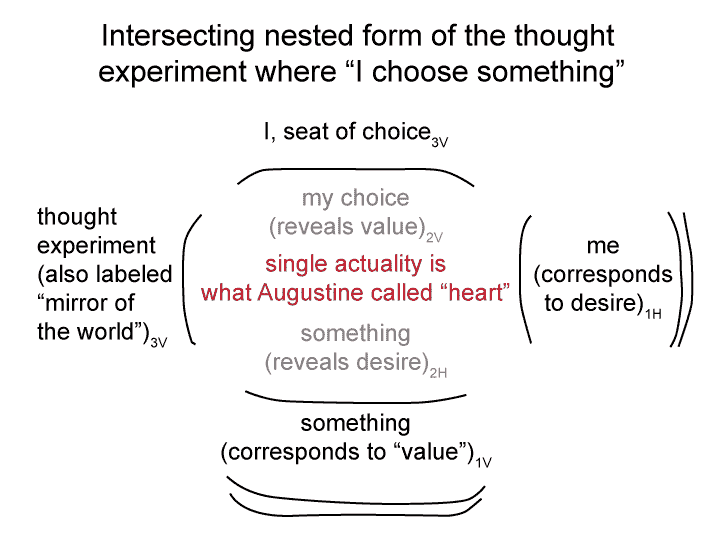
The interscope of Manichean speculation became the intersection of Augustine’s heart.]
Man and Sin by Piet Schoonenberg (1964) 2.3 DH
[The Russian Soviet Communist Godhead embodies this potential:
Liberty (of the state to own all property)
Equality (of all citizens in state ownership of property, with the party speaking for the citizens)
Fraternity (among members of the Communist Party. Party members assure liberty and equality, and challenge the bourgeois, who are the source of all failure.)]
Man and Sin by Piet Schoonenberg (1964) 2.3 DG
Summary of text [comment] page 82
[Schoonenberg writes during the Cold Battle of Materialist Ideologies (1945-1989 AD).
Two contending post-religionist (enlightenment) religions survive the Hot Battle of Fraternal Ideologies (1930-1945).
These are Communism and Progressivism (so-called Big Government Liberalism)].
Man and Sin by Piet Schoonenberg (1964) 2.3 DF
[What is the lesson?
A post-religionist (enlightenment) godhead wins every battle among the enlightenment gods in the 20th century.
American citizens do not win the so-called Cold War.
Big Government Liberalism win the Cold Battle among the Materialist Ideologies (7745-7789 U0’).
Big Government Liberalism is a sovereign religion.]
Man and Sin by Piet Schoonenberg (1964) 2.3 DE
Summary of text [comment] page 82
[Today, certain semiotic scholastics may be labeled post-modern.
In the same way, I call certain enlightenment and modern thinkers post-religionist.
Schoonenberg is not a post-religionist (enlightenment) thinker.
He is a modern who witnessed the horrors of modernism.
He tries to find a way out of the interpellation of the post-religionist (enlightenment) godheads.
Unfortunately, he writes right at the time when a new set of enlightenment gods enter into conflict.
In 1960, the conflict rages between two ideologies of materialism: Soviet Communism and Big Government Liberalism.]
Man and Sin by Piet Schoonenberg (1964) 2.3 DD
[In place of the myth of Genesis, Enlightenment thinkers propose (what they think is) a true (as opposed to false) scenario.
It goes something like this:
Humans are naturally good and well-intentioned.
Then, civilization came along with the concept of property. The self-centering condition of ownership blocks their good and well-intended natures.
Hence the slogan from the French Revolution goes like this:
Liberty (from property)
Equality (of property for all)
Fraternity (through our good and well-intended natures)]
Man and Sin by Piet Schoonenberg (1964) 2.3 DC
Summary of text [comment] page 82
[Enlightenment doctrine holds. Genesis is mythology. Mythology is false.
But is it deceptive?]