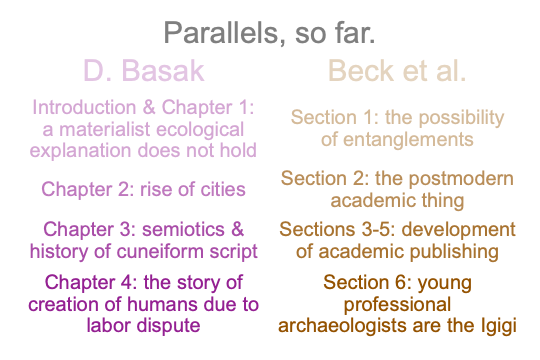
0031 Perhaps, a sense of humor is required in order to appreciate the following comparisons.
0032 Dr. D. Basak, in the introduction to Sumerian mythology, claims that folk in the Ubaid, Uruk and Sumerian Dynastic periods respond to the challenges and the opportunities posed by living in the land between the Tigris and Euphrates Rivers. They do so by building a system of canals to irrigate agricultural fields and to mitigate (to some extent) flooding by annual crests of the rivers. This requires labor and organization.
Jess Beck et al., in the introduction to a manifesto on academic publishing, responds to the challenges and the opportunities posed by living in the world of postmodern academics. They do so by entering into a publication arms-race that is riddled by three (already mentioned tensions).
0033 To me, the Uruk corvee laborer and the hard-working postmodern academic do not seem so different.
0034 Chapter 2 of Dr. D. Basak’s book concerns the rise of cities as the birth of the urban cosmos.
Section 2 of Jess Beck et al.’s essay concerns ideology.
0035 Coincidence?
Dr. Basak starts with the city as a divine idea. The city is not merely a place to live. The city allows humans to forge their identities and their relation with the divine.
Does Jess Beck et al.’s section on ideology resonate?
0036 These authors survive as specialists within the walls of a multiversity, which has one ideology in common among its multiple universes. Peer-reviewed publications are now an end in themselves. Broad dissemination of research results is not a primary goal. Citations are. Pity the academic whose publications languish behind corporate publisher paywalls. Pity the academic’s lack of pay, worries about getting a job in the field, and fears of the various gatekeepers (peer reviewers, editors, and so on, who may be better paid because they are one or more steps further up the “food chain”).
0037 Does that sound like life within the Uruk township?
The gatekeepers seem to be in charge. Every specialist works to exhaustion for the privilege of serving the gods (and making a living in the process).
0038 The Beckians (if I may so label the authors, using a word that no AI would concoct, except by hallucination) are not unaware. They tell a history… perhaps… a “fable” about the rise of the professional pre-publication review process. The process is a recent observable and measurable facet of a noumenon, the early modern journal, arising in Europe in the 1700s.
0039 Early on, every scholar was allowed to submit. Some were more invited than others, of course. Lots of crazy ideas go into print. The gatekeepers are friendly, since the journal is run among friends who are interested in the topics at hand.
0040 After the revolutions of 1848 and the legislation for American land-grant colleges, new systems devote themselves to progress (science) and higher education (promoting the best minds). These are “sold” as public goods. They tried to be meritocracies (hence, exclusive). They did so through mandarin-style testing.
Unfortunately, every system can be gamed.
0041 One benefit of the idea that the university is a public good is that academics could come from poorer families because professors get paid. The salaries are small, but tenure provides security. A poor professor with tenure has more academic freedom than a rich specialist in a modern corporation. This explains why the tenure system is a target of corruption and competition, just like any occupation serving the gods within the township of Eridu or Ur or Nippur.
0042 The tenure system, like all systems, can be gamed. There is a distinction between competition and cheating. Standards become necessary. In 1915, the American Association of University Professors lay ground rules for modern tenure. The scholar… er… university teacher… needs to display recognized scholarship and research productivity. That translates into peer-reviewed publications and citations for the audit culture that comes decades later. Hiring, promotion and tenure is done by committee so that no one gets the blame for failing a candidate.
0043 Even worse, in the eyes of academic deans (who have guarantees greater than tenure), non-tenure track instructors are depersonalized units, serving as economic resources whose productivity and performance is to be rewarded by one scoop from a mass-produced bevel-rimmed bowl, just like during the Uruk archaeological period.
0059 Chapter 4 of Dr. D. Basak’s book is titled, “In the Beginning: Sumerian Creation and the Ordering of the Cosmos”.
Section 6 of Beck et al. is titled, “Discussion”. This section contains calls for action.
0060 So far, I have drawn the first three comparisons. I am about to consider the fourth.
0061 In the discussion, Beck et al. note that demands for ever-increasing academic productivity yield decreasing research quality and professional satisfaction. A system founded on uncompensated labor is not inevitable, sustainable or effectual. A re-alignment is necessary.
Basak’s chapter 4.4 reports on an amazing cuneiform tablet found in 1893 in the holy city of Nippur by an expedition from the University of Pennsylvania. Translated in 1912 by Assyriologist Arno Poebel (1881-1958), the story is now called “The Eridu Genesis”. The cuneiform dates to around 1600 BCE. But, the oral tradition is undoubtedly older.
0062 The Eridu Genesis frames the creation of humanity as a clever solution to a labor dispute among the gods. The topic is covered in chapters 4 and 6 of Basak’s text.
0063 The senior gods (the Anunnaki, but also administrators of postmodern universities) and the junior gods (the Igigi, but also the post-docs, visiting professors, instructors, and tenure-track faculty) are not getting along. The Igigi are tasked with the maintenance of the cosmos (or one discipline in a multiversity). They are overworked (in precisely the same manner as early-career professional archaeologists).
The Igigi rebel.
0064 The labor dispute ends up locking down Enlil’s cosmos (multiversity). Enlil is the god of the storm. The present cosmos is created when Enlil separates his father (An, the sky) and his mother (Ki, the earth) and establishes his own jurisdiction (the air).
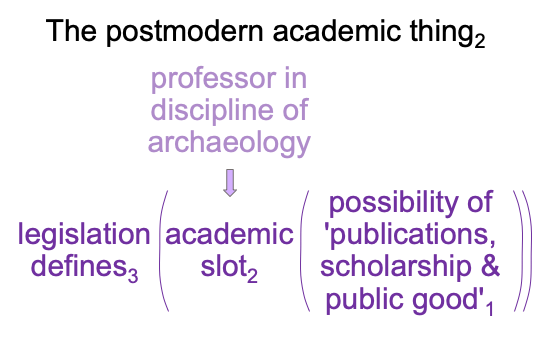
I suppose that the Igigi come around to fill in the empty slots created by Enlil’s system, just as scholars filled in the academic slots created by the post-1848 and land-grant universities. These are the universities that situate the potential of ‘public good’.
0065 Here is a picture.
0066 Around one orbit of Neptune later (165 years), young professional archaeologists are the Igigi. University administrators and publishing houses are the Anunnaki. The solution in the Sumerian myth comes from Enki’s suggestion that the gods fashion humans in order to do the Igigi’s work. Then, the Igigi can rest on their laurels (sort of like tenured faculty) while the humans do all the labor required to keep Enlil’s cosmos working properly.
0067 Enki is the god of subterranean flows, especially spring water. Whenever fresh water flows, Enki is present. So, Enki is in the annual crests of the rivers and in the canals and dikes that control these turbulent flows. Enki is in the freshwater springs that can be found in brackish waters. After rains fall on distant mountains, the waters enter Enki’s domains.
0068 Humans are created to do the work of the overtaxed Igigi.
0068 Who is going to be created to do the work of the over-burdened young professional archaeologists?
A clue comes from the elaborate Table 3, consisting of one and one-third pages, in Beck et al.’s discussion. The table covers the potential consequences of three levels of engagement between a researcher and mass media.
0070 If the labor problem concerns the difficulties for advancement that arise when young archaeologists are compelled to publish in peer-reviewed journals that restrict public views behind a paywall, then a new specialization (corresponding to the creatures that Enki proposes to ease the working conditions of the Igigi who are compelled to satisfy the administrating Anunnaki) should be fashioned out of clay from the Abzu, the primordial freshwater abyss of opportunity in a world of unconstrained social complexity.
0071 Always read paragraphs by ignoring the parentheses, then consider the same paragraph with the parenthetical statements.
0072 In this fusion of ancient and postmodern solutions, Ninmah (an earth goddess) shapes a figure, using a creative mold, corresponding to the new human who will bear the burden of the Igigi’s difficulties.
Who are these humans?
0073 In the Sumerian myth, the humans who are created to do the work of the Igigi are called “lullu”.
For the postmodern version, can the reader guess who the lullu are?
0075 Meanwhile, I doubt whether any of the commentators of the article in Current Anthropology know that Dr. D. Basak has scooped information from publicly available internet sources, therefore performing a function similar to podcasting. Unfortunately, many of Basak’s references are from Wikipedia and other collating on-line venues, rather than from actual researchers.
0076 The lullu podcasters will solve that defect.
All twenty-three researchers who contribute the Beck’s manifesto should network with podcasters who are (1) interested in the material, (2) humble and (3) willing to ask questions.
0077 A comment by Aja M. Lans is on target in this regard, questioning whether multiversities are “public goods”. The term, “public good”, sends a message. The multiversity deserves sovereign support. The sovereign supports the Anunnaki-level administrators, not the Igigi-level yet-to-be-tenured faculty.
If the label, “public good”, acts as a thesis, and if “the Anunnaki-level administrators who claim that their institutions serve the public good” operate as an antithesis, then, as long as the potential for a synthesis is subverted, the status quo will remain.
Something will break. The Igigi will rebel. But, does that bring the synthesis out of the realm of possibility?
0078 Shall we ask Enki?
Is Ninmah available to fashion the podcaster, who will do the heavy labor of interviewing the young professional archaeologists?
The podcasters will be the humans that sustain a world where the Igigi can do what they really want to do: research into the origins of humanity.
0079 In sum, the mythic structures of the ancient Eridu Genesis and a recent (2026) publication concerning academic publishing in archaeology are not only similar, but the comparison allows this examiner to make a prediction. As soon as podcasters fill the role of the newly created lullu, then the nature of professional academic archaeology will transform.
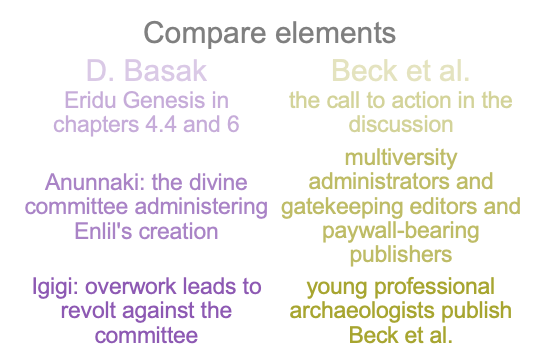
0080 Here is a comparison of mythic and dramatic elements.
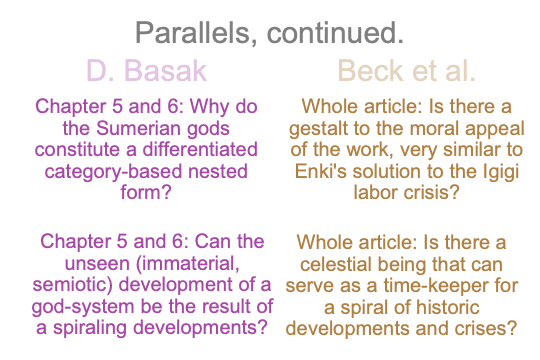
0081 This type of comparison of mythic structures is integral to chapter 1 of Razie Mah’s fiction, titled An Archaeology of the Fall. The Sumerian myth of world creation can be compared to the founding of the United States of America. I call the Sumerian creation myth, “the differentiation of Nammu”. This myth is discussed in chapters 4 and 5 of Basak’s book.
Why demonstrate that the Anunnaki god-system coheres to a complete category-based nested form that reconciles the major gods and many minor ones (at least the gods that appear directly in the Enlil3 creation story)?
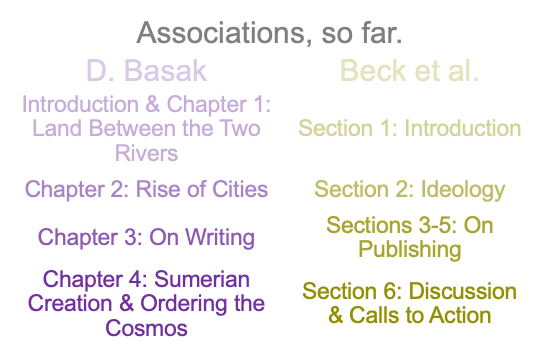
0119 Take a look at where I’ve been.
Here are the parallels between D. Basak’s (2025) text and Beck et al.’s (2026) article.
0120 These parallels tell me that Basak’s notion in chapter 1, that the ecology, geology and climate of the land between the two rivers entangles the Sumerian mind, does not fully account for the origin of Sumerian mythology. It is not the reason why southern Mesopotamia gives rise to one of the first ancient civilizations. And yet, if Basak’s book is AI generated, then that is what pre-2025 modern archaeological literature is saying.
0121 Not only that, but the same… um… potential that Enlil’s Sumerian creation myth imagines, but cannot label, seems to be operating today, as witnessed by Beck et al.‘s article. Little do these experts realize that their civilizational struggle is as old as… um… civilization itself.
The rise of urban sites during the Uruk parallels the academic thing for the past 165 years. The development of cuneiform script unfolds like the three types of natural sign-relations. So does the journal article in modern academic publishing. Finally, the woeful conditions of young professional archaeologists mimic the Igigi. Their rebellion initiates the creation of humans (in order to do the work of the Igigi). The big question is, “Who are the lullu that the gods will create in order to solve the current labor crisis?”
My guess is that they are podcasters.
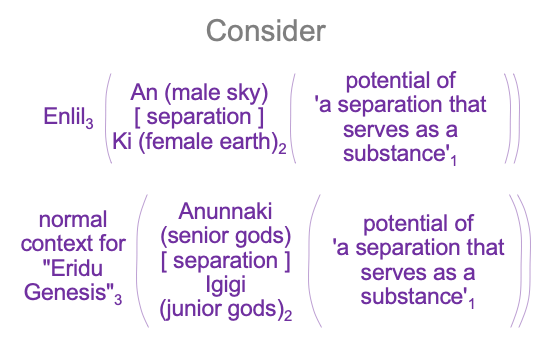
0122 Next, I enter into a nested form inquiry into the Enlil creation story, with the intent to show that the Anunnaki cohere to the relational structure of the category-based nested form. The Anunnaki are the seniors gods compared to the Igigi lower gods. Even though the senior gods are apparently different, because they represent different features of humanity’s material world, each god settles nicely into a slot in a highly differentiated nested form. The actuality of this nested form consists of nested forms.
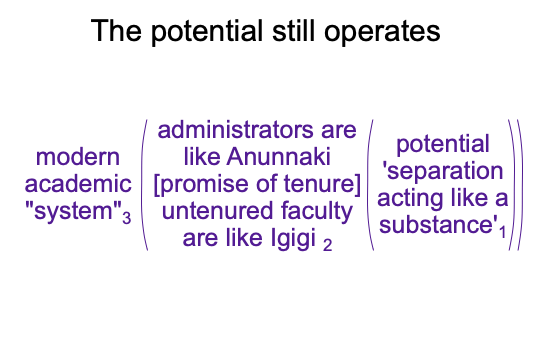
The only slot that does not have a god as a label is the potential1 underlying the ruler of the pantheon and figurehead of the Anunnaki, Enlil3.
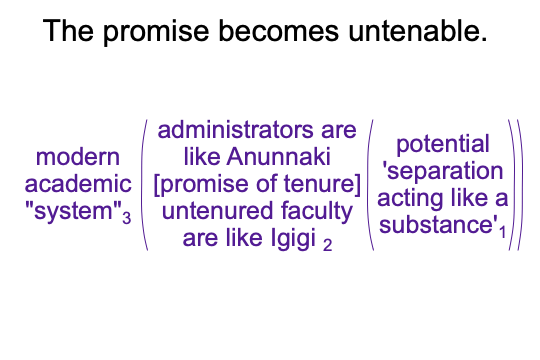
0123 The following nested form tells me that this potential1 still operates.
And, young professional archaeologists are living it.
0124 Here is a problem that is difficult to face. In the above figure, the promise of tenure is the contiguity between Anunnaki-positioned administrators (including the publishing houses) and Igigi-positioned young professional archaeologists. The promise of tenure is the substance that the potential of separation manifests.
To me, the promise of tenure recalls Gilgamesh’s heroic pursuit of immortality.
Indeed, the awarding of tenure elevates a faculty through the contiguity, the substance that manifests the principle of separation, into the realm of the… how shall I say it?… senior gods.
After the coming financial deluge, there will be only one professor with tenure, and his name will be “Utnapishtim”.
0125 What do I mean by that?
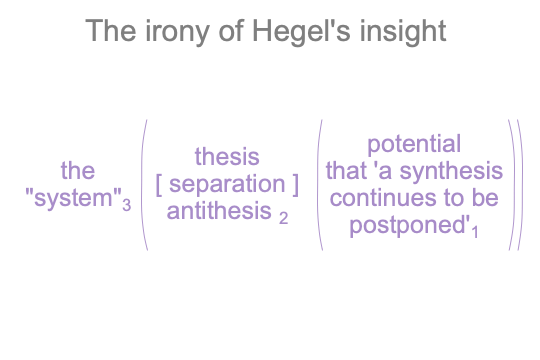
Writing in the early 1800s, Georg Wilhelm Friedrich Hegel (1770-1831) figures out that the spirit3, moving over the waters, operates on the potential of a synthesis1 to overcome the dyadic actuality of a {thesis [separation] antithesis}2 in the normal context of a civilizational system3.
Perhaps, this is precisely what contemporary young professional archaeologistsare calling for.
0126 Unfortunately, as long as the spirit3 does not move, the synthesis1 is postponed.
The system3 remains as is.
In other words, the potential of postponing a synthesis1 resides in the same location as the potential of a separation acting like a substance1.
0127 Just saying.
0128 This pathos-ridden side-comment raises a question hidden within Beck et al.’s history of the academic journal.
Are the authors asking for a solution in which tenure remains, thereby postponing the synthesis1 and maintaining the system3?
0129 Here an introduction to a few of the questions that I am wondering about.
0130 These questions must be regarded in light of Beck et al.’s brief history of academic journals. Their story starts with the establishment of state-supported institutions of higher education around the time of the Civil War in America and after the revolutions of 1848 in Europe.
0130 In America, the federal government establishes land-grant universities through legislation in 1862 and 1890.
In Europe, France, under the Emperor, Napoleon III, starts a war with Prussia in 1870. In 1871, France is defeated after a Prussian siege of Paris. During the siege, the so-called “Paris commune” springs to life, extolling a communist manifesto by an intellectual in Britain, Karl Marx, who (up to this point in history) was regarded a fringe. Marx returns the favor by giving a rousing speech, titled “Civil War in France”.
French citizens blame the results of the war on the superior public universities in Germany.
0131 Before this moment, journals are private affairs aiming to inform practitioners of the latest investigations and results. Journals image problems, methods, data, and results.
After this moment, journals start to serve as indexes of academic accomplishment.
0132 In 2026 AD, Beck et al. notify the readers of Current Anthropology that this civilizational cycle is coming to a close.
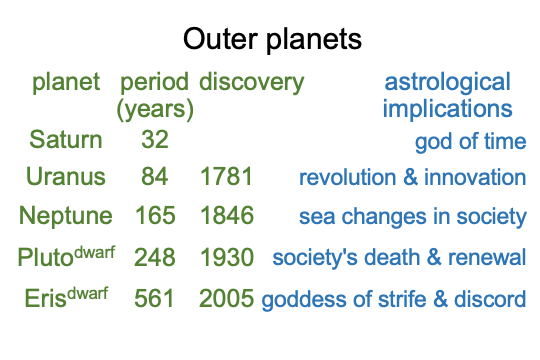
0133 The time difference between 2026 and, say, 1862 is 164 years. If the archaeologist uses the periodicity of the outer planets as celestial clocks, which outer planet matches this timeframe?
0134 Obviously, it is the periodicity of Neptune.
Since Neptune is discovered by astronomers in 1846, astrologers of a modern bent have been hard at work combing though various histories in order to see whether social events show a spiraling periodicity with a 165 year cycle. The zodiac is already divided into 12 slots, so a pattern of social events that occurs when Neptune passes through one house should repeat when Neptune returns to the same house.
Does that sound like an anthropological hypothesis?
0135 As it turns out, Beck et al.’s brief history of journal publishing fits a 165-year spiral with remarkable precision.
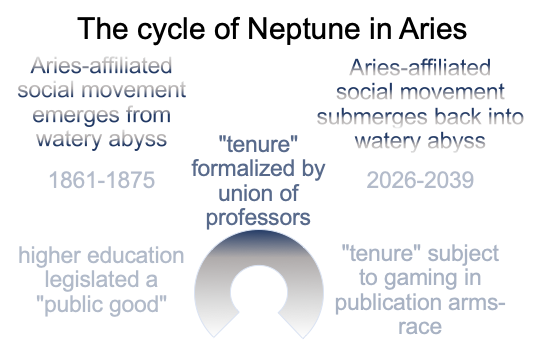
Neptune enters the constellation of Aries in 2026, matching the terminus of a social movement that began the last time when Neptune was in Aries, between 1861 and 1875.
Here is a picture.
0136 The social movement that comes together to declare that higher education is a “public good” in the 1860s currently falls apart on the contradictory nature of what is called, “tenure”. Near the start of the cycle, tenure is formalized by a union of professors. At the top of the cycle, tenure has an impeccable reputation. Then, more are more academics discover that tenure is a substance that can be gamed, resulting in the same societal crisis as the one portrayed in the Eridu Genesis. In the end, corruption from above overwhelms competition from below. The game is rigged.
0137 Here is a reminder.
0138 The label given to Neptune serves as a site for astrologers (and anthropologists) to regard our current Lebenswelt as a developing spiral.The Neptune spiral is about sea changes in society. An idea rises as an island of certainty within a sea of uncertainty. Then, it sinks from the weight of its own internal contradictions.The professionalization of the sciences is not the only spiral associated with Neptune in Aries. The emergence and submergence of other conceptual apparatuses may be worthy of consideration. I will present one shortly.
0156 In biology, appearances initiate sign-relations.
Sign-relations are based on Peirce’s three categories of firstness (monadic possibility), secondness (dyadic actuality) and thirdness (triadic relations).
So are category-based nested forms.
0157 Category-based nested forms are not material. Materials participate in these immaterial relations.
Category-based nested forms are real. They contain secondness (what most scientists consider to be their subject matter) within their relational structures.
0158 How real are triadic relations, such as signs and category-based nested forms?
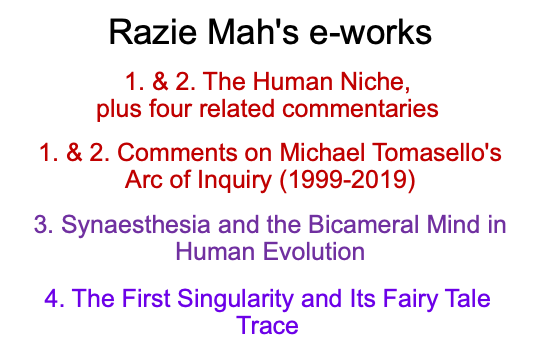
According to Razie Mah’s 2018 e-book, The Human Niche, our kind adapts to exploit the potential of triadic relations. This e-book is packaged with separate reviews of four works: Steven Mithen’s Book (1996) The Prehistory of the Mind, Clive Gamble, John Gowlett and Robin Dunbar’s Book (2014) Thinking Big, Derek Bickerton’s Book (2014) More Than Nature Needs and Robert Berwick and Noam Chomsky’s Book (2016) Why Only Us?.
Later works by Razie Mah include the 2024 work, Comments on Michael Tomasello’s Arc of Inquiry (1999-2019).
0159 What else might be of interest to young professional archaeologists?
What else points to the failure of Marx’s thing?
Here is a question.
Does human evolution comes with a twist?
In four blogs posted on January 1, 2026, Razie Mah looks at Melinda Zeder’s Article (2025) concerning the term, “Neolithic”. He proposes that two transitions occur at the same time (S and T).
0160 The first (S) concerns the domestication of plants and animals, sedentary communities, and other items that archaeologists associate with the term, “neolithic”. This topic has been the subject of intense inquiry by archaeology since… around… 1861 to 1875? Research into the neolithic era has been conducted with Marx’s thing in mind.
0161 Well, shades of Neptune in Aries, according to my internet search, the term “neolithic” was first coined by John Lubbock in 1865, as a refinement of the stone, bronze and iron ages.
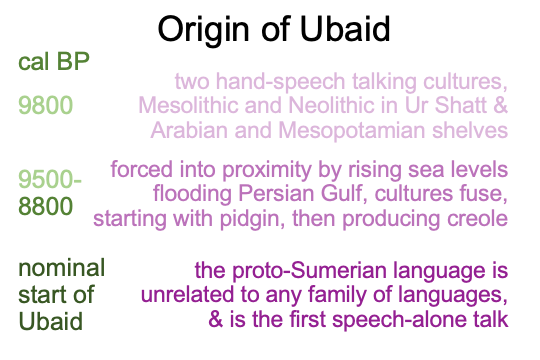
0162 The second (T) concerns a change in semiotic conditions, from hand-speech talk (the way of talking for Homo sapiens since its inception) to speech-alone talk. According to Razie Mah’s short 2014 e-book, The First Singularity and Its Fairy Tale Trace, the first culture to practice speech-alone talk is the Ubaid of southern Mesopotamia. The Sumerian language (which is unrelated to any family of languages) is a speech-alone creole formed when two hand-speech talking cultures (one living along coast and rivers and one living on hills in the dryland Arabian Gulf) are forced into proximity by the rising waters of the Persian Gulf. They form a pidgin, then a creole.
0163 Returning to that review of Melinda Zeder’s (2025) article in the journal, Prehistory, Razie Mah suggests that, within the currently conceptualized Neolithic period, another transition – a change in semiotic practices – occurs with the spread of speech-alone talk from the Ubaid to the hand-speech talking world, constituting an irreversible phase transition.
Needless to say, Razie Mah’s hypothesis of the first singularity suggests that a lot of research needs to be done in the field of archaeology.
The e-work, The First Singularity and Its Fairy Tale Trace, is framed as a research proposal.
0164 The word, “sumer”, is first published in 1869, when Neptune is in Aries.
0165 The review of Melinda Zeder’s article is published January 1, 2026, at a time when Neptune is about to enter Aries.
0166 I’m not saying that this is an astrological phenomenon. I am saying that anthropological researchers need a way to track civilizational changes within our current Lebenswelt, spanning from the most rapid sea-water rise at the end of the last ice age (nominally, at 0 Ubaid Zero Prime) to our current moment (nominally at 8823 U0′). The orbits of the outer planets may have periodicities convenient for marking spiraling developments in unconstrained social complexity.
I love sentences like that.
For U0′, subtract BC year from 6800 or add AD year to 6800. 6800BC equals 0 U0′.
Future refinements should be anticipated.
0167 This examination of two distinctly different contemporary works, a (possibly AI-generated) book on Sumerian mythology by Dr. D. Basak and a recent publication on the need for a change in publishing in archaeology, show that – whatever is responsible for the Sumerian civilization – is still operating today.
0168 There may be (say) two millennia (12 Neptunian cycles) between the routinization of the creation myth associated with Enlil3 and the one associated with the so-called “Eridu Genesis”.
Yet, from my associations (which are admittedly speculative), both narratives rely on the potential of ‘a separation that serves as a substance’1.
0169 Here is a picture.
0170 Does that potential still operate today?
The surprisingly evocative similarity between the creation of humans in the Eridu Genesis and a recent publication in Current Anthropology suggests that the current labor dispute will resolve with the creation of a new “human” that will take some of the work of the Igigi-like professional archaeologists.
I think that these new “humans” will be podcasters.
0172 Even more disturbing, the similarity suggests that [tenure]2a, the promise of low pay combined with total job security, is the substance that actualizes the potential of ‘a separation that serves as a substance’1a for the current labor dispute.
0174 Did the Igigi work so diligently for the Anunnaki because they were promised something akin to tenure?
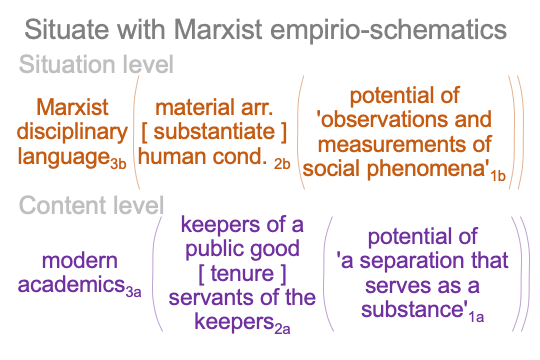
0175 In the following diagram, the current iteration of the Eridu Genesis occupies the content-level of the following two-level interscope.
0176 Marxist empirio-schematics occupies the situation-level.
Marxist disciplinary language (relation, thirdness) brings the dyadic model, {material arrangements [substantiate] human conditions} (what ought to be, secondness) into relation with observations and measurements of civilizational phenomena (what is, firstness).
0177 The situation-level virtually emerges from (and situates) the content-level.
Here, “virtually” means “in virtue” (the premodern reference) rather than “in simulation” (the modern reference).
0178 Beck et al. clearly exhibit the hallmarks of this sensible construction. The article clearly articulates that the material arrangements of academic publishing and university promotions [substantiate] their less-than-acceptable conditions. The essay suggests ways to improve those arrangements.
The manifesto does not suggest any changes that challenge the substance that separatesthe archaeological researchers (the authors) fromthe keepers of the public good (university administrators and publishing houses). After all, these young professionals have worked so hard to obtain tenure. It is inconceivable that “tenure” is the highest point of elevation in a wave, passing through time, starting with legislation promoting higher education as a “public good” (in the 1860s) and ending with a publication arms-race that guarantees that the… um… well connected get to pass through the separation that serves as a substance (in the 2020s).
0179 Meanwhile, Dr. D. Basak does not need tenure to produce an (apparently AI generated) book on Sumerian mythology, ancient civilization and the epic search for humanity’s origins. Perhaps, Dr. Basak does not care that tenure is what falls apart as a sea change submerges due to the weight of its internal corruption and contradictions.
Nor does Dr. D. Basak recognize that the first chapter, which asserts the dyad, {the material arrangements of geology, ecology and climate of the land between the Tigris and Euphrates Rivers [substantiates] the human conditions associated with the emergence of the one of the earliest civilizations on Earth}, is Marxist to the core.
0180 The proposition may be correct to some degree.
A particular set of material arrangements may have set the stage for a change in humanity’s semiotic arrangements.
However, speech-alone talk is what potentiates unconstrained social complexity, in a unique irreversible transition that starts with the Ubaid of southern Mesopotamia, 8826 years ago.
0181 Doesn’t that sound like a huge research project?
Plus, it portends the dissolution of the Neptune-in-Aries sea-change starting between 1861 and 1875.
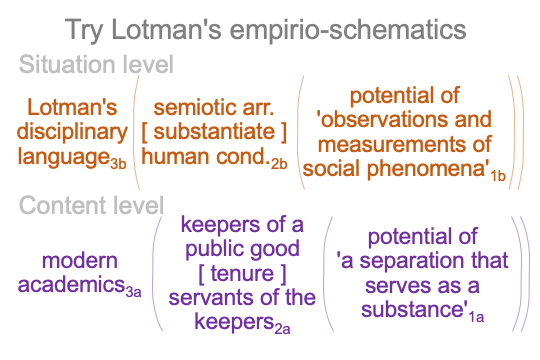
0182 The claim that Juri Lotman’s semiospheric thing will replace Karl Marx’s materialist thing as the social science model is developed in Razie Mah’s blogs in December 2025 through March 2026. The first in the series is Looking at Igor Pilshchikov and Mikhail Trunin’s Article (2016) “The Tartu-Moscow School of Semiotics”.
0183 Here is a picture of a new paradigm for understanding Beck et al.
Now, postmodern intellectuals can imagine that tenure2a actualizes the potential of ‘a separation that may serve as a substance’1a.
This raises the semiotic question, “What does tenure2a stand for?”
0185 First, ideology defines the Sumerian city (chapter 2, Basak) and the modern multiversity (section 2, Beck et al.).
0186 Second, Peirce’s natural sign typology may be used to frame the historic transition from ideographs to the rebus principle (chapter 3, Basak) as well as the historic development of academic journals (section 2, Beck et al.).
0187 Third, the same historic transitions in the second item may also be framed using Razie Mah’s category-nested form for the definition of a spoken word.
0188 Fourth, the creation of humans in the Eridu Genesis (chapter 4, D. Basak) portrayed as a nested form, matches the current crisis in academic publishing in the discipline of archaeology (discussion, Beck et al.).
0189 Fifth, D. Basak fails to recognize that the Sumerian divine assembly (the Anunnaki) may be portrayed by filling in slots within the purely relational structure of the category-based nested form. This failure indicates a blind spot that implicates the field of archaeology for the past 165 years. If the speculation that the book under examination is AI-generated is true (and that is not certain at the moment of writing) and if an AI program cannot process what its training material does not envision, then this failure may also apply to Jess Beck et al.’s assessment of the material arrangements that substantiate the conditions of young professional archaeologists.
These researchers are blind to parallels between ancient Sumerian mythology and their own professional crisis, because the Marxist thing clouds their vision.
0190 Sixth, the Marxist thing sinks into a sea of uncertainty.Anthropologists are burdened with material analysis. They cannot envision Lotman’s thing, {semiotic arrangements [substantiate] human conditions}, distilled within a Marxist political institution from the art and literature of Slavic civilization.
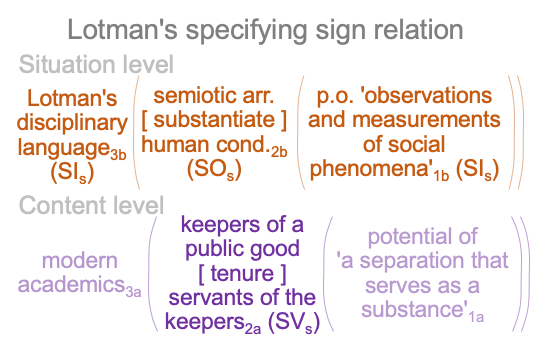
Only Lotman’s thing3b allows anthropologists to address the question, “What if tenure2a (SVs) stands for the substance2b (SOs) actualizing the potential of ‘observing and measuring a social conflict’1b in the normal context of the disciplinary language of the Tartu-Moscow School of semiotics3b (SIs)?”
What if tenure is not situated as a material arrangement?
What if tenure (SVs) stands for a semiotic arrangement (SOs)?
0191 Indeed, the specificative sign-relation says the following, “The content-level actuality of {keepers of the public good [tenure] servants of the keepers)2a (SVs) stands for the situation-level actuality of Lotman’s thing2b (SOs) in regards to the disciplinary language of the Tartu-Moscow School of Semiotics3b operating on the potential of ‘observations and measurements of phenomena of the current crisis in the publishing of research papers and its importance in promotions in post-modern universities’1b (SIs).
Where can I get information on this specifying sign-relation?
Take a look at Razie Mah’s blog for October, 2023, titled Looking at John Deely’s Book (2010) “Semiotic Animal”.
0192 Now, I would like to return to the idea that Dr. D. Basak approaches Sumerian mythology, ancient civilization and the epic search for humanity’s origins from a Marxist point of view, because, to date, all research in anthropology is conducted with the Marxist thing as a model.
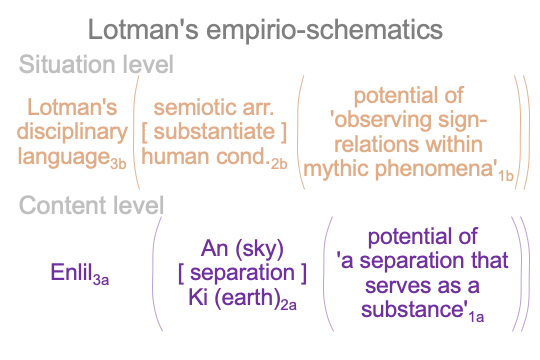
0193 The following figure shows the challenge posed by a specifying sign-relation whose time has come (according to a Neptune in Aries cycle).
0194 This specifying sign-relation says, “The content-level dyad, {An (sky) [separation] Ki (earth)}2a (SVs) stands for the situation-level dyad, {semiotic arrangements [substantiate] human conditions}2b (SOs), in regards to a situation-level normal context, Tartu-Moscow School of Semiotics disciplinary language3b, operating on the potential of ‘observations and measurements of mythic phenomena’1b (SIs).
0001 The citation for this article is: Cuttler, R. (2013). Considering marine transgression as a mechanism for enforced migration and the littoral Gulf ʿUbaid phenomenon. Arabian Archaeology and Epigraphy, 24(1), 37–43.
I obtained my copy from Wiley online. Thank you.
0002 In the early 2010s, Dr. Richard Cuttler smells a very interesting intellectual aroma, but is unable to sense where the trail leads. What is the link between the infilling of the Persian Gulf and the appearance of the Ubaid culture of southern Mesopotamia?
0003 The titular “consider” is one way of saying, “Imagine the possibility.”
If the marine transgression into the Arabian… or is it Persian?.. Gulf enforces a migration of the people who originally settled the fresh water marshes of the Ur Shatt (that’s “Ur Schatt” for Germans) waterway, then does that account for the Ubaid appearing in both Mesopotamia and on the shoreline of central Arabia?
0004 Why would an archaeologist consider such an if-then scenario?
During the glacial period, the Euphrates and Tigris Rivers flowed together into a waterway, the Ur-Shatt, that fed a corridor of lakes and marshes (now underwater “basins”) into the sea. Such a concourse would be a favorable place for Epipaleolithic enthnoses to settle, taking advantage of diverse natural resources.
0005 Little did they realize that the Ur-Shatt waterway, a veritable oasis during the glacial period, would slowly be covered with around 70 meters of sea-water. By “slowly”, I mean thousands of years. At the same time, the rise in sea-level has a horizontal dimension. After filling the basins, sea-water spreads into a shallow geological bowl.
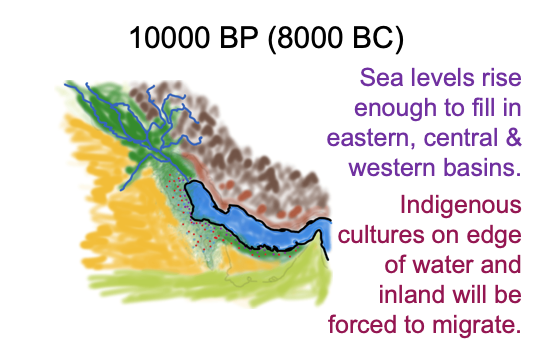
0006 Here is a picture of the scenario once the low-lying basins are full.
The indigenous settlements are represented by red and purple dots.
The sea-rise will force these people to migrate.
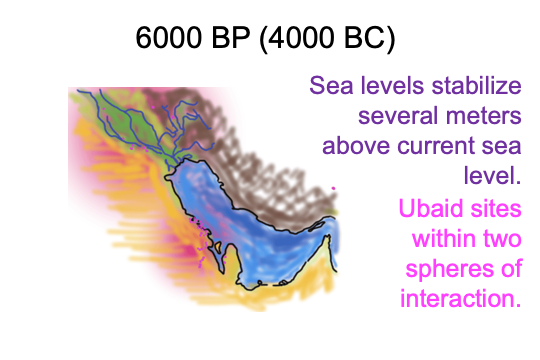
0007 Here is a picture once the Gulf is filled to the brim (as far as the sea-rise would go, which is several meters above the present sea-level).
The Ubaid settlements are represented by magenta dots. Plus, the background color has taken on a magenta hue, denoting two spheres of interaction, the central Arabian Gulf and southern Mesopotamia. This is my rendition of Figure 1 of the article.
0008 How does anyone know that there are two spheres of Ubaid settlements?
Originally, the term, “Ubaid”, labels a type of pottery found in excavations throughout southern Mesopotamia. Why did archaeologists not also look at the central Arabian Gulf region?
The author is perhaps too embarrassed to say that late-nineteenth and early-twentieth century archaeologists focused on this region because… well… that is where the Garden of Eden is supposed to be. That is where Noah’s flood took place. That is where Judah was taken into exile in ancient times. So, of course, Protestant Christians are going to pay for exorbitant excavations in order to reveal… you know… something about justification by faith alone, scripture alone, and grace alone.
0009 Okay, I am just guessing on that one.
0010 Then, in 1968, G. Burkholder discovers Ubaid pottery in the western Gulf littoral.
0011 What a surprise.
The Ubaid is the lowest level excavated in southern Mesopotamia, which means that it has the deepest time horizon. Now, the Ubaid shows up near Bahrain. Doesn’t that smell like a great research project? To an archaeologist, it sure smells good… but, how does one follow the scent when the trail goes under the waters of the Gulf?
Professor Richard Cuttler, who I am sure has some good stories to tell, seeks funding for seismic reflection maps of the Gulf’s underwater landscape, in order to obtain better placed sediment cores of the sea-floor. He wants to investigate, but he does not know that there is another component to the puzzle. Also, big funding is hard to come by.
0012 If the project is funded, what will he find?
Among other points, the sediment cores would provide pollen-based clues to the changing climate of the time.
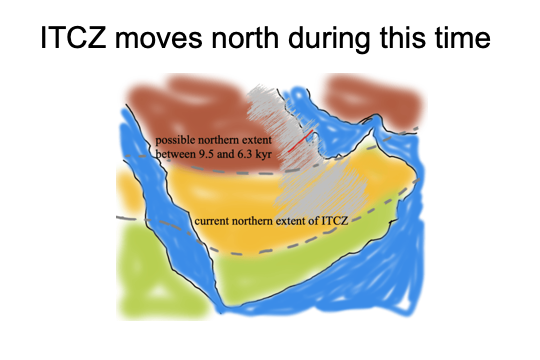
0013 At the start of the current interglacial, the Inter-Tropical Conversion Zone (ITCZ) shifts north, then back, then north again, in a most fickle manner. For the time under consideration, the ITCZ moves north, but not as far north as the gulf-to-be.
Here is a picture.
0014 The two dotted gray lines indicate the furthest extend of the ITCZ currently, and between 9.5 and 6.3 thousands of years ago (kyr). South of the line, the monsoons deliver plenty of rain water. North of the line, the westerlies lose all their water before arriving in Arabia.
0015 Curiously, all the Ubaid sites develop north of the early Holocene ITCZ line, suggesting that water was not a crucial issue. That makes no sense. Southern Mesopotamia obviously has lots of fresh water because of the Euphrates and Tigris and other rivers. What provides water to the pre-Ubaid sites in the central western Gulf?
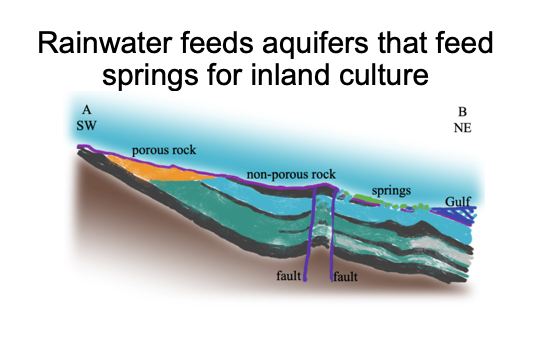
0016 Take a look again at the above figure. The gray brushstrokes and the red line denote a massive aquifer that is tilted. It is high in the west and low in the east. The Dammam label is a concatenation of the saying, “That’s a damn aquifer, ma’am.” Am I kidding? This aquifer relies on a huge tilted fault-riddled plate of non-porous rock supporting porous layers that allow rain water, falling south of the northernmost ITCZ line, to flow underground and come to surface in springs that stand outside the low-lying basins.
0017 Here is my version of the article’s Figure 2.
Note how water flows downhill in the Dammam aquifer then comes up in springs further inland from the sea-water filled basins.
0018 Why is this so important for this examination?
This examiner wants to show that… in the land surrounding the freshwater marshes and salt-water depths of the basins at 10,000 BP… there are two cultures: a Mesolithic culture that lives right along the water and uses fresh and salt water resources and a Neolithic culture that exploits the water from Dammum-fed springs to engage in rudimentary agriculture and stockbreeding.
0019 The question is, “Why would I want to establish two disparate cultures in the same region?”
Wouldn’t that just complicate the story of an enforced migration?
0020 Here, I review.
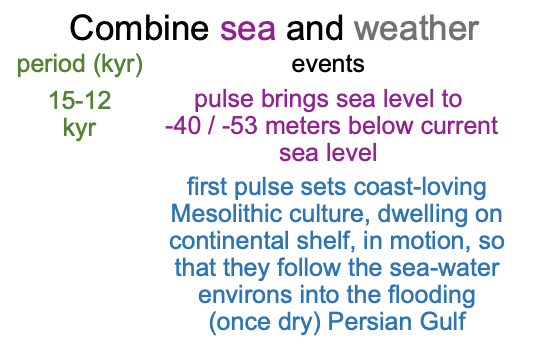
0021 First, the sea level starts to rise, if there is not a paleolithic culture already on the fresh-lakes of the Ur-Shatt waterway, then a Mesolithic culture displaced from living on the continental shelf could enter into the environs. Such a culture would simply follow the water into the eastern, central and western basins, since they already know how to exploit fresh-water and marine resources.
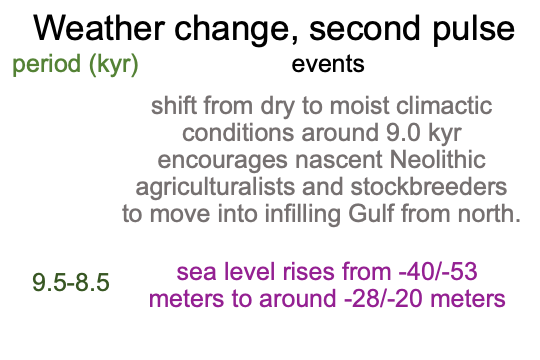
0022 Second, there is a shift from dry to wet climactic conditions, as the intertropical convergence zone (ITCZ) shifts north. Does it shift north enough to provide water directly to lands around the infilling Gulf? The author establishes that even if it does not, the ITCZ shifts north enough to feed the Dammum aquifer which would provide fresh water to a Neolithic agricultural and stockbreeding culture that migrates in from the north and settles in the dry-lands just beyond the marshes.
0023 Then the sea-level rises more, overfilling the basins and entering into the flat-bowl terrain of the surrounding landscape. Now, both the Mesolithic and Neolithic culture are forced to migrate in response to the rising seas.
0024 Here is where I introduce an idea that Dr. Cuttler did not think of and may have never heard about until this moment.
The economies of the Mesolithic and the Neolithic culture are different. They do not depend on the same resources. Practical reason predicts that these cultures should mingle with one another and eventually become one.
However, each culture practices its own hand-speech talking language. That means that they have a serious impediment to talking with one another. Both practice a dual-mode style of language. How are they going to get around that?
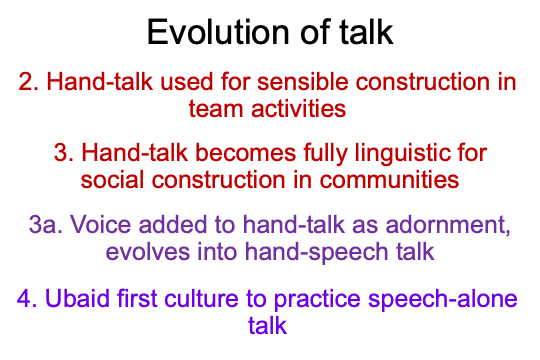
0025 Let me step back and say that the evolution of talk is not the same as the evolution of language. Almost every book available on human evolution discusses the evolution of language as a facet of hominin communication. Only Razie Mah’s books discuss the evolution of talk as a semiotic adaptation.
0026 Here is a brief overview.
0027 The first period ranges from the separation of the chimpanzee and human lineages (around 7 Myr) to the start of bipedalism (around 3.5 Myr). The hominin lineage communicates in two small and one larger social circles. The small social circles are family (5) and friends (5). The larger social circle is the band (50).
0028 The second period ranges from the start of bipedalism to the domestication of fire (around 0.6 Myr). Michael Tomasello says that this period is dominated by “obligatory collaborative foraging”. That means that the social circle under the most intense selection pressure is the team (15). Hominins forage in teams. Pre-linguistic hand-talk is an adaptation to team work. Pre-linguistic hand-talk relies on sensible construction. Sensible construction relies on content and situation.
0029 The third period ranges from the domestication of fire to the first singularity (around 9kyr). The social circle under the most intense selection pressure is the community (150), the team of teams. This period is dominated by, what Razie Mah calls, “obligatory social-circle harmonizing”. Hand-talk becomes fully linguistic as an adaptation to the semiotic dynamics of social construction. Social construction involves content, situation and perspective.
0030 Prior to the evolution of Homo sapiens, the voice comes under voluntary neural control for singing. Why sing? There are two social circles larger than the community, the seasonally gathering mega-band (500) and the occasionally gathering tribe (1500). Their episodic gatherings require rapid synchronization. The voice was recruited to do precisely this. Singing identifies each participant within these larger social circles as belonging to the group. Plus, singing synchronizes all participants to the tasks at hand.
Sexual selection does the rest.
0031 With the evolution of Homo sapiens, the voice is systematically adapted for use as an adornment to hand-talk. In liminal lighting, communal hand-talk is difficult to instantly recognize. The voice is added as an adornment. Sound-word adorns gestural-word. The semiotics of the union remains grounded in hand-talk. However, the semiotic qualities of the sound-word (speech) are unique. So, cultural evolution produces two independent channels of talk, hand and speech talk, that are highly socially regulated.
In short, the transition from the voice as an adornment to hand-talk to fully elaborated hand-speech talk occurs over hundreds of thousands of years during the Paleolithic. My guess is that archaeological evidence of adornment parallels the development of this cultural adaptation.
0032 The fourth period begins when two hand-speech talking cultures, one Mesolithic and one Neolithic, are forced into the same migration. These cultures have different economies, so they do not fight over resources. Rather, they trade and get along. They intermarry. They engage in interactions familiar to anthropology. They start with a pidgin. Then, later generations establish a creole. That creole is the proto-Sumerian language. Sumerian is unrelated to any large family of languages.
0033 Plus, that creole is the first speech-alone talk on Earth.
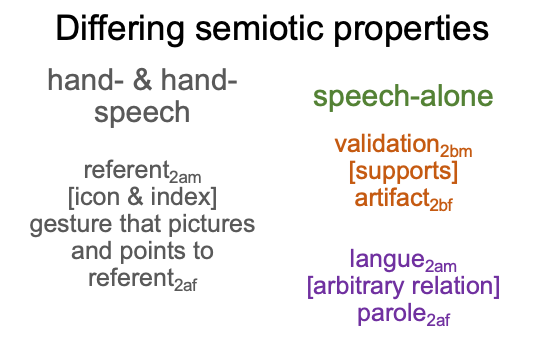
The semiotic properties of hand- (and hand-speech) talk and speech-alone talk are significantly different. The following figure presents dyads (characteristic of the Charles Peirce’s category of secondness) that may be read as Aristotle’s dyad of {matter [substance] form}.
0034 Hand- (and hand-speech) talk requires only one hylomorphe. A referent as matter substantiates, by way of icon and index, a manual-brachial word-gesture as form. The fact that word-gestures become routinized, and thereby instantly recognized, does not detract from this semiotic grounding. The referent precedes the hand-talk word.
0035 Speech-alone talk requires two hylomorphes, one on the content and one on the situation level. In terms of content, Ferdinand de Saussure (1859-1913) defined spoken language as “two arbitrarily related” systems of differences. What I think is arbitrarily related to what I say. So, where does the referent come in?
The referent comes on the situation-level, because each content-level word-utterance2af must be validated2bm(as situation-level matter) by the form of an artifact2bf. The spoken word precedes its referent.
0036 While this explanation sounds like gibberish to any newcomer to the field of semiotics, including many anthropologists and archaeologists in 2026, there is clearly method to the madness.
0037 Here is a list of Razie Mah’s e-works that are pertinent to this topic.
0038 The bottom line?
Hand- and hand-speech talk constrain social complexity.
Speech-alone talk facilitates unconstrained social complexity.
0039 This is precisely the theory that Dr. Cuttler needs in order to bring his research proposals to the next level.
0040 The origin of the Ubaid is the first step in a huge research project that is intrinsic to The First Singularity and Its Fairy Tale Trace.
0041 Cuttler’s analysis concerns the material arrangements that set in motion a dramatic shift in semiotic reality.
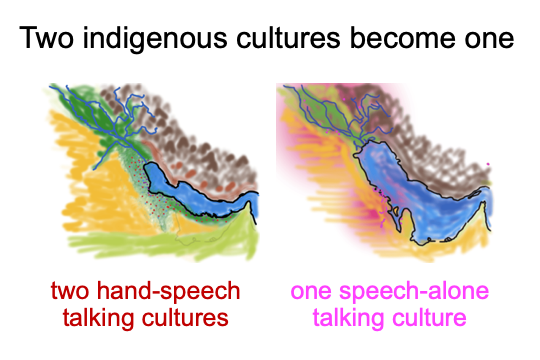
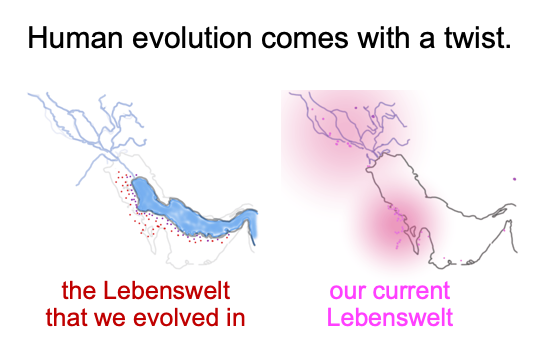
0042 Our current Lebenswelt is not the same as the Lebenswelt that we evolved in.
The image on the left represents two hand-speech talking cultures that belong to the Lebenswelt that we evolved in.
The image on the right represents one speech-alone talking culture that initiates our current Lebenswelt.
0043 I suspect that the Ubaid narod knows that they are different. They are surrounded by ethnoses that are poor and disorganized, in comparison to the wealth and the power that comes from (even a little) labor and social specialization.
The Ubaid does not know why it is special, it only knows that the surrounding hand-speech talking cultures talk with their hands. The hand-speech talking culture cannot help but notice the inverse. The Ubaid emissaries do not talk with their hands. However, they have the best dried fish. Plus, they want to give us their pottery, but it seems that they expect something in return.
Soon enough, the Ubaid strains at maintaining communality, or whatever it was that they had before their creation. Meanwhile, their way of talking encourages them to create artifacts that validate their spoken words, condemning them to further social complexity.
0044 It is hard to imagine what it was like, when every youth is ready to move past the tired artifacts that validate their grand-parent’s words.
Or, maybe it is not hard to imagine.
0045 Nor is it hard to imagine Abdullah Hassan Masry’s 1974 “sphere of interaction” hypothesis. Each Ubaid site belongs to a sphere of interaction, where it takes on its own “specialties”, its own gods, and its own ways of accommodating its labor and social specializations.
Doesn’t that sound like the contemporary term, “multipolar world”?
0046 Here is a picture.
0047 What is the second research project demanded by the hypothesis of the first singularity?
From the spheres pictured above, speech-alone talk spreads to the four corners of the world.
Imagine the research project needed to establish whether that claim is plausible!
0048 Dr. Richard Cuttler, the door is open. Follow your nose. Thank you for publishing your considerations.
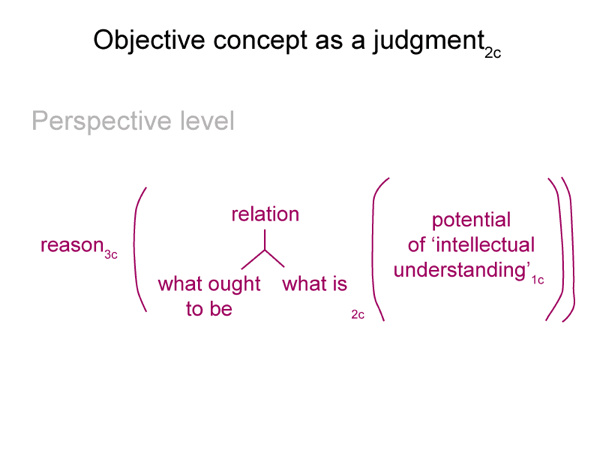
0282 Judgment is the actuality of a perspective-level nested form. Unlike the drama of Hamlet, the scholastic objective concept is a judgment within the normal context of reason, rather than paranoia and passion.
0283 The normal context of reason3c brings the actuality of a relation between ‘what is’ and ‘what ought to be’2c into relation with the potential of intellectual understanding1c.
0284 The actuality2c goes with objective concept. The normal context3c and potential1c compose objective precision.
0285 How do the four meanings figure into this model of the scholastic term “objective concept”.
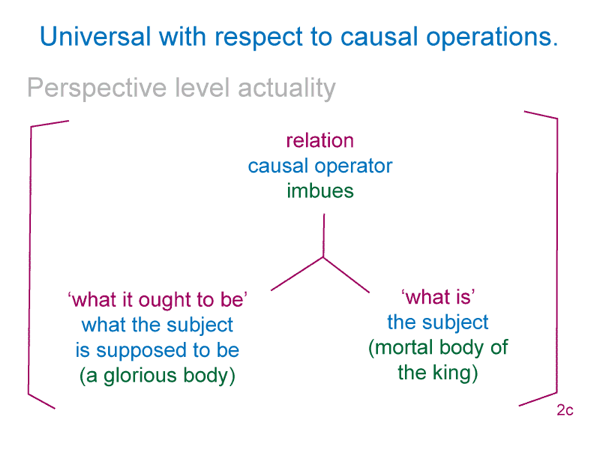
0286 The first meaning (M1) goes like this: A universal may be with respect to causal operations.
0287 The following depicts the ongoing example.
0288 The other three meanings behave similarly. Each occupies a slot for judgment.
0289 Now, back to universals.
0290 According to Izquierdo, Aristotle follows two definitions of universal.
D1. A universal can exist in the many.
D2. A universal can be predicated in the many.
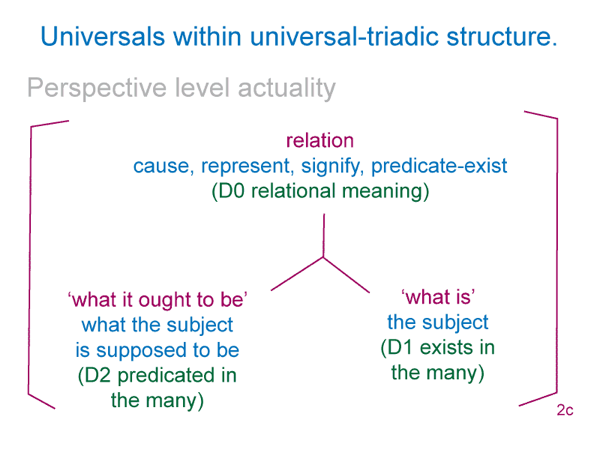
0291 To me, D1 goes with what is and D2 goes with what ought to be.
0292 Here is how that fits the ongoing model of judgment2c.
0293 This diagram implies that a third universal exists within the (universal) triadic structure of judgment. This universal (D0) coincides with the meaning that brings D1 and D2 into relation.
0294 What does this imply?
0295 Universals are important because they participate in judgment2c. Judgment2c is a primal triadic relation occurring within the normal context of reason3c. The potential of intellectual understanding1c underlies judgment2c.
0296 Judgment2c is the natural harbor for universals. In fact, judgment itself is a universal, since all humans share the ability to formjudgments that may be diagrammed as a triadic relation.
0297 Aristotle isolated two universals (D1 and D2) and potentiated the discovery of the third (D0).
The third corresponds to the four meanings that Izquierdo assigns to universals.