What about this vision of Original Sin as a reification of our own interpretations of the ‘what is real’. Once reified, a “serpent” inspires us to actions that produce results that differ from expectations (i.e. what is defined to be ‘real’). How do we deal with those results? Examples? And how does this picture resonate with traditional interpretations of these chapters of Genesis. This topic is addressed in chapters 11,12 and 13.
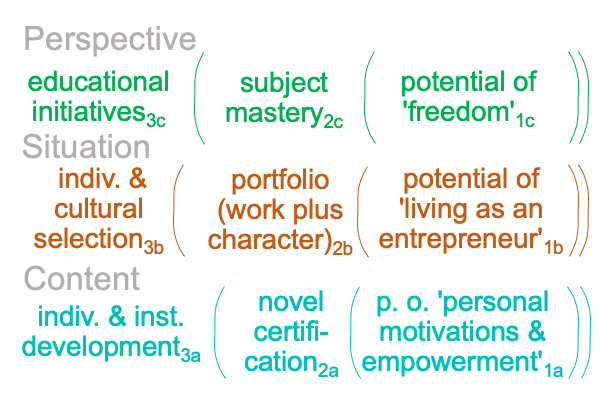
Before it opens, I want to thank Betsy DeVos for taking this reader beyond the notion of school choice and into the dynamics of educational freedom1c. There is more to be discovered in this new jurisdiction, standing outside the prison of big government3c (il)liberalism1c.
0056 Of course, the curtain may never open. People may decide that it is better to live as slaves under the appearance of freedom. But, that collective decision only assures the experts that appearances are no longer necessary. Experts are trained to know these things. Certain experts are prepared to make us slaves to the identities that they have manufactured for us.
0057 Be that as it may, the following diagram presents (what I imagine) is behind the curtain. Betsy DeVos’s educational interscope is a vision to behold.
0001 According to Neoplatonic legend, the descent of the soul starts with a small immaterial gem resting on an undefinable pillow in the presence of transcendental beauty. Then, a trap door opens and the little source of illuminationbegins to fall. As it descends, it accrues matter. Matter enters form.
One may say that the matter is evil and the soul, good, and conclude that the immortal soul becomes encased in corruptible matter. But, the story is more complicated, because the term, “matter” slyly includes the capacity to become entangled with purely relational being. Matter holds the capacity for meaning. Matter substantiates form. So Christians, following the complication, witness the baby as bearing a message. The message? Baptize me.
0002 The book before me is Brian Kemple’s The Intersection of Semiotics and Phenomenology: Peirce and Heidegger in Dialogue, published in 2019 by Walter de Gruyter Press (Boston/Berlin). The masterwork is dedicated to the memory of John Deely (1942-2017 AD), who served as Kemple’s professor.
0003 The book presents a complex argument. I, a simpleton, fixate on the titular word, “intersection”.
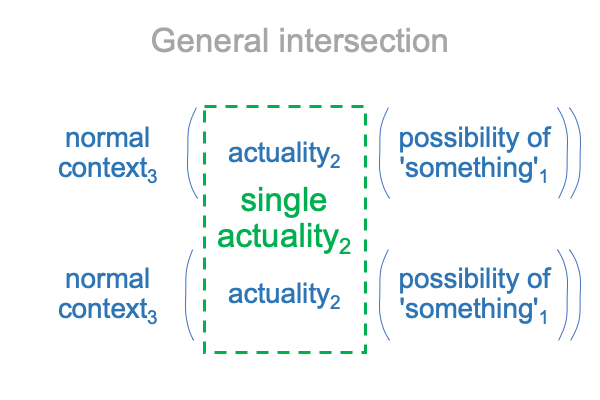
For me, the term has a technical definition, as formulated in the chapter on message in the e-book How To Define The Word “Religion” (by Razie Mah, available at smashwords and other e-book venues). An intersection is a single actuality composed of two actualities, each with its own category-based nested form.
Say what?
See APrimer on the Category-based Nested Form.
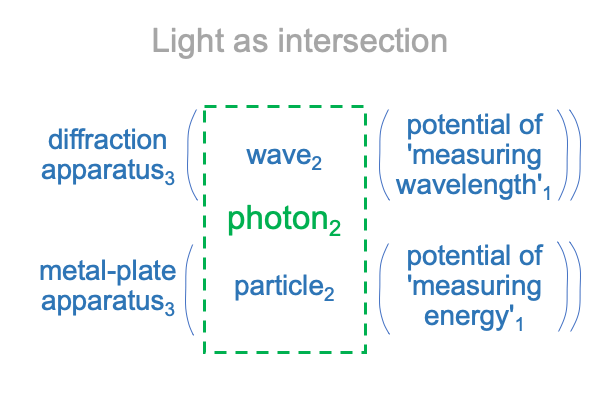
0004 A photon is an example of an intersection of two actualities: a wave and a particle. The normal context of a diffraction apparatus3 brings wave properties of light2 into relation with the potential of ‘observations of wavelengths’1. The normal context of a metal plate3 brings particle properties of light2 into relation with potential ‘observations of the photo-electric effect’1.
0005 Here is a picture.
Figure 01
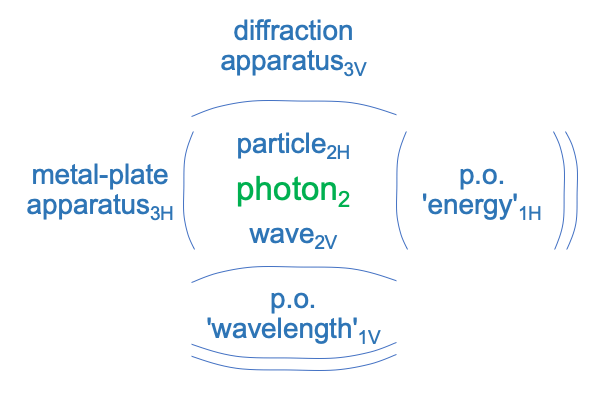
0006 Here is another way to look at the photon as intersection.
Figure 02
0007 In the following blogs, I will endeavor to visualize whether Kemple’s use of the term, “intersection”, coheres with this technical definition.
In order to do so, I will locate two category-based nested forms, one for both Peirce and one for Heidegger, and see whether the two actualities meld into one.
0008 The intersection is a technical term describing a single actuality constituted by two seemingly independent actualities.
Figure 03
Now I collect two nested forms from prior works by Razie Mah.
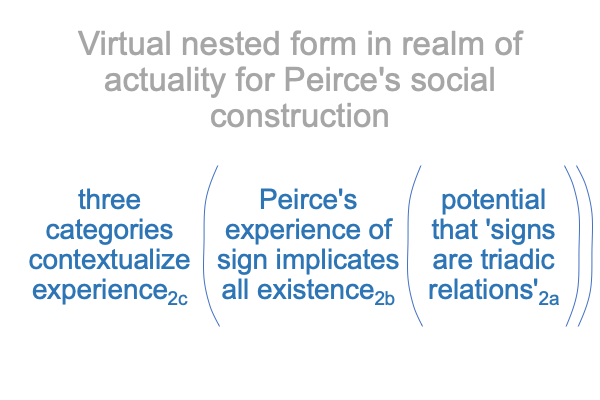
0009 For Peirce, I consider A Primer on Sensible and Social Construction. Point 0062 presents a three level interscope, depicting Peirce’s social construction. Here is a diagram of the virtual nested form in the realm of actuality.
Figure 04
0010 The content-level actuality2a is the discovery that signs are triadic relations2a. Triadic relations are luminous2a and Peirce cannot situate that luminosity2b within the modern philosophies of his day. This difficulty2b situates the content-level actuality2a and demands social construction3c. Peirce realizes that three categories contextualize all experience2c(because all experience utilizes signs2a). The categories of firstness, secondness and thirdness are discussed in detail in chapter four of Kemple’s book.
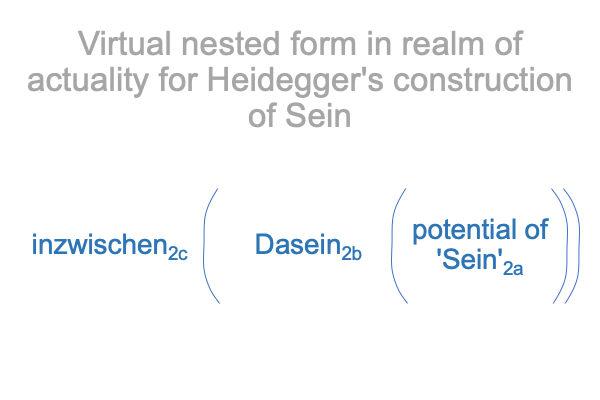
0011 For Heidegger, I turn to Comments on Alexander Dugin’s Book (2012) The Fourth Political Theory. Point 0037 presents a three-level interscope for Heidegger’s construction of Being (Sein). Once again, the virtual nested form in the realm of actuality captures my attention.
Here is a diagram.
Figure 05
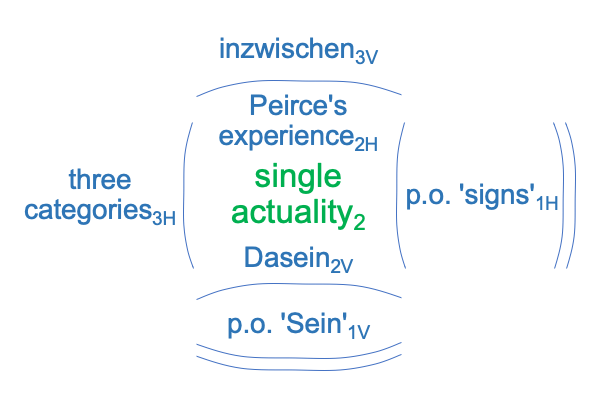
The normal context of inzwischen2c (in between-ness) brings the actuality of Dasein2b (the realization that Being is there (da-)) into relation with the possibilities inherent in Sein2a (Being Itself).
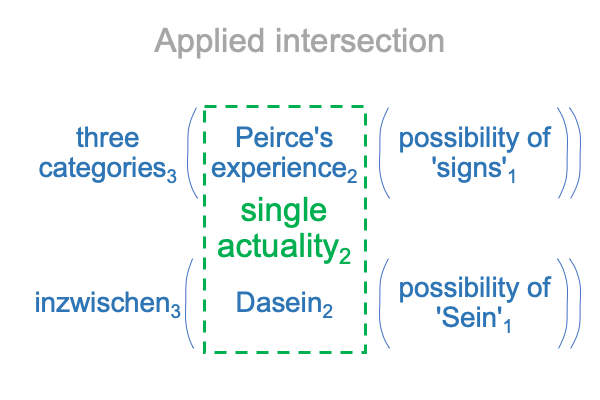
0012 For these two virtual nested forms to serve as the nested forms for an intersection, the perspective-level actualities2c, must take on the character of thirdness (over and above their location in secondness). This makes sense in so far as the perspectivec level corresponds to thirdness, the realm of normal contexts.
The same “taking on” applies to the content-level actualities2a. They take on the character of firstness (over and beyond their location in secondness). This makes sense because the contenta level corresponds to firstness, the realm of possibility.
0014 Unbeknownst to author, Razie Mah proposes a technical definition of the term, “intersection”, that adorns the title of Brian Kemple’s book. An intersection is a single actuality composed of two actualities. Every intersection is riddled with unresolved, and unresolvable, contradictions. The intersection is inherently mysterious. The philosopher strives to delineate these contradictions, not to resolve them.
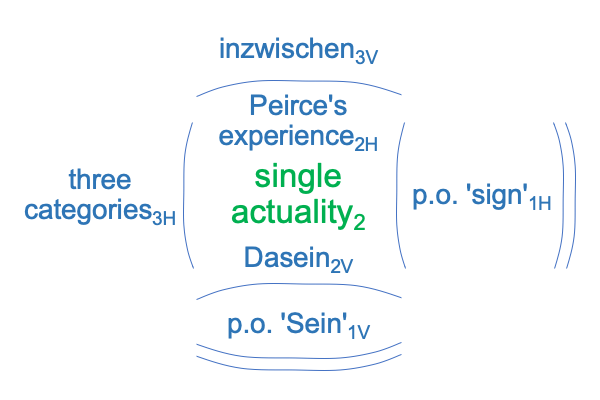
0015 Here is the intersection derived from Peirce’s social construction and Heidegger’s construction of Being in the prior blogs.
Figure 07
0017 To me, the coincidence is amazing. Kemple identifies the category-based structure that brings Peirce and Heidegger together and, in the subtitle, suggests a name for the single actuality. The name is “dialogue”.
I wonder if “dialogue” is the same as “delineating a union of two actualities without resolving their contradictions”.
The word that labels the single actuality should intimate the difficulty of Kemple’s task and perhaps, the genius of his approach.
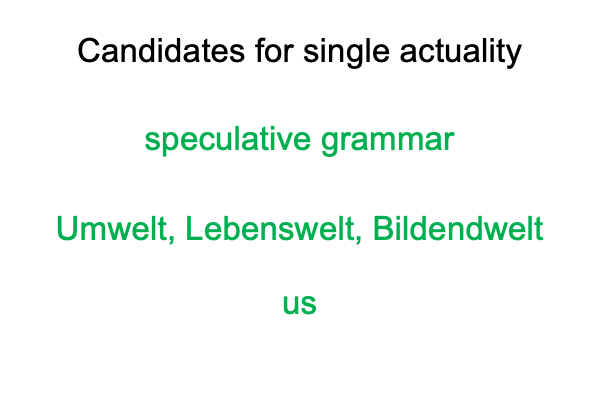
0018 At first, Kemple tempts the reader by mentioning an author who, early on, inspires both Peirce and Heidegger. A manuscript by Thomas of Erfurt, long attributed to the scholastic philosopher Scotus, discusses modes of signification for a speculative grammar. Speculative grammar? Look at the above figure. Should the single actuality be labeled, “speculative grammar”?
Yes, Peirce and Heidegger are inspired by Thomas of Erfurt.
0019 After that tease, Kemple devotes a division (chapters two and three) to Heidegger, followed by a division (chapters four and five) to Peirce. In these two divisions, Kemple introduces a term that takes a step beyond the German compound-words of Umwelt and Lebenswelt. The Umwelt is the significant world for each type of animal. The Lebenswelt denotes the world of signification for our kind, to which I add a caveat.
There are two Lebenswelts. The first is the Lebenswelt that we evolved in (characterized by hand- and hand-speech talk). The second is our current Lebenswelt (characterized by speech-alone talk). In one more step, Kemple introduces the compound-word, “Bildendwelt”, for civilizations within our current Lebenswelt, such as the one discussed in Looking at Heather Heying and Bret Weinstein’s Book (2021) A Hunter-Gather’s Guide to the 21st Century.
0020 The term, Bildendwelt, sounds like the concatenation of the words, “Bilden” and “dwelt”, as in the English statement, “I dwelt in that Bilden, before it came crashing down.”
In order to appreciate my humor, consider the October 1, 2022, blog at www.raziemah.com, titled, “Fantasia in G Minor: A speech written for Gunnar Beck MEP”.
Da Bilden is coming down!
Oh, I meant to say… the Bildendwelt makes no sense at all.
0021 So much for wordplay.
The compound-word, Bildendwelt stands, waiting to be refined in the furnace of postmodern use.
0022 The third division of Kemple’s book weaves together divisions one and two, titled World and Sign, into an intersection. In the process, Kemple focuses on two elements in the following figure: Sein1V and sign1H.
Figure 08
0023 To me, Kemple’s focus is remarkable, because Being1V and triadic relations1H are crucial for bringing our lineage from Umwelt, to Lebenswelt, and further into Bildendwelt. Indeed, I wonder whether these compound terms should be used to label the single actuality of Peirce’s experience2H and Dasein2V.
0024 But, let me not ignore one further possibility, the single actuality is us.
Here is a list of labels for the single actuality.
Figure 09
0025 Now, I can portray our descent.
Imagine us, as purely spiritual illuminations, perched on undefinable pillows, in the presence of transcendent beauty in an era when all time is now. A trap door opens and we descend into Being and Time. As we fall, we accrete two actualities, coinciding with Peirce’s experience following his realization that signs are real1H and with Heidegger’s vision of Dasein1V. These actualities are full of contradictions.
As we descend through Being and Time, we accrue World and Sign. We pass through our primordial Umwelt, the Lebenswelt that we evolve in, the first singularity, our current Lebenswelt and now, our Bildendwelt. Descent with modification. Then we are born, in the present, and each one of us bears a message. Baptize me.
0026 What does baptism do?
Baptism cleanses us of Gestell, the grammars of our world, carrying temptation, misdirections and lures that entrap us, confound us, and, in the end, convince us that the truth can never be found.
How so?
Truth is just a spoken word. We create our own “truth”. Spoken words are merely projections of our Innerwelt upon that which is outside ourselves. After temptation fixes our occasions of sin, after our own projections redirect the projections of others and weave a veil of reality, and after we begin to believe in our own self-divinizing speculative grammar, we construct artifacts that validate our spoken worlds. We build our own prison. Heidegger calls it, Gestell.
0027 When the waters of baptism pour over an infant, the baby often cries. The baby represents all of us.
The waters of baptism disturb. Dasein2V! We enter a world perfused with signs. We are welcomed into a world where the material finds meaning in the immaterial. The human niche is the potential of triadic relations. How all encompassing will Peirce’s experience2H be? We stand on the threshold of a new age of understanding.
Kemple offers the reader a portrait of John Deely’s vision, in a book that lives up to its title, in more ways than one. Bravo!
0001 Professor Gad Saad is an expert in applying evolutionary psychology to contemporary consumer behavior. He publishes a book, titled, The Parasitic Mind: How Infectious Ideas Are Killing Common Sense. The cover of the book is adorned with a graphic. A hand holds one end of a thread that goes on to become a line drawing of the human neocortex. Is the thread going into the head? Or, is the thread (of common sense) coming out of the head?
I suppose I have to read the book to find out.
0002 Saad gets into the push-pull operation in chapter four, titled, “Anti-Science, Anti-Reason and Illiberal Movements”. He lists four contemporary academic beings… er… parasites: postmodernism, social constructivism, radical feminism and transgender activism. Each movement… er… parasite is founded on a demonstrable falsehood. Each desires to be free from reality.
For these comments, I use gender as an example.
0003 In order to diagram these statements, I consult A Primer on the Category-Based Nested Form and A Primer on Sensible and Social Construction. These primers, by Razie Mah, are available at smashwords and other e-book venues. They are not long. They are very informative.
0004 A parasite feeds off a host.
The host goes with the content-level. The parasite places content in an alternate situation.
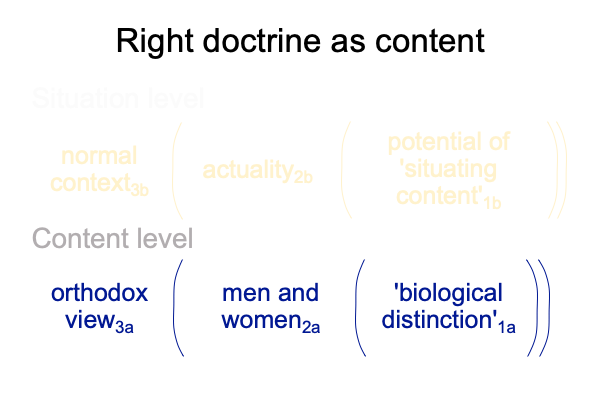
0005 I begin with the host. The host takes the actuality of men and women2a, which emerges from a biological distinction (which, in turn is an actuality in another nested form)1a in the normal context of an orthodox view3a. The term, biological distinction1a, is short for the potential of sexual dimorphism, as expressed in humans1a. Roughly, “ortho” means “right” and “dox” means “doctrine”.
Figure 01
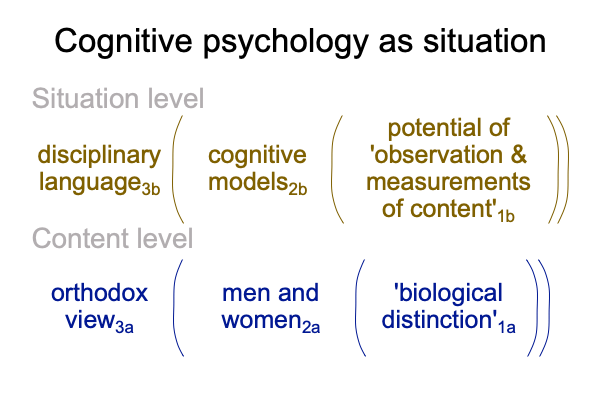
0006 Obviously, this content-level is scientifically, reasonably and liberally situated by cognitive psychology and its companion discipline, evolutionary psychology. Evolutionary psychologists explain the findings of cognitive psychologists in terms of natural selection and genetics: adaptations and phenotypes.
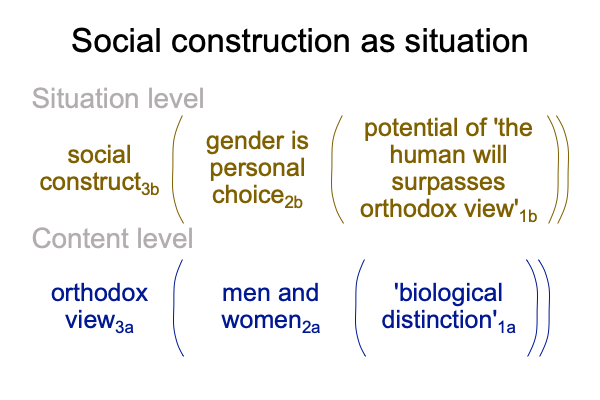
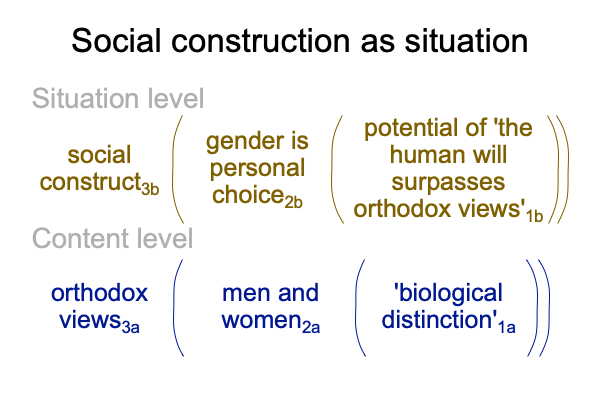
0007 The social constuctivist approach runs opposition to cognitive (and evolutionary) psychology. The social constructivist claims to situate the orthodox view, with the possibility that biological distinctions are irrelevant. Instead, only the human will is relevant. Gender is a personal choice. Gender is an act of the will.
The resulting situation-level nested form looks like this.
0008 Now, people talk about men and women all the time. They act within a traditional framework3a where ideas about men and women2a emerge from (and situate) the potential of sexual dimorphism, as expressed in humans1a. Explicit ideas2a can be articulated in speech-alone talk. Conversations may be recorded for scientific inquiry. Implicit ideas2aproduce expressive phenomena, such as blushing or averting one’s gaze, that can be observed and measured using instrumentation (surveillance cameras).
Consequently, cognitive psychology3b virtually situates the same content-level nested form as social construction3b.
Figure 03
0009 The difference is obvious. Social constructionism does not observe and measure1b attitudes and behaviors associated with the orthodox view3a. Rather, social construction3b virtually situates othodox views3a with a situation-level potential1b, the human will1b, which is an explicit abstraction concerning human nature.
Saad calls the forced choice between the scientific potential of observations and measurements1b and the constructionist potential of the human will1b, “intellectual terrorism”.
Well, terrorists hold people and things hostage. What do social constructionists hold hostage?
Ah, it must be observations and measurements1b.
Is that what makes these postmodern movements anti-science?
0010 But, there is more.
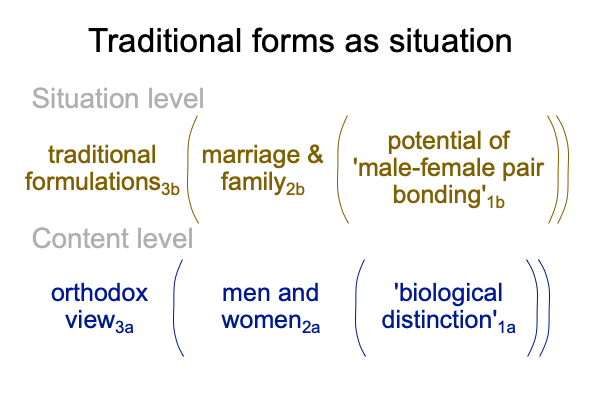
The content-level is also virtually situated by traditional formulations about the nature of the content-level. In the West, these forms come from churches, for the most part. They are very old, but still remain within our current Lebenswelt.
Figure 04
0011 The normal context of traditional doctrines3b brings the actuality of marriage and the family2b into relation with the potential of male-female pair bonding1b.
Isn’t that reasonable?
The relational logic of marriage is portrayed in A Primer on the Family, by Razie Mah, available at smashwords and other e-book venues.
Nature appears to express its own will. There is a natural intention1b (male-female pair bonding) that virtually situates a biological distinction1a. Plus, that natural intention1b appears at the very start of the foundational text for Christian civilization. Remember Adam and Eve?
0012 What is another thing that social constructionists hold hostage?
Ah, it must be male-female pair bonding.
0013 The possibility of male-female pair bonding1b underlies marriage and family2b in the normal context of tradition3b. Plus, male-female pair bonding1b emerges from (and situates) the entire contenta level. Male-female pair bonding1baccounts for the entire contenta level. It is perfectly reasonable that human bodies are adaptations into the niche of male-female pair bonding.
This is what makes postmodern movements anti-reason.
0014 So far, in looking at chapter four of Saad’s book and using gender as the example, I re-articulate some of the author’s claims using the category-based nested form.
Postmodern illiberal movements situate orthodox views about men and women2a with the concept that gender is a personal choice2b.
Figure 05
0015 Plus, postmodern illiberal movements3b exclude both traditional formulations3b and the disciplinary language of cognitive psychology3b.
On what theoretical grounds do they exclude?
0016 Well, if they have no theoretical grounds, then they would be intellectual terrorists.
But, if they do, then what would put the normal context of social construction3b into perspective3c?
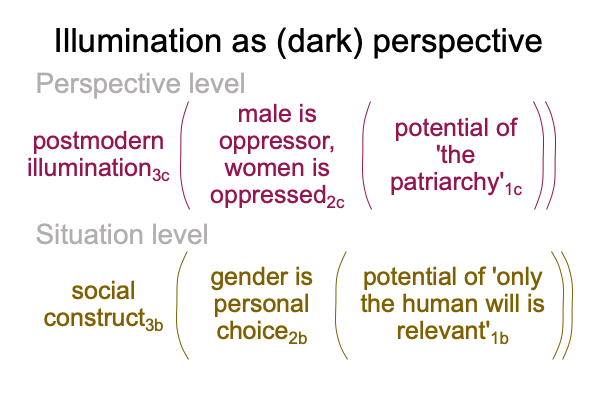
Well, the perspective must be a postmodern illumination3c, because the situation-level normal context3b displaces both science and reason. The situation tells me that gender is a personal choice2b. An third-level actuality2c must put that personal choice2b into perspective. If the world2c is “naively innocent”, then that perspective empowers the situation-level actuality2b. If the world2c is “treacherously corrupt”, then that perspective explains why the situation-level actuality2b may never be realized (without the assistance of a benevolent being with sovereign power).
0017 Here is a picture of the dark side of the postmodern illumination3c.
Figure 06
0018 The slogan of “toxic masculinity”2c enters the picture as emerging from (and situating) the potential that contextualizes the situation level1c. Men are oppressors. Women are oppessed. And, that is all there is to it. The actuality2c emanating from the potential of ‘the patriarchy’1c is an illumination of darkness3c, in the Manichaean sense of the term, “darkness”.
Of course, this perspective is counter-intutitive in the sensethat is incomplete. The problem? The other half of the illumination goes unspoken. An illumination3cof light, as opposed to darkness, remains unspoken.
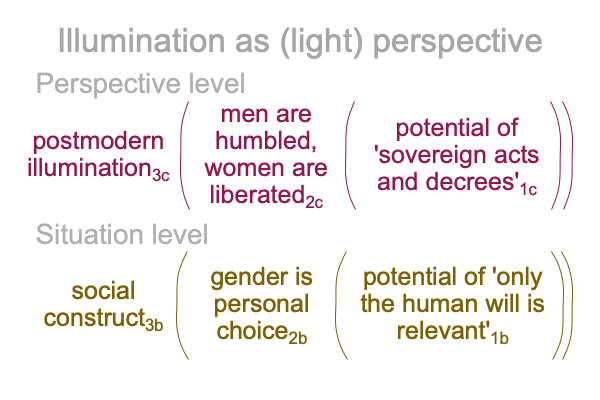
0019 Here is a picture of the naively innocentside of the postmodern illumination3c.
Figure 07
0020 Naive and innocent sovereign acts and decrees have the potential1c of mitigating the dominating and inflexible patriarchy1c. Of course, this requires sovereign power1c.
0021 What happens when ‘sovereign acts and decrees’1c counters ‘the patriarchy’1c?
Men are humbled2c and women are liberated2c in the normal context of the light-filled normal context of postmodern illumination3c.
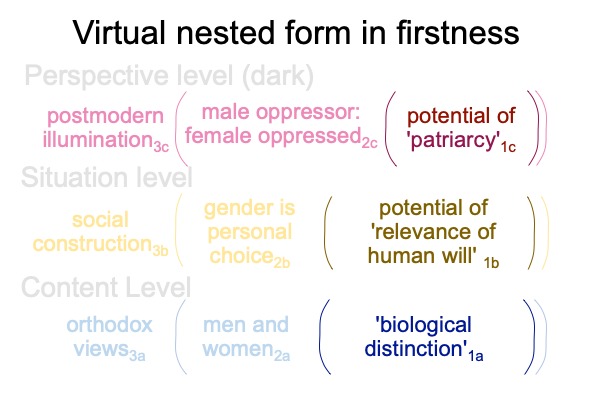
0022 In order to appreciate the three-level interscope derived in the last blog, I consider the virtual nested form in the realm of possibility. This turns the column in firstness, consisting of elements 1a, 1b and 1c into a category-based nested form.
0023 Here is a picture.
Figure 08
0024 Postmodern gender studies only proclaims the dark illumination3c. The light illuminations3c, where liberation2coccurs, cannot be articulated, because humiliation2c and liberation2c emerge from (and situate) sovereign acts and decrees1c. What does the postmodern (il)liberal gain from bringing politics and policies into the picture?
So, the proclamation of the dark illumination3c fills the airwaves.
0023 In the normal context of the patriarchy1c, the relevance of the humans will1b virtually emerges from (and situates) the irrelevance of biological distinctions1a, including the potential of sexual dimorphism in humans1a.
Consequently, men choose to gender themselves as males based on human will1b, rather than the potentials of scientific observations and measurements1b and the reasonable (natural law) conclusion that men and women are adapted to pair-bonding1b. The human will1b does not virtually emerge from a biological distinction1a. Rather, the human will1b decides how to situate biological distinctions1a, where biological distinctions1a correspond to the potential inherent in male and female phenotypes1a.
0024 In short, the situation-level potential of the relevance of the human will1b veils the relevance of observations and measurements1b (in cognitive science3b) and the relevance of pair-bonding1b (from traditional moral and religious fomulations3b).
What happens next?
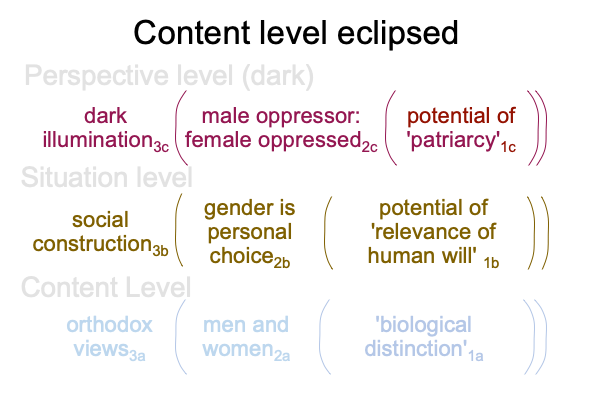
According to the normal context of social construction3b, if neither science3b nor religion3b are relevant, then content-level of orthodox views3a should no longer serve as subject matter. The content-level is eclipsed.
0025 Here is a picture.
Figure 09
0026 What does this imply?
Discussions about men and women2a, one of the favorite topics in bars and coffeeshops near college campuses, are no longer pertinent.
0027 Chapter Five is titled, “Campus Lunacy: The Rise of the Social Justice Warrior”.
I continue with gender as the exemplar concern. In the perspective-level of the previous diagram, being oppressed2c is a feminine trait2c. On the situation level, the normal context of social construction3b brings the actuality of gender as a personal choice2b into relation with the potential of human will1b. The human will1b is so relevant, that it makes biological distinctions1a irrelevant.
Once biological distinctions1a are irrelevant, then all orthodox views3a of men and women2a no longer matter. Orthodox views3a concerning the biological distinctions1a between men and women2a have been around a long time. The first great epic of the Greek language, The Iliad, revolves around that distinction. Paris kidnaps Helen and brings her to Troy and triggers the Trojan War. The unique masterpiece of the Jewish and Christian tradition starts in the Garden of Eden with the distinction between man and woman.
0028 Social construction replaces any need for the so-called “Western canon”.
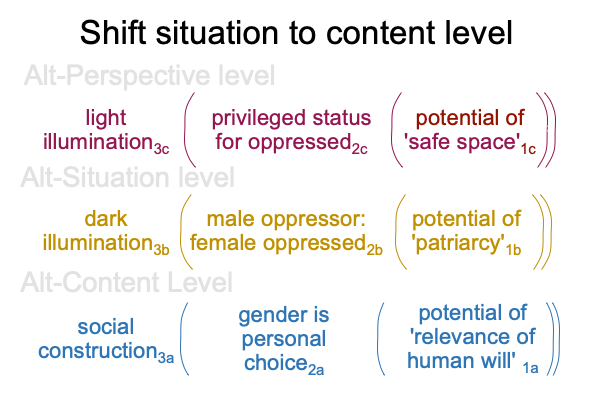
Indeed, social construction offers an alternate content level, allowing me to depict the following speculative diagram, based on the title of chapter five.
Figure 10
0029 Yes, once feminism triumps, the situation level shifts to the content level. A new “humanities”2a must be constructed3a in order to aesthetically represent the potential of the relevance of the human will1a (over biological distinctions1a) and to politically portray gender as a personal choice2a.
There goes the Iliad and the Bible. Fare thee well, Western civilization.
0030 Of course, the alternative literature of the nouvelle academics must be situated by the patriarchy1b, as the potential from which arises the unspeakable horrors of well… those throwbacks who still are talking about the biological differences between men and women.
Call them “scientists”. Call them “humanists”. Call them “religious”. They are overruled by the critique of dark illumination3b. Ssocial construction3a, not orthodox views3a, should define the content level.
0031 Remember the so-called College of Arts and Sciences?
Let us now advocate for a new coalition of social inquiries.
May we call it the College of Social Constuction?
0032 Take a closer look at the above figure.
Several postmodern themes intertwine.
0033 On the content level, radical individualism predominates. For other brands of social construction, replace “gender” with “the issue du jour”.
0034 On the situation level, Marxism stands out. The “patriarchy” is the “system”. The “system” is a term that substitutes for “capitalism”, along with its attendant division between the “bourgeois” and the “proletariat”. The “system” injects a fantastic fluidity into the Marxist tradition. A phantasmic dyad2b of dark illumination3b always manifests as oppressor and oppressed. Another term for dark illumination3b is “critical theory”3b.
0035 On the perspective level, American big government (il)liberalism blossoms. Who provides the protection1c and the privileged status for the oppressed2c? It is the federal government. Another term for protection1c is “safe space”. Another term for light illumination3c is “social justice”3c. The lawyer who sues for the causes of the ones privileged to be called, “oppressed”, is a “social-justice warrior”.