05/30/26

Semiotics and History: Baroque Scholasticism

SaH0001 Are there independent courses of study completely contained within Razie Mah’s blog?

Yes, besides the main courses that are announced at Razie Mah’s website, other online courses may be found.

Semiotics and History offers various courses.  The courses are like threads.  Each strand integrates with other strands, so the conceptual apparatus starts to work like a rope, giving the student a tool to climb through history.  

Here is the reading list for this strand.

Looking at Daniel Novotny’s Book (2013) “Ens Rationis from Suarez to Caramuel” (points 0001-0265, appearing in May, 2026)

Looking at Daniel Novotny’s Essay (2017) “Izquierdo on Universals” points (0266-0365 appearing in June 2026)

The dates pass backwards because WordPress places latest post first, for each month.

So, click on the month, then scroll downwards

0002 Other notes.  

Words and phrases that belong together may be placed in italics for easier reading.

Prerequisites include A Primer on the Category-Based Nested Form and A Primer on Sensible and Social Construction,by Razie Mah.  These are available at smashwords and other e-book venues.

A list of other strands may be found on the Semiotics as History Post at Razie Mah’s website, dated April 1, 2026.

05/29/26

Looking at Daniel Novotny’s Book (2013) “Ens Rationis from Suarez to Caramuel”(Part 1 of 19)

0003 The following 2016 essay comments on a recent book on baroque scholasticism by Daniel Novotny, a Professor of Philosophy at the University of South Bohemia in the Czech Republic.  The title of the work is Ens rationis from Suarez to CaramuelA Study in the Scholasticism of the Baroque Era (Fordham University, 2013).  

0003 This commentary is not a close reading.  Rather, it is a curious association of postmodern and semiotic diagramsto Novotny’s writing.  These models come from Razie Mah’s foundational works, including How to Define the Word “Religion” as well as An Archaeology of the Fall.

I regard Novotny’s work as both insightful and prophetic.  By “insightful”, I mean seeing through the highly nuanced Latin text in order to grasp the core.  He plainly condenses each nuanced argument into one or two sentences.  By ‘prophetic’, I mean that he quests for truth.  In chapter 9, paragraph 3, Novotny admits that his initial aim was to show that, even today, Baroque scholastic culture could produce philosophical illumination.

As the following comments will show, he is on target, but not in the way he expected.

0004 Why consider baroque scholasticism?

John Deely (1942-2017 AD) writes the first postmodern survey of the history of philosophy, from the ancient Greeks to the 21st.  His book is entitled, Four Ages of Understanding (2001, University of Toronto Press).

0005 Deely locates Baroque scholasticism (1600 to 1680 AD) at the start of the Age of Ideas and the end of the Latin Age.  He focuses on this time – right around the promulgation of the Peace of Westphalia (1648 AD) – as paradigmatic.  Two figures stand out.

0006 In France, Rene Descartes (1596-1650) wrestles with the philosophical implications of the new mechanical philosophy.  Note, the word “philosophy” appears twice.  On one had, philosophy trends to modernism and postmodernism.  On the other hand, philosophy spawns science.

0007 In Spain, John Poinsot  (1589-1644) arrives at the definition of a sign.  A sign is a triadic relation.  The relation was classified as ‘a being of reason’ (ens rationis) by Suarez, the first philosopher covered by Novotny.  Almost 300 years after Francisco Suarez ,(1548-1617) the sign as a triadic relation is independently discovered by Charles Sanders Peirce.  Peirce marks a new turning.  He is the first philosopher of the upcoming Age of Semiotics.

0008 Both John Deely and Daniel Novotny seek to understand the critical juncture where the Latin Age gave way to our current Age of Ideas. 

The origin of the Age of Ideas is wrapped in modern mythology.  Descartes is lionized.  Poinsot is ignored.  The Age of Ideas reigns in the shining castles of modern universities.  To me, state-supported multiversities look like palaces. Mechanical philosophy is taught to some.  Analytic philosophy is taught to others.  Propaganda and technique covers the rest.

Outside the palaces of big government (il)liberalism lays a moat of resentment, filled with materialistic philosophies, political theologies and television.  Even further away, the forgotten remnants of the Latin Age slowly convert an apparently dead civilization into a living soil.  For centuries, moderns were warned about going into the dark forest of scholasticism.

Yet, that is where John Deely and Daniel Novotny wander.

0009 A crucial difference arises between Deely and Novotny.  Deely has Peirce’s definition of the sign to guide him.  He has a lantern.  Novotny does not have the advantage of a postmodern source of light.  Novotny only has his own intuition.

John Kronen, of the University of St. Thomas, captures Novotny’s lack of an illuminated path in his review, writing, “If one agrees with Aristotle that opposites are treated in the same science (e.g. medicine treats both health and sickness) … then one should agree that metaphysics (the study of being) ought to study nonbeing”.

Indeed, Novotny bravely says, “OK, I will look into this nonbeing stuff.  I will go into the dark forest of scholasticism and see what happens.”

0010 From these labors, he comes up with the insights and the prophecy that I place before you.

0011 What about this nonbeing stuff?

During the Latin Age, the term “beings of reason” appears in various scholastic discussions.  In 1597 AD, the Spanish Jesuit Francisco Suarez writes the first comprehensive treatment on the topic (Chapter 9:Paragraph 1).  This marks the start of Baroque scholasticism (Chapter 1: Sections A-D).

0012 Why are ‘beings of reason’ needed?

Suarez proposes three reasons (Chapter 3: Section C: Point 3).  These are distilled by Novotny into claim SN8:

Beings of reason are needed (1) to know nonbeing, (2) to know things comparatively and (3) to explain why humans can think of self-contradictory beings.

Over the previous centuries of inquiry in Aristotle’s tradition, schoolmen routinely use the term “beings of reason” on three occasions.  These occasions suggest reasons for inquiring into the nature of the term.  They are (1) negations, (2) privations and (3) relations.  Self-contradictions (4) are also implicated.

So, at the beginning, Suarez asks: What is the ontological status of the term ‘beings of reason’?

0013 Now, let me turn to my own methods.

What do I have that makes my comments more than a curiosity?

Just as Deely holds the lantern of Peirce’s semiotics, I hold the flashlight of the category-based nested form.  You can be the judge of the power of this source of illumination.

Please note the prerequisites at point 0003.

Here is the category-based nested form in a nutshell:

0014 The nested form is depicted as follows:

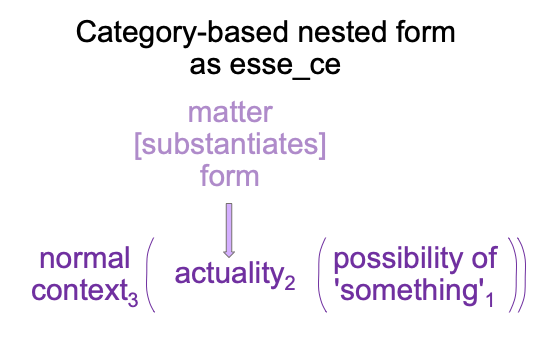
normal context3( actuality2( possibility or potential of something1))

The numerical subscripts denote Peirce’s categories.  The parentheses denote precission.

This depiction breaks down into four statements:

Actuality2 emerges from the possibility of something1.

Actuality2 situates the potential of something1.

A normal context3 contextualizes actuality2(something1).A normal context3 brings actuality2 into relation with the possibilities inherent in something1.

05/8/26

Looking at Daniel Novotny’s Book (2013) “Ens Rationis from Suarez to Caramuel”(Part 19 of 19)

0249 Second, what is the structure of this ‘being of reason’?

0250 Let me start with an example.

My example will be the words “being of reason”2a.

This example belongs to our current Lebenswelt, since both ‘being’ and ‘reason’ are explicit abstractions.  The terms are juxtaposed in a way that violates the laws of non-contradiction.  ‘A being’ is an actuality whose existence cannot be denied.  It is a fact.  ‘Reason’ is the determination of a ratio.  This determination is a second, contradicting actuality.

0251 Why does the juxtaposition entail a contradiction?

A being is one element.  A ratio compares two elements.  What is the other element that ‘a being’ is compared to?  It must be something regarding the manner of being because it is weighed against being.  But, it does not exist in the manner of being.

0252 OK, maybe I can accept that there is a contradiction between two actualities.

What are the two actualities?

The first is being2 (‘what is encountered’).  The second is the determination of a ratio2.

A single actuality contains these two contradicting actualities.  It does so by serving as the terminus for the ratio.

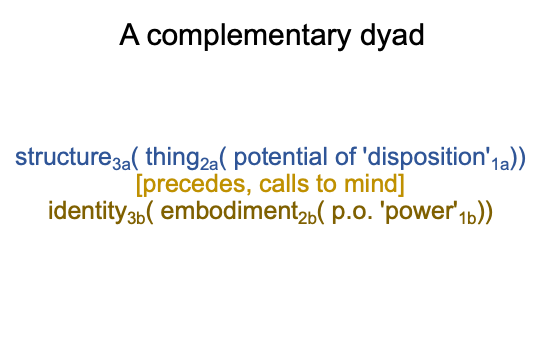
0253 At this point, to me, the intrinsic unity becomes apparent.  The beingin_reason2a is what the encountered being ought to be.

In this case, the encountered being2a is an extrinsic, linguistically formulated, self-contradiction.  The being of reason2abecomes a single, unified nonbeing composed of two actualities: the word “being”, pointing to existence or what is, and the determination of a ratio or reason, pointing to the constellation of what ought to be.  The unification must be a nonbeing because the logic of non-contradiction cannot reduce it to its component actualities.

0254 This suggests that nonbeings resist the logic of non-contradiction.  Yet, beingsin_reason are actual when they occupy the slot designated for secondness in the category-based nested form.

0255 This also suggests that the two component actualities belong to nested forms.  In other words, each of the actualities comes with a normal context and possibilities.

0256 What could these nested forms be?

I figure that the normal context3 for being as what is there2 might be realness3.  Perhaps, it3 is existence3.  The underlying possibility1 is a basis for realness1.   Realness3 brings ‘being (what is)2’ into relation with a potential basis for realness1.

I suppose that the normal context3 for the determination of a ratio2 is rationality3.  The underlying possibility1 is a basis for the ratio1.  So, rationality3 brings ‘the determination of a ratio2’ into relation with a potential basis for the ratio1.

0257 The two nested forms intersect in the realm of actuality, as follows:

0258 Curiously, this intersection reflects all the elements in judgment2c.  Judgment2c belongs to the formal intellect2c. Judgment2c virtually contextualizes the reckoning by the efficient intellect2b.

0259 Judgment2c is a relation between ‘what it is’ and ‘what it ought to be’.  The formal intellect virtually designs the normal contexts of the intersection and sets the parameters for the potentials.

0260 For Baroque scholastics, the basis of rationality was captured in the logic of non-contradiction.  This is why the beingin reason2a could not exist, even though it could be regarded in the manner of being.  The basis of realness was existence.  Facts went with existence.  Fiction did not.

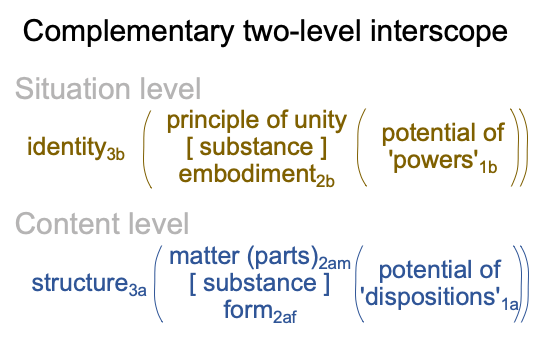
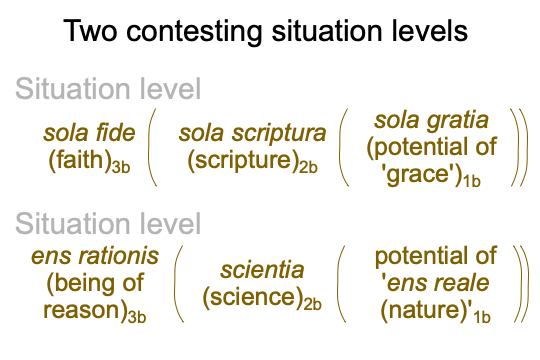
0261 The interscope for ‘being of reason’ in Baroque scholasticism ended up looking like this:

0262 To me, this interscope marks the beginning and the end of the Age of Ideas.

The Age of Ideas emphasizes the axis of true versus false, throwing the axis of true versus deception into shadow.  Baroque scholasticism faded from view, along with fictions like beingsin_reason.

On the one hand, once the elevation of one axis and the occlusion of the other axis became ingrained as habit, then modern philosophy and science follows.

On the other hand, modern literature explores the negations, privations, relations and self-contradictions in which Baroque scholasticism sleeps.

0263 Modernism is a world with a fixed perspective.  Actuality is every thing.  Actuality is all there is.  For example, modernism elevates human dispositions.  It occludes human conscience.  Thus, the term “sin”, which coincides with the intersection of human action and thought, follows the same trajectory as “beings of reason”.

0264 Modernism is a world of deception.  Surely, facts may paint a false picture.  Facts depend on one’s fictions.  Indeed, facts will support ‘the current intersection of existence and rationality’ until the moment when deception turns realness into deprivation and negates rationality with its own distorted valuations.

Will we then return to beings of reason as explanations for negation, privation, relation and self-contradiction?  Or will we return to beingsin_reason in order to locate the intrinsic unity between fact and fiction?

0265 There is more to actuality than every thing.  Charles Peirce opens a path to postmodern scholasticism.  Deely and Novotny opened a vista into where we have been.

05/7/26

Semiotics and History – Baroque Scholasticism and Early Modernism (Part 1 of 1)

SaH0043 The Baroque scholastics of southern and central Europe live at the same time as the mechanical philosophers of northern and western Europe.  The latter give rise to the Age of Fiction, with Cervantes publishing Don Quixote in the early 1600s.  The former give rise to the Age of Ideas, with the birth of modern science.

Of course, it is not as neat as that.

Consequently, an examination of an article by Novotny serves as a capstone for Razie Mah’s online course on Baroque Scholasticism and as an introduction to an online course in Early Modernism.

Baroque Scholasticism consists of Looking at Daniel Novotny’s Book (2013) Ens Rationis from Suarez to Caramuel (and appears in Razie Mah’s blog in May, 2026).

The capstone for Baroque Scholasticism and the introduction to …and Early Modernism consists of Looking at Daniel Novotny’s Article (2017) Izquierdo on Universals

Baroque Scholasticism and Early Modernism consist of a review of Eric Santner’s Book (2016) The Weight of All Flesh.

SaH0044 Both are strands in the course: Semiotics and History.

See Razie Mah’s blog for February 3, 2026.

05/7/26

Looking at Daniel Novotny’s Essay (2017) Izquierdo on Universals (Part 1 of 6)

0267 What are universals? Why are they important? 

In the Spring 2017 issue of the American Catholic Philosophical Quarterly (vol. 91(2) pages 227-249), Daniel Novotny examines Disputation 17 of the Baroque scholastic treatise, The Lighthouse of the Sciences (1659).  The title of Novotny’s article is Sebastian Izquierdo on Universals: A Way Beyond Realism and Nominalism.  These comments intend to demonstrate the postmodern relevance of this work using the category-based nested form.

0268 Oh, back to the starting questions.

Some things are similar to one another.  Universals grow out of this impression.  Various things can share in certain universals, to the exclusion of other things.  In this very brief paper, Daniel Novotny reviews and summarizes the theory of universals proposed by the Spanish Baroque scholastic, Sebastian Izquierdo, SJ (1600-1681 AD).

Izquierdo’s life overlaps with the northern European authors who mark the dawn of the Age of Ideas, including Thomas Hobbes (1588-1679) and Rene Descartes (1596-1650).  His life also overlaps with theorists marking the twilight of the Latin Age, including Francisco Suarexz (1548-1617) and John Poinsot (1589-1644).  Our current age is born at this time.  This is the moment to which we must return in order to come to terms with our era.

0269 Daniel Novotny is not unfamiliar with the Baroque philosophers.  I commented on his full-length book, Ens Rationis: From Suarez to Caramuel, published in 2013.  Novotny’s exposition is so clear that constructing (inevitably messy) category-based nested forms came easy.

My comments wove a story into his presentation, starting with the dichotomy of fact versus fiction and ending with an intimation of postmodern social construction.  This narrative adds value by connecting Baroque scholasticism and our present, postmodern, world.

0270 As for the article under examination, Novotny begins with a caveat.  Baroque philosophy and theology is a complex tapestry, filled with commentary and references.  One can easily get lost in this forest of questions and answers.  Typically, an entire text must be examined in order to configure an author’s opinion, if distinct from all others.  Since such effort is very difficult and time consuming, Novotny limits this publication to a careful examination of Disputation 17 of Izquierdo’s major philosophical work, The Lighthouse of the Sciences.

Disputation 17 presents Izquierdo’s theory of universals.

0271 The table of contents for The Lighthouse of the Sciences is organized in a novel way, portending substantial differences from traditional doctrines and methods.  In Disputation 17, Izquierdo considers three questions.  To me, these questions sound postmodern.

Q1. What are universals?

Q2. Are some universals independent of the intellect?

Q3. If universals are intellect dependent, what is their nature?

0272 To the first question, Izquierdo offers four meanings:

0273 Let me supply an example from Eric Santner’s (2016) book, The Weight of All Flesh

0274 During late medieval and early modern times, political theologians proposed that the king had two bodies.  One was mortal.  The other was glorious.

When a king died, his mortal body was quickly buried.  An effigy (representing the king’s glorious body) was manufactured and placed on the throne until the coronation of a new king.  Then, the effigy was buried in a separate funeral.

0275 The glorious body of the king is a universal with four meanings.

0276 The last meaning is particularly twisted.  The universal, in its proper sense, cannot be a particular.  Yet, here is a particular effigy that becomes a symbol of the king’s glorious body.

According to C. S. Peirce, a symbol is a sign based on tradition, convention, law, consensus and so on.  Here, a political and theological consensus connects a sign-object (the king’s glorious body) to a sign-vehicle (an effigy of the deceased king).

0277 In Peirce’s semiotic terminology, the scholastic term “objective concept” portrays the union of a sign-vehicle and sign-object.  The term “objective precision” reflects the operation of a sign-interpretant.

0278 In the terminology of the nested form, “objective concept” belongs to secondness, the realm of actuality.  “Objective precision” belongs thirdness and firstness, the realms of normal context and possibility, respectively.  An objective concept is a mind-dependent being.  Objective precision is a formal act of the intellect.

0279 For example, in Shakespeare’s Hamlet, a murderous uncle gains the throne and becomes king (objective concept).  Unfortunately, the ghost of Hamlet’s father (the glorious body of the deceased king) appears, calling Hamlet to reject his uncle’s claims (through objective precision).  Hamlet’s uncle has no nobility.  Therefore, his uncle is not king (and does not have a glorious body, since the glorious body of Hamlet’s father haunts the world).

0280 This dramatic call to judgment may be depicted as a relation between what is and what ought to be.  Indeed, I define the actuality of judgment as this triadic relation.

0281 Here is a diagram.

05/1/26

Looking at Daniel Novotny’s Essay (2017) Izquierdo on Universals (Part 6 of 6)

0350 Next, the fourth proposition (P4) comes up for consideration.

0351 What is the disposition of the universal to each of Aristotle’s definitions?

According to the working model, both definitions are in play in the primal triad.  They are not independent.  How can this be?  This model supports further philosophical inquiry.

0352 Propositions P2 and P3 pertain to the interscope of the individual in community.

0353 P3 points to the fact that the normal context for judgment2c is reason3c.

0354 P2 suggests that what is and what ought to be may not be labeled.  Instead, phantasms and impressions substitute for these intersubjective unities.  The resulting judgment is called an intrinsic abstraction.  This is the type of judgmentrendered in the Lebenswelt that we evolved in.

0355 The Christian sacrament of the Eucharist serves as an example.

What is appears as a piece of bread2a.  What ought to be is the phantasm of the body of Christ2b.  Thomas Aquinas discovered the relation, twelve hundred years after the commissioning of the Last Supper.  Transubstantiation2c (as the universal, relation) brings the appearance of bread2a->2c (as the universal, what is) into relation with the body of Christ2b->2c (as the universal, what ought to be).

0356 What is emerges from the potency of the material and physical.  What ought to be emerges from the potency of the formal and logical.  What brings these into relation is a mystical operation emerging from the potency of human understanding.

0357 Of course, I will never hear the word “transubstantiation” on television in this era of big government (il)liberalism.

Instead, I will see a commercial for a Czech beer, starting with the image of an amber bottle, glistening with condensate.  Music starts.  The word “you” appears as a hand grasps the bottle.  “Can”, another hand pops the cap.  “Be”, one hand lifts the bottle.  “The King”, the hand pours the beer.  “Of Bohemia”, the cascading brew fills an image of a throne.

The music swells as the honey-colored throne morphs into a glistening glass of beer.

The voice-over intones, “You can be the King of Bohemia.”

0358 Has the glorious body of the king transubstantiated into a commodity, a regal libation?

0359 I raise my glass to Ceske Budejovice in the Czech Republic, the home of the University of South Bohemia.

0360 Daniel Novotny lists the consequences of Baroque Scholastic Sebastian Izquierdo’s Disputation 17 in The Lighthouse of the Sciences.  He concludes with an impression: Izquierdo is close to modern empiricism.

0361 Izquierdo rejects the extra-mental features of universals and avoids the projection of universals into the realm of the mundane.  He avoids nominalism by insisting on objective concepts.

0362 Novotny suggests that Izquierdo’s rejection of Aristotle’s act-potency distinction draws him into the same errors that plague contemporary metaphysics and philosophy of mathematics.  The middle way between nominalism and Platonism must be grounded in the metaphysical structure of reality.  But, Izquierdo cannot lock onto that relational structure.

0363 Charles S. Peirce gave me a gift.

0364 His three categories point to the ground that Izquierdo intimated.  Izquierdo’s third way may have failed, but with the category-based nested form, I can look across the turbulent seas of the Age of Ideas and say, “I see what you mean.”

0365 The Lighthouse of the Sciences still beacons.

04/30/26

Looking at John H. Walton’s Book (2025) “New Explorations in the Lost World of Genesis”  (Part 1 of 20)

0001 The book before me is published by Intervarsity Press.  The subtitle is “Advances in the Origins Debate”.  This work is the latest in the “Lost World Series” that delves into how Genesis should be regarded in light of the archaeological discoveries of the past three centuries.

Of course, “new explorations” implies “advances”.  Advances adjust previous positions.  The reader is advised to consult the conclusion immediately after the introduction, and before the section on methodology.

An examination of a prior work can be found in Looking at John Walton’s Book (2015) “The Lost World of Adam and Eve” appearing in Razie Mah’s blog in August 2022.  The review is updated and fashioned as the first and fifth chapters in Razie Mah’s 2024 e-book, Exercises In Artistic Concordism, available at smashwords and other e-book venues.

0002 The term, “literature of the ancient Near East” is somewhat awkward, because the writings of the ancient Near East were buried in the ruins of royal libraries throughout Egypt and the Levant.  The writings are in cuneiform, wedge impressions on clay tablets.  The clay fires into brick when the royal library burns, along with the rest of the royal city.  Then, the ruins get buried in vegetation, and later human settlements, and so on.  Then, the tells (or hills) are excavated by modern archaeologists.  Archaeologists discover thousands of cuneiform tablets and learn how to translate them.  These translations constitute “the literature of the ancient Near East”.

0003 Of course, this story sounds implausible.

However, God tends to manifest the implausible.

0004 In fact, if God only performs sensible… what is the correct term?… “interventions”, then no one would notice.  If anyone could turn water into wine, then the miracle at Cana would be ho-hum.

The Uruk culture invents writing by impressing tokens onto the surface of clay balls (which then contain the impressed tokens).  That seems sensible.  Centuries later, a Sumerians scribe uses a reed stylus to create impressions on a clay surface that is curved, like the surface of a ball.  That seems sensible, also.  Then, stylus impressions on a clay tablet become so routine that cuneiform is used for centuries to record transactions and inventories.  Eventually, the same writing is used to record the civilization’s origin myths.

0005 Okay, each of these steps is sensible, although unlikely.

How many unlikely, yet sensible, developments can be strung together before the results may be declared “miraculous”?

0006 So, what is miraculous with respect to Walton’s lost-world propositions?

God provides eighteen centuries of biblical interpretation by Christians before creating the conditions where a challenge to traditional reference and affirmation occurs.

The archaeology of the ancient Near East unearths literature that is (more or less) contemporaneous with the Old Testament.

That is the challenge.

0007 The Old and New Testaments are no longer subject to plain reading as the sole foundation of interpretation.

Why?

How can one conduct an honest reading of the Old and New Testaments and not accommodate the literature of the ancient Near East?

0008 Okay, replace the word, “honest”, with the word, “literal”.

It seems that figurative and allegorical readings are not challenged.

04/8/26

Looking at John H. Walton’s Book (2025) “New Explorations in the Lost World of Genesis”  (Part 20 of 20)

0218 Chapters seven and eight cover the Fall and God’s pronouncements in Genesis 3.

These are more results of Walton’s scientific explorations.

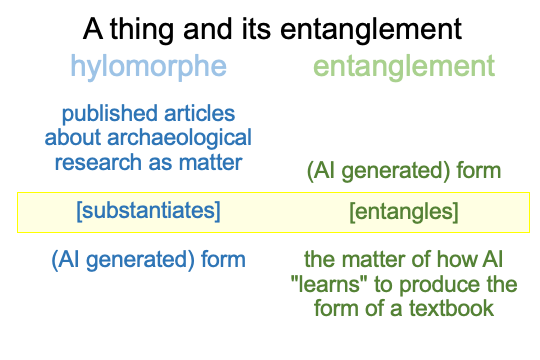
I leave the application of hylomorphe, entanglement, confounding and resolution to the reader.

0219 Recall, a scientific paper contains five elements: introduction, methodology, results, discussion and conclusion.

So does Walton’s book.

0220 Chapter nine offers a discussion on Genesis and science.

At no point in the discussion does Dr. Walton touch base with the following hylomorphes.

0221 In regards to the Creation Story, Razie Mah’s Looking at Hugh Ross’s Book (2023) “Rescuing Inerrancy” reviews what Walton is trying to avoid.  Walton imagines that the entanglement of a moderate or an artistic concordism will turn out to be… um… dangerous.

Didn’t I say that confoundings are dangerous?

Hugh Ross’s version of moderate concordism cannot rescue the doctrine of biblical inerrancy, because it offers only a miraculous coincidence between what the Genesis text for each day appears to be describing and a corresponding evolutionary epoch.

Razie Mah’s version of artistic concordism changes the character of the doctrine of biblical inerrancy, because it offers a method for showing that each Genesis day offers natural signs of a corresponding epoch.  There are three types of natural signs: icons, indexes and symbols.

0222 If the Bible is supposed to be plainly read, then why would an author write the Creation Story as a vision that depicts the evolution of the Earth on the basis of natural signs?  The author could not possibly had known the natural history of the Earth, unless having been presented with a series of visions.  The text breaks down into natural signsbundled for each day, as images, indicators and symbols.

0223 It is enough to make John H. Walton swoon.

There is no way that Genesis 1-11 can entangle the modern… now… postmodern age.

There is no way… except… for… that ever-churning Christian imagination.

See Razie Mah’s e-book, Exercises in Artistic Concordism.

0224 In regards to the Primeval History, all the written origin stories of the ANE (except for the Creation Story) depict a recent creation of humans, by newly differentiated gods, according to their designs and purposes.

The question is, “Why?”

The civilizations of the ANE cannot see past a theoretical time point corresponding to the start of the Ubaid archaeological period in southern Mesopotamia.  They cannot see from our current Lebenswelt into the Lebenswelt that we evolved in.

0225 The first singularity is currently a hypothesis.

As further research is conducted with this hypothesis in mind, we may eventually feel confident that the Ubaid is the first culture in human evolution to practice speech-alone talk.  8800 years ago, all other cultures practice hand-speech talk, in continuity with the founding of our species 300,000 years ago.

Over a period of a few thousand years, these hand-speech talking cultures convert to speech-alone talk, after being exposed to speech-alone talking cultures.  Why do they adopt the new way of talking?  Hand-speech talk promotes constrained social complexity.  Speech-alone talk removes the constraints.  The semiotic qualities of hand-speech talk and speech-alone talk are hugely different.

0226 The above hylomorphes are resolutions in favor of the entanglement.

Against this prospect, Walton configures his own confounding.

0227 Will this be sufficient to stop the goofy, science-loving impulses of the Christian imagination?

I don’t think so, because even if Walton’s confounding resolves in favor of his entanglement, the form of the resulting hylomorphe will entangle the Christian imagination.

0228 The Tartu-Moscow School of Semiotics pulls up a fish from the depths of the Christian Slavic civilization.

They open the mouth of the fish.

What do they find?

The golden coin of entanglement.

0229 Welcome to the Fourth Age of Understanding, The Age of Triadic Relations.

0230 I thank John H. Walton for publishing this advance in the origins debate and I wish J. Harvey Walton the best.

03/31/26

Looking at Mikhail Trunin’s Article (2017) “Semiosphere and history”  (Part 1 of 8)

0841 The article before me is published by Sign System Studies (volume 45(3/4), 2017, pages 335-360) by Mikhail Trunin in the School of Humanities at Tallinn University, Estonia.  The full title is “Semiosphere and history: Towards the origins of the semiotic approach to history”.  This particular volume is dedicated to semiotics and history.

0842 Juri Lotman (1922-1993 AD) and Boris Uspenskij (1937-present) are central characters in the first ascent of the Tartu-Moscow School of Semiotics during the 1960s through the 1980s.

Lotman’s treatment of a semiotics of history connects to his conceptualization of the semiosphere.  Of course, “semiotics” stands in the place of “semiology”.

Uspenskij’s treatment of the semiotics of history starts with the Latin phrase, “historia sub species semioticae”.  The phrase transliterates (more or less) into “history as a species of semiotics”.

Or maybe, “historical under the semiotic species”.

Of course, “semiotics” stands in the place of “semiology”.

0843 Previous examinations of articles in this and other volumes of Sign System Studies provide a way to appreciate what these semiologists have in common.

0844 So, let me briefly review.

The academic development of semiological consciousness for humanities scholars starts in the Departments of Slavic languages, during the so-called “Cold War”, since the Union of Soviet Socialist Republics casts its dominant ideology as that of science.  These humanities scholars begin to frame their interpretations of Slavic literature in terms of Saussure’s semiology and structuralism.  After all, semiology and structuralism are scientific, aren’t they?

0845 Semiology deals with content, the relation between parole (spoken words) and langue (corresponding ideation).  Technically, the relation between speech and thought is not motivated (hence the qualifier, “arbitrary”), since spoken words do not image or point to their referents.  Nonetheless, civilized humans behave as if they do.  But, that behavior may be attributed to grammatical structure (for a mother tongue) or a style system (for specialized discourse).

0846 Structuralism deals with how content is situated. Humans do not behave as if a spoken word is arbitrarily related to a mental act (or thought).  Humans act as if words and thoughts are one thing.  

Rather than attributing this behavior to an innate trait evolved under conditions where a parole (manual-brachial word gesture) images and indicates its referent (by way of the natural sign-qualities of icons and indexes, respectively), the modern scientist must attribute the behavior to truncated material and efficient causes.

In this case, the situating efficient and material causes are due to a system3b. Both mother tongue and specialized discourses3b operate on the potential of ‘laws of the system’1b.

0847 Here is a fundamental interscope containing semiology3a and structuralism3b.

0848 On the content level, the normal context of Saussure’s semiology3a brings the actuality of the dyad {langue as matter2am [substantiates] parole as form2af}2a into relation with the potential of ‘signifier and signified’1a.

Cleverly, the content-level potential1a buries the evolution of language in the milieu of hand-talk in the ambiguity of the co-existence of signifier and signified.  Can a signifier exist without a signified?  Of course not. They must be belong to a monad, a single element.

Can a thought about ‘something’ exist without an image or indication of that ‘something’?

Does a manual-brachial word-gesture picture or point to its referent?

0849 Ironically, both Charles Peirce (1839-1914 AD) and Ferdinand de Saussure (1857-1913) live right before the monumental, civilization transforming battles among the enlightenment gods.  Peirce focuses on the nature of signs as triadic relations.  Saussure focuses on language as a thing (that is, a dyadic actuality).  

0850 The above figure tells the tale.  The content and situation level actualities2 are dyads, as suggested by Saussure. Normal contexts3 and potentialsare presumed in Saussure’s tradition, but explicit in terms of Peirce’s categories.

The category-based nested form is a triadic relation.  Triadic relations constitute the human niche.  Hominins adapt into the potential of triadic relations.

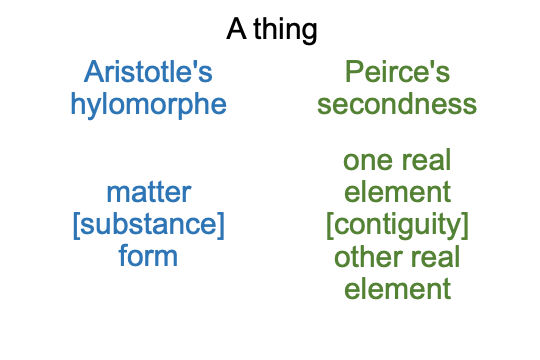
The content-level appears to be a reasonable expression of Saussure’s semiology because it expresses a triadic relation.  Not only that, but the content-level category-based nested form manifests all four of Aristotle’s causalities.  The dyadic actuality, corresponding to Peirce’s category of secondness, parallels Aristotle’s hylomorphe, the home of material causes and one terminus for efficient causation.

0851 Here is a picture of the category-based nested form as a manifestation of Aristotle’s causalities.  Peirce’s category of secondness contains two contiguous real elements.  For Aristotle’s hylomorphe, the one real element is matter.  The other real element is form.  The contiguity is [substantiates] or [substance].

0852 So, what does this imply?

First, Lotman and Uspenskij start out as scholars of Slavic literature in Russia, under a socialist regime, which extols its scientific credentials.  Academics in literature adapt to regime incentives by adopting Saussure’s scientific approach to language.  Saussure’s semiology is regarded as a scientific theory explaining the phenomena of language in our civilized world.

Second, the fundament interscope starts with Saussure’s semiology3a as a content-level nested form.  The actuality2 is {langue2am [substantiates] parole2af}.

Third, the category-based nested form manifests all three of Peirce’s categories as well as all four of Aristotle’s causalities.

Fourth (and yet to be discussed), Lotman’s and Upsenskij’s treatment of history and semiology starts with the fundament interscope.  Semiology characterizes a content-level interscope.  History enters the picture as a literature-based situation-level form2bf.  

0853 If these implications stand, then Upsenskij’s Latin title, “history as a species of semiotics”, will convert into “history as a species of literary text”.

03/23/26

Looking at Mikhail Trunin’s Article (2017) “Semiosphere and history”  (Part 8 of 8)

0935 What happens next?

Lotman and Uspenskij publish an article in Russian (in 1971), which is translated into English (in 1978), titled “On the semiotic mechanism of culture”.

This is followed by intense study of Vernadskij’s language of life-pressure, then the publication of Lotman’s seminal paper, “On the semiosphere”, in Russian (in 1984).

0936 The author goes to some length to distance Lotman’s concept of the semiosphere and Teilhard de Chardin’s (1881-1955) framework of Alpha-Omega Points.

Why?

De Chardin’s concept does not put the dyad, {cognition as matter2bm [substantiates] social interaction as form2bf}, into a semiological message1c.  De Chardin packages this actuality2b into a theological message1c.  A theological message1cdoes not comport with the TMS positivist intellect3a.

0937 Or does it1c now that the USSR no longer reigns?

That is question for another day.

0938 For this examination, I must stay with a positivist-loving message1c.

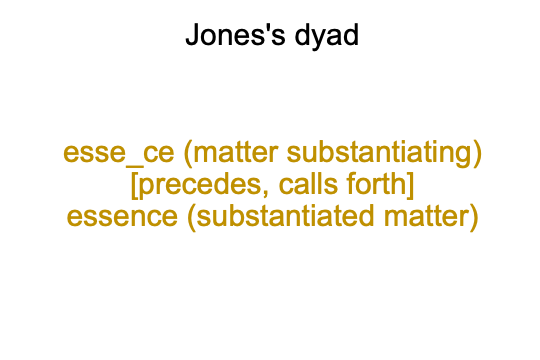
The crucial point is that culture-pressure2b is like life-pressure2b and the perspective-level model1c that is appropriate for this culture-pressure2b is esse_tially semiotic.

Esse_tailly?

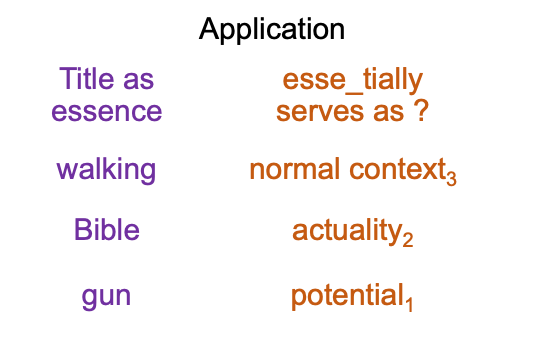
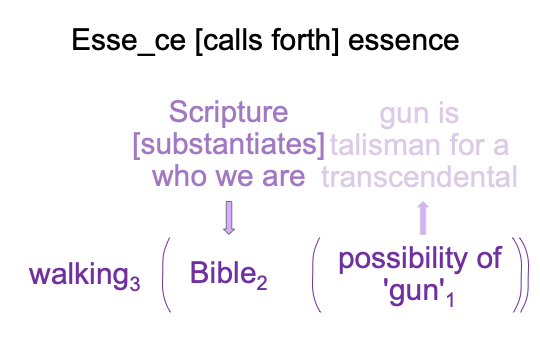
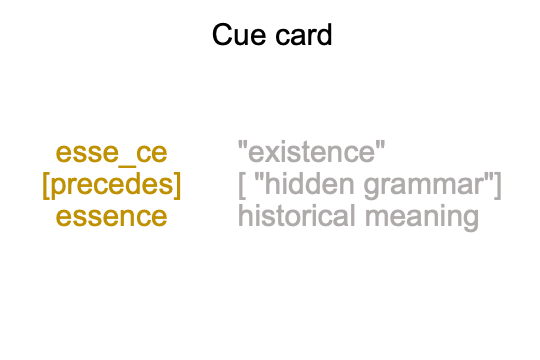
Yes, esse_ce is matter substantiating and essence is substantiated form.

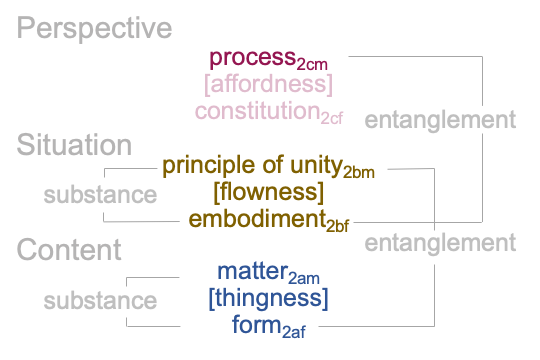
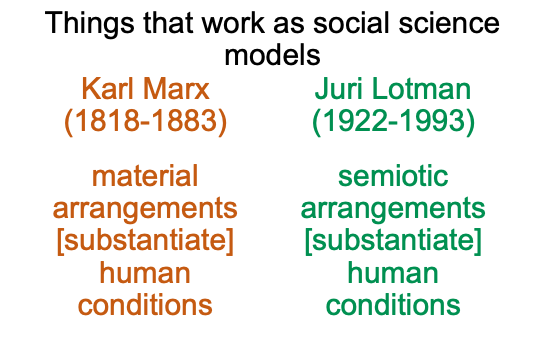
So, semiotic arrangements as matter2cm [substantiate] human conditions as form2cf.

0939 Here is a picture.

0940 Esse_ce is {semiotic arrangements as matter2cm [substantiating]}.

Essence is {[substantiated] human conditions as form2cf}.

0941 Do I need to note that the universe of messages1c is Lotman’s “semiosphere1c“?

0942 The semiosphere1c parallels the concept of biosphere1c.

One can say that the semiosphere1c contains the totality of individual texts and independent languages.  They all relate to one another.

Why?

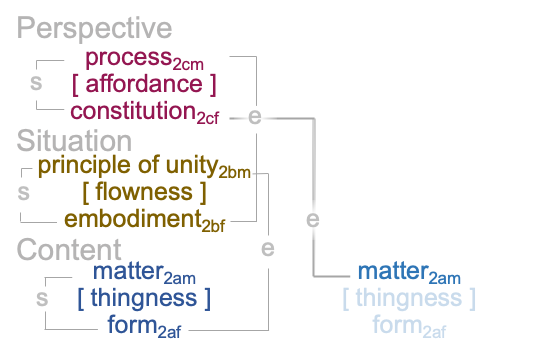
All texts and statements are forms2af that entangle matters of the language of meaning2am.  The presence of the language of meaning2am has the potential1b of engendering the matter of cognition2bm.  Cognition as matter2amsubstantiates social interactions as form2bf.  These forms2bf are contextualized as messages1cA universe of messages1cundergirds the doctrine2c that semiotic arrangements2cm substantiate human conditions2cf, in the normal context of mind theory3c.

0943 And what else?

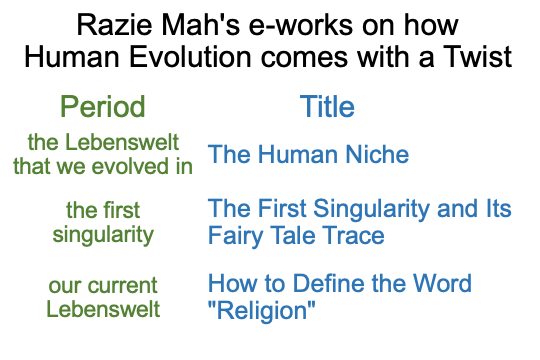
This explanation also applies to the Lebenswelt that we evolved in.  See Razie Mah’s e-book, The Human Niche.   The human niche is the potential of triadic relations.

0944 According to the author, Lotman and Uspenskij agree.

They also disagree.

That is the nature of intellectual discourse and discovery.

The author tells some of the story in a section titled, “How Lotman and Uspenskij influence each other”.

0945 In our current Lebenswelt, cultural studies3b (the situation-level normal context in the derivative interscope) always involve historical processes and texts2bf (situation-level actualities of the fundament interscope).

0946 How so?

The normal context of cultural processes3b brings the dyadic actuality2b of {cognition2bm [substantiates] social interaction2bf} into relation with the possibility of presence1b.

The presence1b of what?

Literary texts2af [entangling] a language of meaning2am.

0947 In the twentieth volume of Sign Systems Studies (1987), Uspenskij publishes “On the problem of the genesis of the Tartu-Moscow School of Semiotics”.

This examination adds value by commenting on Mikhail Trunin’s 2017 review of Uspenskij’s conflation of semiotics and history.

0948 The subtitle of the twenty-fifth volume of Sign Systems Studies (1992), the last volume edited Juri Lotman, is “Semiotics and history”.

Twenty-five years later, the forty fifth volume (2017) contains a special issue on semiotics and history.

0949 Finally, in 2025, Kaveli Kull and Ekaterina Velmezova publish Sphere of Understanding: Tartu Dialogues with Semioticians.  The book contains interviews with several of the figures mentioned in this article (volume 23 of Semiotics, Communication and Cognition, edited by Paul Cobley and Kalevi Kull, Walter De Gruyter, Boston/Berlin).

0950 One wonders whether the Tartu-Moscow School of Semiotics will find a path to a second ascent.

0951 Surely the scenery will differ.

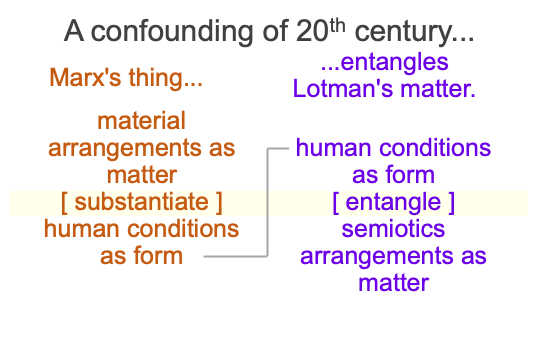
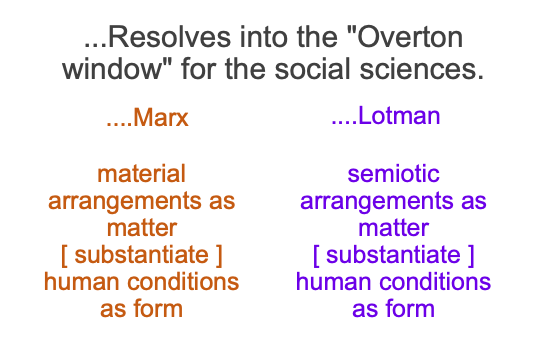
In the first ascent, science is god and {material arrangements [substantiate] human conditions}2c.

In the second, the divine Trinity is God and {semiotic arrangements [substantiate] human conditions}2c.

0952 So, what I am I suggesting?

Is Juri Lotman the Karl Marx of a new era?

History is a species of semiotics.