Looking at Ian Hodder’s Book (2024) “Entangled.” (Part 5 of 22)
0054 In S3C1, Hodder discusses changing definitions of entanglement.
His original proposition, from 2012, associates “entanglement” to four types of relation between humans (H) and things (T). These are (1) humans depend on things (HT), things depends on humans (TH), humans depend on humans (HH), and things depend on things (TT).
0055 This proposition now expands to include flows, as well as things.
0056 This raises the question, which portions of the two-level interscope associate to things?
The situation and content-level actualities do.
Then, what portions associate to humans?
It must be the normal contexts and potentials.
0057 This is sort of confusing. Normal contexts and potentials concern things, but they are really mental processes in humans. Is that another style of “entanglement”? If so, this would be neither sociological or philosophical. It would be psychological and existential.
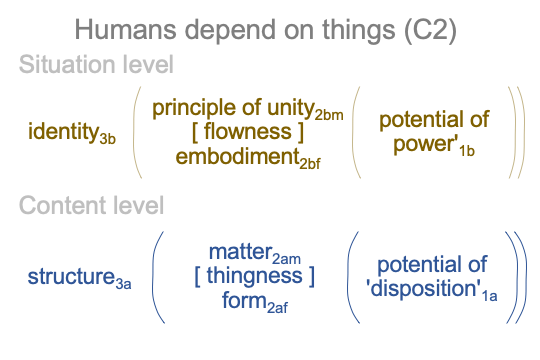
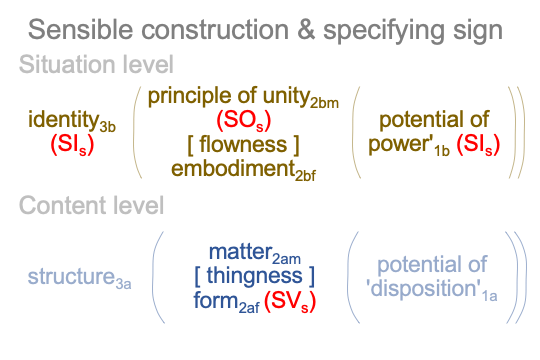
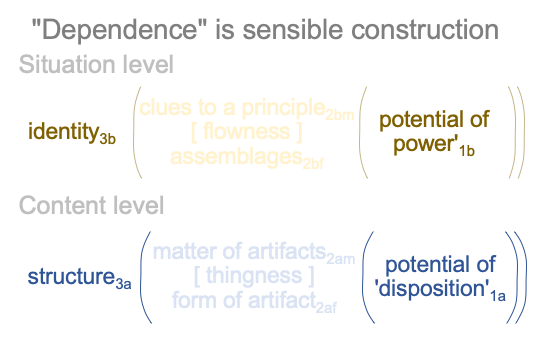
0058 I now proceed with caution into an appreciation that (what Hodder calls) “dependence” engages the normal contexts3 and potentials1 within the following sensible construction.
0059 How do humans depend on a thing2a?
They note its structure3a and what it can do1a. Then, the identify a use3b according to one of its powers1b.
How do things2a depend on humans?
Once the humans use a thing2a, then they will continue to do so until something better comes along. But, that ‘something’ has to be a lot better for humans to make the adjustment.
0060 Hodder mentions how pottery appears in the timeline of the excavation at Catal Hoyuk.
Three phases are present.
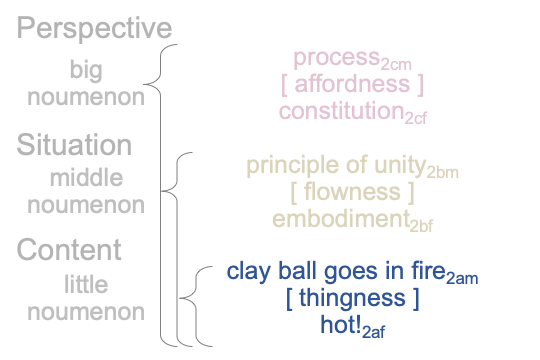
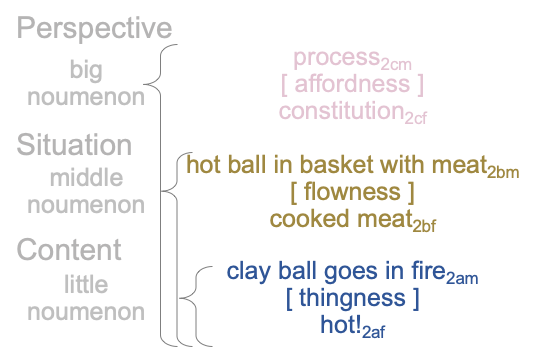
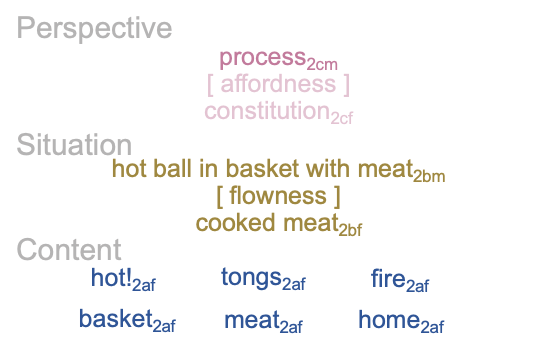
An early phase has little (or no) pottery. But, they use clay for cooking. How? They make clay balls and place them in a cooking fire (in the house with plastered walls). Then, they remove the heated clay ball and place it in a closed basket containing meat. It is a time consuming way to cook. The results are delicious. Today, the process is called “sous vide”.
During a middle phase, pottery is used for cooking meat. It is also used for making yogurt and cheese. Cooking in a pot requires less attention than clay balls. Clay pots are used for cooking and storage.
In the late phase, some pottery gets decorated. Decorated clay pots are used for exchange. Pot stands (used to display decorated pots) become fashionable.
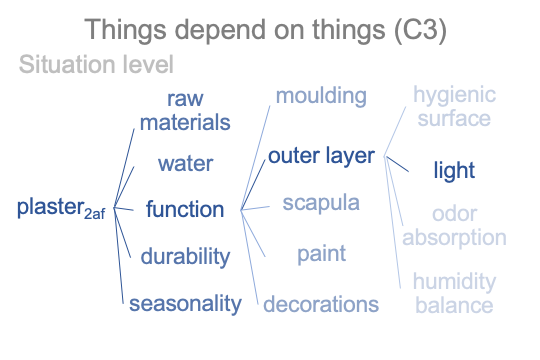
0061 In S4C1, the author discusses the entanglement of things (TT). The clay for clay pots is dug up in an area near the settlement that is also used for grazing sheep. Clearly, the identity3b and structure3a of the resulting holes do not comport with the identity3b and structure3a of grazing sheep. Nothing says “stupid” as much as a sheep and a hole in the ground.
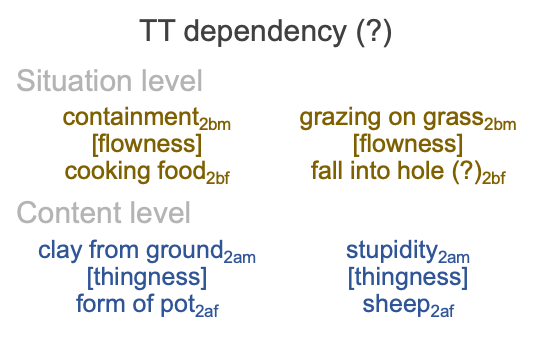
0062 The content and situation levels for clay pots look perfectly sensible. Of course, one would want to obtain clay from a nearby location.
The same levels for sheep do not. Rather than embodiment2bf, sheep stumble into nearby holes dug for clay.
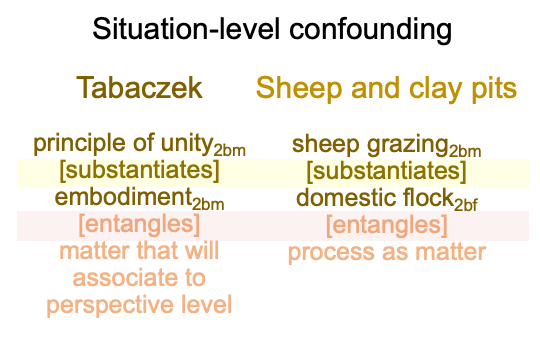
0063 So, there is a situation-level entanglement.
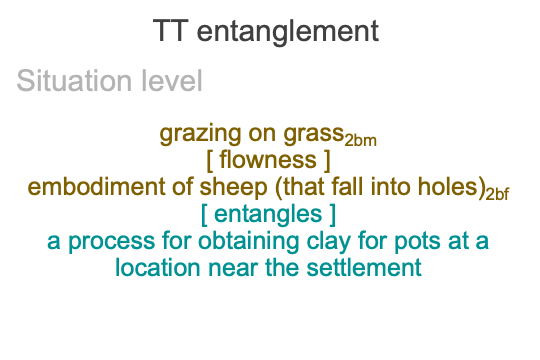
0064 Grazing on grass2bm [substantiates by way of flow] the embodiment of sheep2bf.
The holes that interfere with the embodiment of sheep2bf [entangle] what?
What is entangled?
0065 Surely, the process of making of clay pots (as matter) is entangled with the form of the embodiment of sheep2bf.
The process of making clay pots (as entangled matter) is not the same as containment (as situation-level matter) serving as the principle of unity2bm.
0066 Two steps take place.
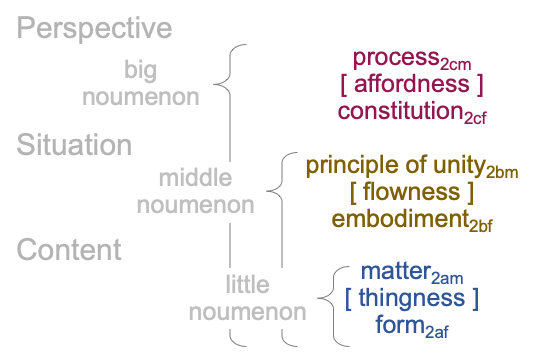
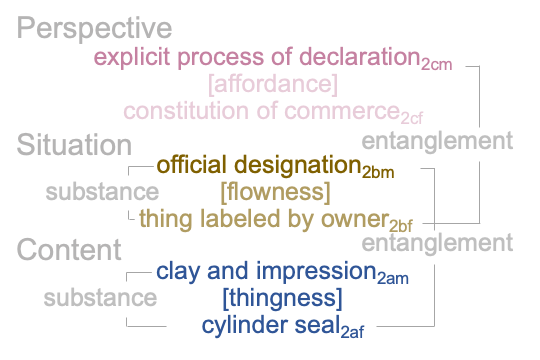
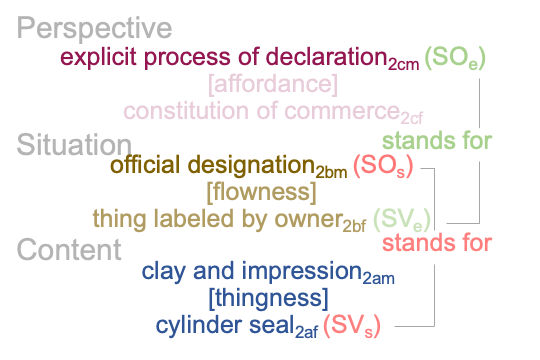
The content-level form2af inspires (through the resolution of a content-level entanglement) a principle of unity2am as situation-level matter. The form of a clay2af pot stands for the principle of containment2bm.
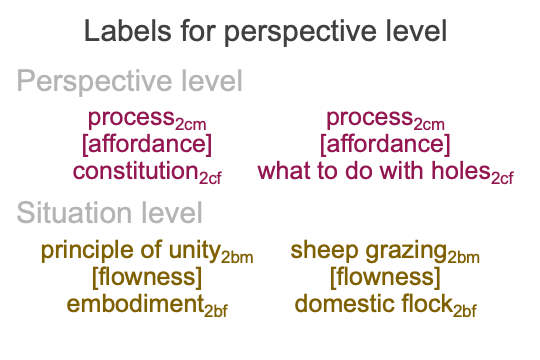
The situation-level form2bf inspires (through the resolution of a situation-level entanglement) a process2cm as perspective-level matter. The embodiment of clay pots2bf stands for the principle of a process2cf whereby clay is obtained from local sources.
0067 For sheep, the form of sheep2af stands for the principle of grazing grass2bm.
The embodiment of sheep2bf stands for the principle of a process2cm whereby sheep are pastured near the settlement.
0068 Thing-thing entanglement (TT) (C3), such as the one between obtaining clay for pots and setting pasture for sheep, implicates a perspective-level form2cf. That perspective-level form2cf must be some kind of agreement, concerning the use of land around the settlement.
Similarly, thing-human entanglement (TH) (C4) produces a mutual dependence between human efforts (processes2cm) and the embodiment of things2bf.
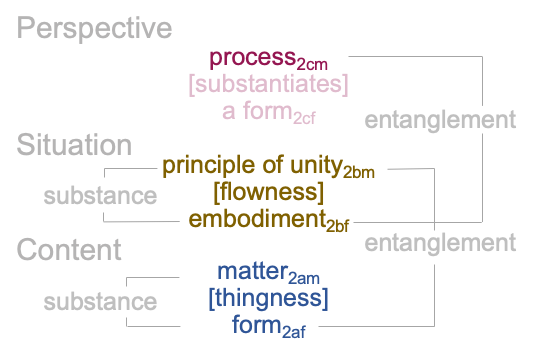
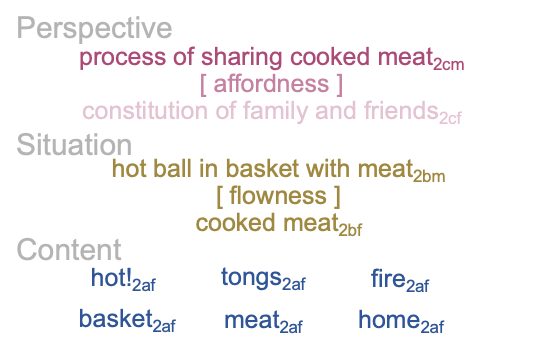
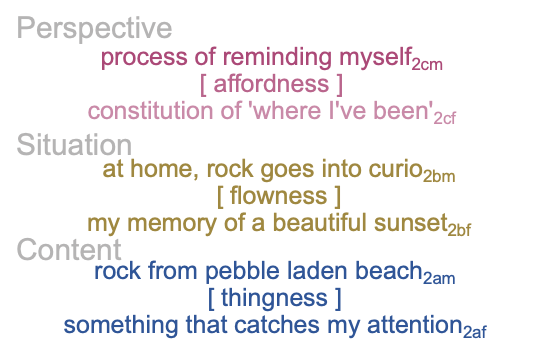
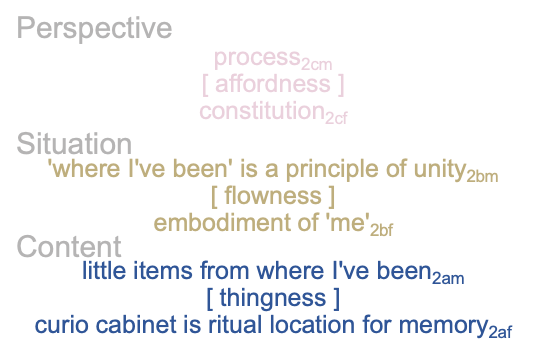
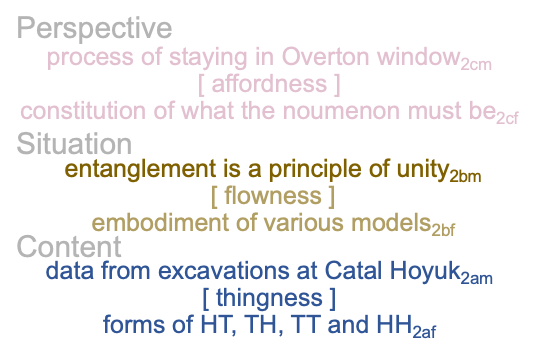
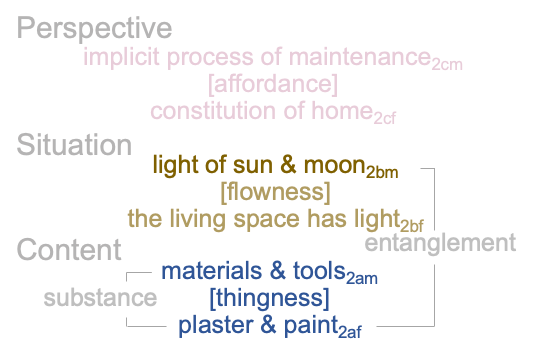
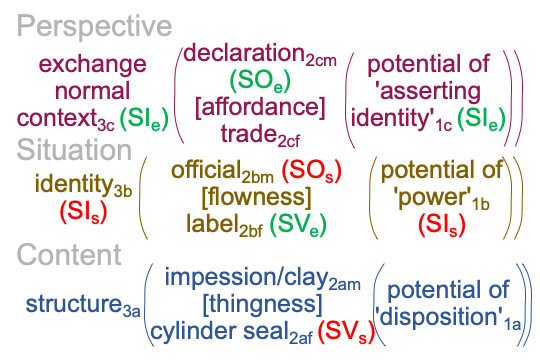
0069 Here is a picture of the result, where the perspective-level actuality2c contains the label “form2cf“.
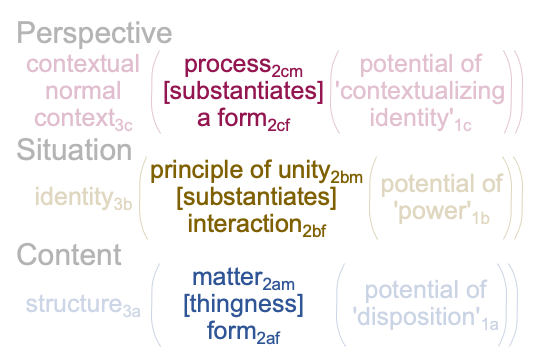
0070 Finally, human-thing entanglement (HT) (C2) may or may not bring processes2cf to awareness, because [thingness] and [flowness] do not question [their perspective-level substance].
For example, an innovation may be required to figure out that one can cook food in a basket by adding clay balls heated in a fire. Once the tradition is established, then there is no reason to deal with the perspective level. The perspective level only comes into play when sensible construction (somehow) does not work well.