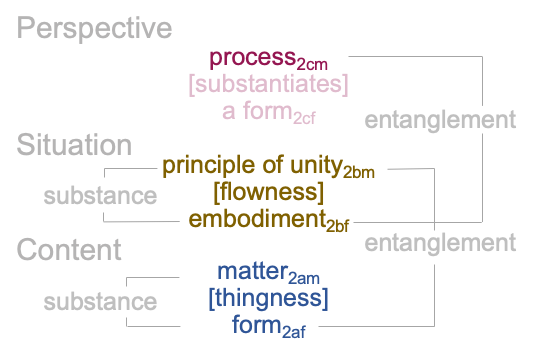
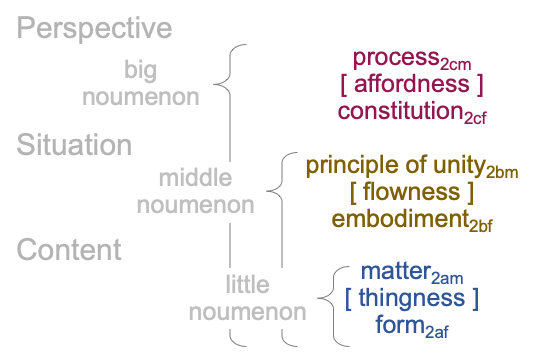
0071 So far, this examination presents a philosophical definition of entanglement that complements Hodder’s use of the term. On top of that, there appears to be two confoundings that resolve in a very specific fashion. The entangled matter actually (in secondness) belongs to the adjacent-higher level than the originating matter.
Here is a picture.
0072 Now, I would like to focus on the second confounding.
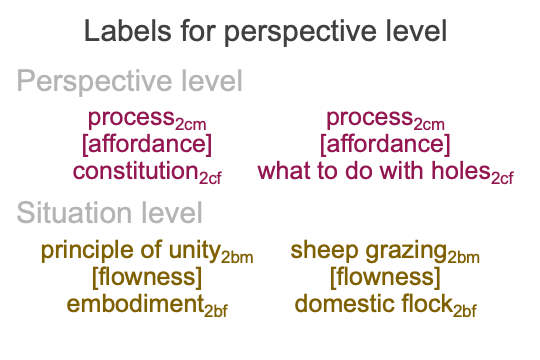
I would like to figure out a satisfying label for the perspective-level form2cf.
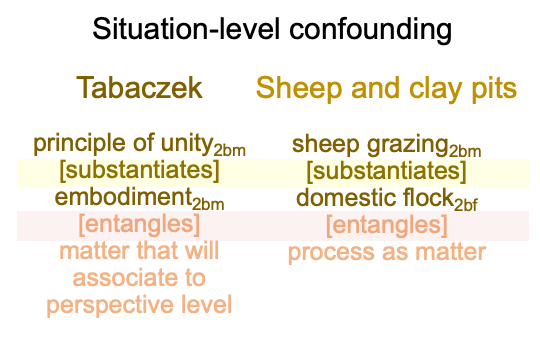
0073 The general structure, as an extension of Tabaczek’s exploration into classical and contemporary hylomorphism, occupies the left side of the following diagram.
The example of sheepand pits dug in the pursuit of good clay occupies the right side.
0074 The author is not clear about this situation with respect to sheep that are grazed in the area that has pits dug out in pursuit of clay. Really, can I expect an answer? Catal Hoyuk goes out of business around 7500 years ago (radiocarbon dating).
There are clues.
Apparently reeds grasses (technically called “phragmites”) proliferate in wet areas, which could correspond to holes dug for clay. In Figure 4.2 (S1C4), the author diagrams a process where reeds are used for roofing. So, maybe the holes were not a problem, after all. Maybe the scenario is even more complicated. Do sheep eat phragmites? I suspect that they do.
So, maybe sheep are not as stupid as I originally imagined.
The ones that go into the pits to eat the reeds, however, might not have a plan for getting out.
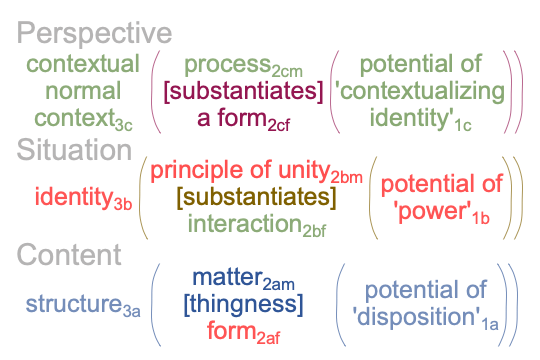
0075 So, humans have to constitute a plan, not an explicit plan, but a habit of action that constitutes a judgment. A process2cm as matter [substantiates] a habit for checking whether sheep cannot get out of holes2cf as form. At the same time, the person checking the sheep can gather a bunch of reeds to keep the rooftop flush.
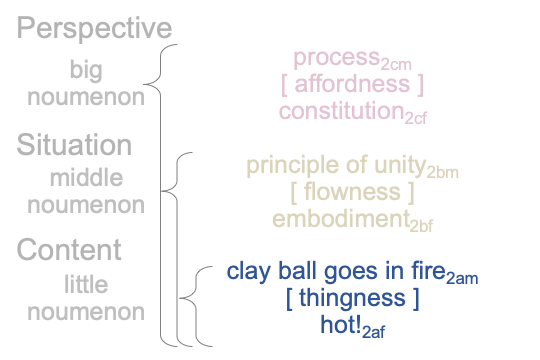
0076 Here my picture of the resolution of the situation-level confounding.
A single process2cm deals with both getting clay for pots2am and the stupidity of sheep2am.
0077 Note that the perspective-level contiguity is not [substantiates]. It is [affordance] or [affordness]. Affordness associates with the niche, which is the potential of ‘an actuality independent of the adapting species’1. Every thing in the digging holes for clay and grazing sheep in the same area saga offers a danger and an opportunity. That danger or opportunity is called an “affordance”. So, the awkward sounding, “affordness”, is not too far removed.
I will try not to fall into the pit of terminology.
0078 Hodder strives to capture a complex and nuanced appreciation of a suite of actualities that associate with the noumenon of archaeology, whose observable and measurable facets (or phenomena) are recorded during excavations.
He has only one word, “entanglement”.
0079 The following actualities come from a Peirce-based rearticulation of chapter one (C1) and touch on chapters two through four (C2-C4), on the basis of a Dominican’s recent survey of post-modern philosophers on the topic of Aristotle’s hylomorphism.
0080 These three actualities may be cast as “sensical2a” (based on the senses), “sensible2b” (based on one’s assessment of the situation) and “social2c” (typically assumed to be operational, but one never knows when sensible construction will fail).
In the above figures, the three actualities are configured as “little2a“, “middle2b” and “big2c” noumenon.
0081 The above figure presents a virtual-nested form in the realm of secondness. The normal contexts3 and potentials1 do not appear, even though I may correctly claim that, without them, the actualities2 cannot be correctly assessed. Fortunately, I know what they are for the content and situation levels, because of Dr. Tabaczek’s fine review. Unfortunately, the perspective-level normal context3c and potential1c remain unlabeled.
0082 What about those clay balls?
In section 2 of chapter 2 (S2C2), Hodder poses some questions.
Do humans depend on clay balls?
Do the clay balls depend on humans?
What does “dependence” mean?
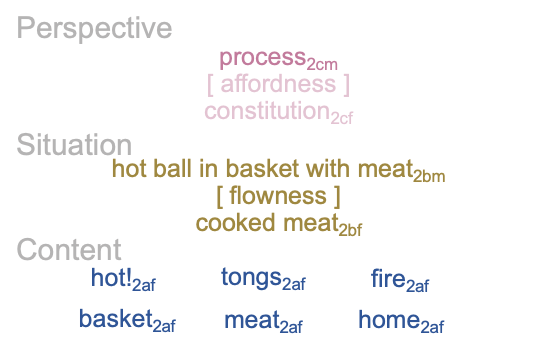
0083 Four items are required: fire, clay ball, basket with lid and a hunk of meat.
Oh, one also needs sticks that will work as “tongs”.
0083 If this is a family-based operation, whoever is in charge of the clay ball must have the skill to “tong” the hot ball.
I don’t think that these sticks have ever been found in the ruins of Catal Hoyuk. The baskets that hot clay balls go into have also not been found.
0084 Here is a picture of the first step for one of those items.
I suspect that archaeologists figure this out by various residues on excavated clay balls. What a hot little noumenon the clay ball is.
0085 The author is completely on target with respect to the tong-wielding person and the clay ball. They depend on one another. That is the story of the first edition. The second edition takes the situation under consideration. The situation entangles things other than the hot clay ball. Other things are necessary for the flow.
0086 The little noumenon entangles matter that enters the middle noumenon.
The entanglement resolves in the substance of flow.
0087 The middle noumenon may be labeled “a two-level interscope” or “a sensible construction”.
The sensible construction includes moments when a less-than-agile cook drops the hot clay ball, sending it rolling across the well plastered floor.
Such an incident does not make the two-level interscope any less sensible.
But, it is funny to imagine.
0088 Peirce’s category of secondness covers the entire drama. But, the inquirer should not forget the attendant elements in thirdness and firstness, that are not included in the above diagram.
0089 Situations may encompass several contents, one for each thing2a. Recall, the normal context3a for each thing is structure3a and the potential1a is ‘disposition’1a. Key to the process2cm is the fact that raw meat2af needs to be cooked.
0090 Let me suppose the following.
A team slaughters one sheep and the family of each team member gets a cut. The archaeologist may build a model optimizing the slaughter of a sheep in terms of the number of families that get a cut of meat and organs. Surely, another team will tan the hide. Another team will process the bones for use as tools. Each team member has family and friends. Plus, each team member must make sure that the down-the-line processors get a cut.
This is why the situation-level forms entangles the perspective-level matter of “process2cm“. Humans depend on humans that know how to handle things. Even with an inconspicuous social hierarchy, social networks are active. Teams are crucial. Every child must compete to join one or more teams. The teams are specialized, not the individuals in the team.
0091 If some teams are more successful in obtaining calories than other teams, when why should a team cooperate with sharing their success with other teams?
That question could not be explicitly abstracted when Catal Hoyuk started. It could be explicitly stated before Catal Hoyuk ended.
The answer is that each team member shares success with family and friends.
0093 This question and answer is outside of the scope of Hodder’s conceptual apparatus. A sociological version of “entanglement” is simply not sufficient to ideate the noumenon that is responsible for the phenomena of an archaeological excavation, especially for a site such as Catal Hoyuk, which begins in one Lebenswelt and ends in another.
0094 Hodder reaches for something that he cannot quite grasp. In a subsection of S2C2, titled “reflective and non-reflective relationships with things”, the author discusses the distance between practical, everyday experience (such as cooking with hot little noumena) and abstract reflective thought (such as what occurs after the cook drops a hot clay ball and it rolls towards the pillar supported by the skull of the cook’s father, which reminds her of her brother, who has a sick child and cannot – by taboo – participate in today’s sheep slaughter, even though he is a member of the team).
0095 Forget the qualifier “abstract”. The qualifier should be “socially constructive”. The wayward ball may have been the ancestor’s way of reminding the cook to socially construct her brother’s condition into the process of dividing the cooked meat. There are always more mouths to feed than any slab of meat can accommodate. Happily, today’s hunk of meat is large. She puts an extra ball into the fire.
She knows that she is a little clumsy with the tongs.
0096 She is both cooking and engaging in reflective thought.
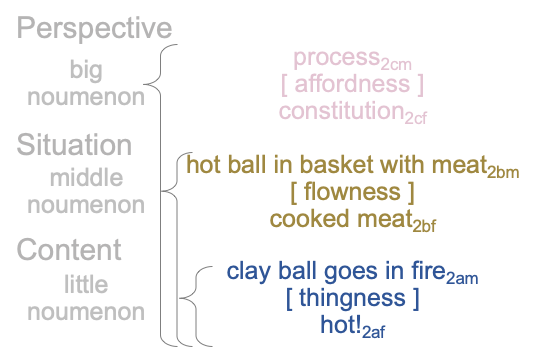
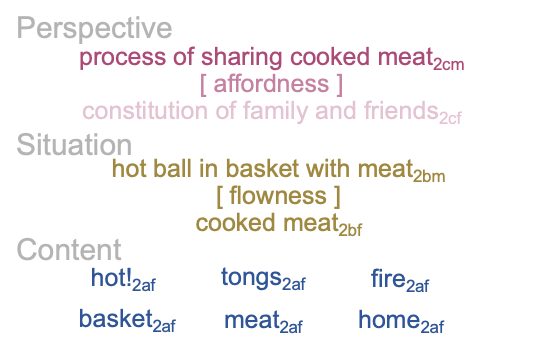
Here is a diagram.
0097 Note how the biological sounding term, “affordance”, is the contiguity between process2cm as matter and consitution2cf as form.
My example has already given away the fact that the perspective-level form2cf will entangle matter2am that brings the story back to the content-level. The cook’s family and friends are already constituted from prior affordances. Yet, the rolling of the dropped hot clay ball serves as a reminder. Think about your father, whose skull holds up this house.
0098 In S3C2, the author admits that the perspective-level thing2c is hard to imagine.
Years of corporate indoctrination… er… “education” have beat the potential to ‘contextualize identity3b and structure3a‘ out of us, only to insert other postulates of inevitability.
The author’s example is a tourist finding a lovely pebble on the beach during a stunningly beautiful sunset. The pebble marks a moment. Heidegger labels the moment “Dasein”.
The English translation is “You had to be there.”
0099 The tourist takes the pebble home, and places it on a tray of travel momentoes in the curio display cabinet.
Perhaps, it is unremarkable among the other travel momentoes. The sunset was so beautiful that it lingers in the tourist’s dreams.
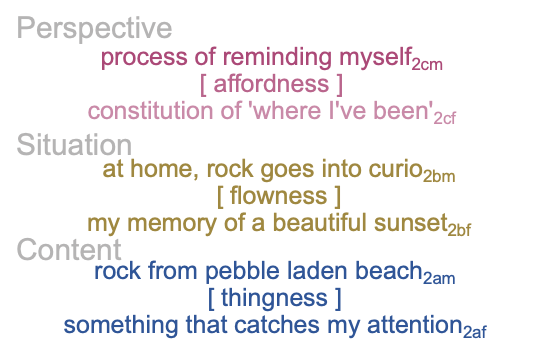
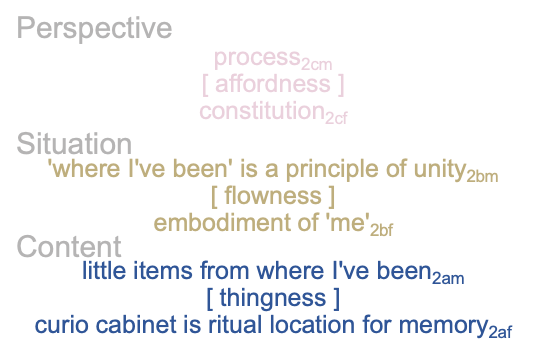
0100 Following the previously developed three-level interscope, here is a diagram of Hodder’s example of “reflective thought”.
0101 Notice anything interesting?
Where are the tourist’s family and friends?
0102 I guess that you had to be there.
The luminosity of Hodder’s theory of entanglement cannot be dimmed by the author’s sociological breakdown of HT, TH, HH and TT distinctions. But, it can be parodied by examples such as this.
0103 The constitution of ‘where I’ve been’2cf stands for little items that I’ve collected and placed in my curio2am.
Plus, the curio cabinet as a ritual location for my travel memories2af stands for the principle that ‘my travels have made me who I am’2bm.
0104 How pathetic is that?
0105 Martin Heidegger (1889-1976) lives through the Second Battle among the Enlightenment Gods, the Hot War among Fraternal Ideologies (1939-1945) as the pre-eminent philosopher in Germany. He gets tagged with working for the losing side. Now, Hodder testifies that Heidegger was wrestling with issues relevant to eighty years in the future.
0106 How does one describe the substance of thingness?
Does the German label, “Dasein”, suffice?
Does the label, “ready to hand”, portray the way that flowness situates thingness.
Does the label, “present to hand”, portray the way that affordance contextualizes flowness?
Peirce’s categories provide a new “language” for speaking the terminology of Martin Heidegger… and… Ian Hodder, for that matter.
0107 Heidegger pays no attention to the writings of the obscure American, Charles Peirce (1839-1914). He has an excuse. He lives in Germany during a civilizational crisis.
Alfred North Whitehead (1861-1947), trains in and teaches mathematics in London before he accepts a professorship at Harvard in 1924 (at the tender age of 63). Harvard University gave him an office near where Charles Peirce’s handwritten papers… er… “unpublished manuscripts” were kept. In 1927, Whitehead publishes Symbolism: Its Meaning and Effects and delivers the Gifford Lectures that are later edited into the volume, Process and Reality. These are the topics of interest to Hodder.
0108 Some of Peirce’s papers were purchased in 1914 by Josiah Royce (1855-1916). When Royce suddenly died… well… that put an end to his efforts. Peirce’s copious notes remained in an office at Harvard.
Replace the terms “little items” and “curio cabinet” in the above figure with “Peirce’s unpublished manuscripts in various empty offices” and “trunks stored in the library at Harvard University”, then adjust the narrative accordingly.
What if… like in a science fiction story… you had access to a curio cabinet where the tokens of memory told their stories to whoever picked them up?
Could anyone become family or friend?
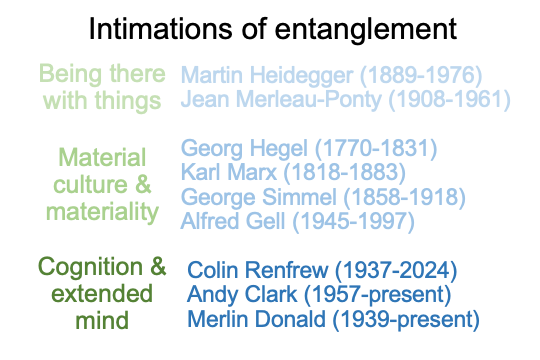
0109 Section three of chapter two (S3C2) considers previous accounts of human dependence on things. The author breaks his discussion into three topics. The list of authors is not exhaustive.
0110 Being there with things concerns phenomenology. “Phenomenology” transliterates into “the logos of phenomena”. This seems strange, because this “logos” (the “word”, so to speak) is the noumenon. To me, Hodder’s treatment of entanglement, including the HT, TH, TT and HH dependencies, does not pose a mechanical or mathematical model. It offers a guess as to what the noumenon must be. Once the noumenon is clarified, then its phenomena can be observed and measured, resulting in positivist models.
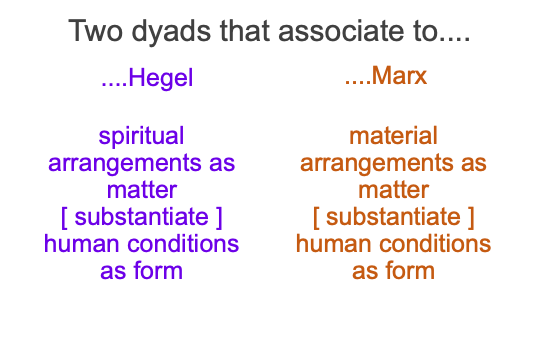
0111 Material culture and materiality includes both Hegel’s thing and Marx’s thing, as well as later proposals by Simmel (on social interaction) and Gell (on agency). In the following, I will only discuss Hegel and Marx.
Why?
They are entangled.
0112 Cognition and extended mind proposals are formulated while regarding recent advances in the neurosciences. Neuroscience research is laboratory-oriented and may regard the human brain as matter and cognition as form.
0113 To me, the brain-cognition thing associates to – what Hegel called – spiritual arrangements. It is just like the hot clay ball rolling towards the one pillar of the house that is “supported” by the skull of the cook’s father, recovered after decomposition, then covered with plaster.
One cannot deny the material arrangements of cooking a slab of meat. At the same time, the rolling ball signifies another situation, where her brother’s son is like the rolling clay ball and her brother must now deal with it. The agency of the ball speaks in tongs.
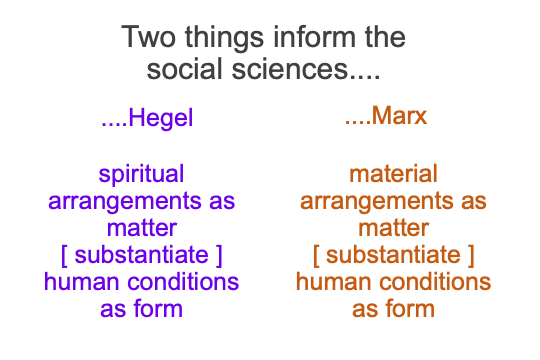
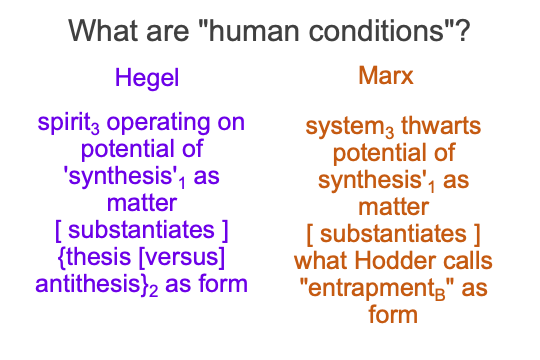
0114 Here are diagrams of Hegel’s and Marx’s things.
0115 While onlookers may offer smelling salts to philosophers who swoon over these simplifications, allow me to refer to Razie Mah’s blogs for December 2025, which details the entanglement of the things of Karl Marx (1818-1883) and Juri Lotman (1922-1993). These two things, one materialist and one semiotic, also appear to be diametrically opposed.
They are not. They are entangled. Some of the implications are discussed by Razie Mah in four blogs posted on January 1, 2026 titled, Looking at Melinda A. Zeder’s Article (2025) “Unpacking the Neolithic”.
0116 As it turns out, Marx’s and Lotman’s things constitute a new Overton window for postmodern archaeology.
Does that mean that the above figure depicts the old Overton window?
I guess that depends how how one defines the term, “Overton window”.
Otherwise, the answer is “yes”.
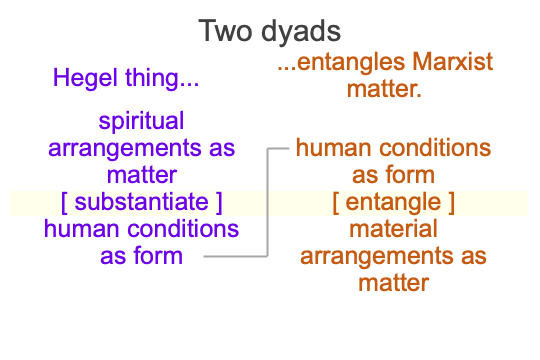
0117 So how does Hegel’s thing end up entangling Marxist matter?
Here is a picture.
0118 Hegel’s and Marx’s things game the empirio-schematic judgment, in so far as they both consist of two contiguous real elements, which precisely fits Peirce’s category of secondness. Secondness is the realm of actuality.
In the empirio-schematic judgment, a disciplinary language (relation, thirdness) brings mathematical and mechanical models (what ought to be, secondness) into relation with observations and measurements of phenomena (what is, firstness). Note that mathematical and mechanical models are imbued with secondness, the realm of actuality. This makes sense, because there are real elements on either side of an equal sign for any equation. Mechanical models manifest cause and effect in truncated material and efficient manners.
Truncated?
The formal and final attributes of material and efficient causation go into the trunk.
The trunk ate it.
0119 Hegel’s and Marx’s things cannot be mechanically or mathematically modeled, even though anthropologists go to great lengths to imagine that they do. That is because they are not models (in the natural science sense of the term). They are expressions of what the noumenon must be.
0120 What does that imply?
If phenomena are observable and measurable facets of their noumenon, and if the noumenon is not as obvious for the social sciences as it is for the physical sciences, then social scientists measure phenomena on the basis of what the noumenon must be.
0121 What better way to assess what the noumenon must be than to theoretically structure a social-science noumenon according to the structure of Peirce’s secondness?
Aristotle’s hylomorphe is an exemplar of Peirce’s secondness.
So are Hegel’s and Marx’s things.
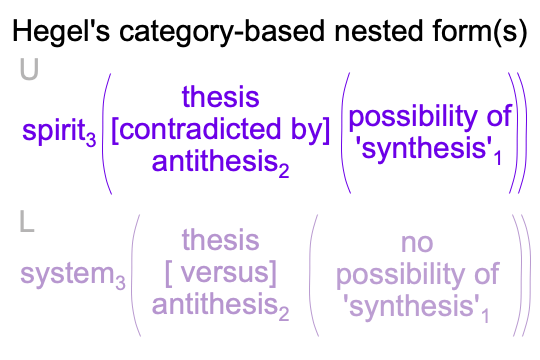
0122 Georg Wilhelm Friedrich Hegel is the first to propose a dyadic structure as a social noumenon. Hegel’s thing reifies his insight that the normal context of a spirit3 brings the actuality of a historical contradiction of any thesis by an antithesis2 into relation with the possibility of ‘synthesis’1.
History goes like this. First, there is a thesis. Then, contradictions within the thesis inspires an antithesis. Then, for the longest time, people attuned to the thesis battle people attuned to the antithesis. Then, the apparently insoluble conflict is put into context by a spirit3 operating on the potential of a synthesis1. That synthesis1 becomes the thesis2 as a new system3 constellates.
0123 Here is a picture of Hegel’s category-based nested form.
I should say “forms”, because there are two of them (U and L).
0124 Now, I depict the trajectory of a historical entanglement and its resolution.
0125 The upper category-based nested form (U) describes the civilizational changes that fascinated Hegel.
0126 How does this nested form pack into Hegel’s thing?
To me, the normal context of spirit3 and the potential of ‘synthesis’1 go into matter that substantiate the long-lived “human condition”, where thesis and antithesis are locked in contradiction2 as form.
0127 So, the overall picture of the human condition2 (as form) is that the spirit3 and its synthesis1, which created our Zeitgeist in a remarkable thesis, must be preserved (as matter), but is subject to disagreements about what this remarkable insight really means (as form, again).
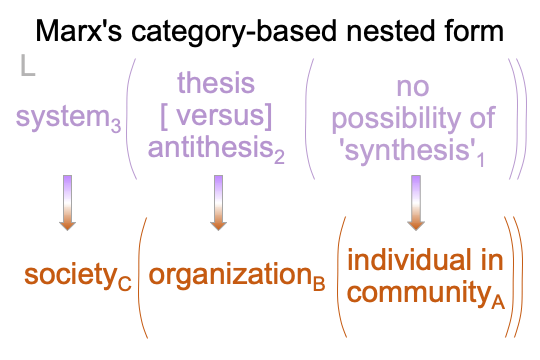
0128 The lower category-based nested form (L) describes a civilizational stasis that Marx instantly recognized.
If Hegel’s spirit3 operates on the possibility of ‘synthesis’1, then a civilization-exploiting elite3 will try to ensure that there is no possible resolution1 to the social conflict2 that their party benefits from.
0129 An elite party infiltrates institutions in societyC. Then, elite institutionsC promulgate a thesis that calls for individuals in communityA to join organizationsB that are under management by the elitesC. Individuals resisting material and instrumental exploitation in an organizational setting produce the antithesis, which unfortunately, gets co-opted by the elite.
0130 So, a thesis is promulgated by elites and its antithesis is co-opted by elites. The result is that the spirit3 cannot constellate a synthesis1. The system3 continues as long as there is no potential for a ‘synthesis’ that collapses the promulgated thesis and its co-opted antithesis.
Perhaps, the best way to thwart the spirit3 is to obsessively focus on material arrangements.
Imagine someone so twisted as to propose that material arrangements are … um… spiritual arrangements.
Imagine the education required forth that.
0131 To me, the downside of Hegel’s nested form (that is, the Marxist nested form) overlays a three-tier nested form, where the societyC tierbrings the organizationB tier into relation with the potential of ‘the individual in communityA tier‘.
Hmmm, maybe I am off target in that impression.
The condition of the individual looks bleak, to say the least.
0132 The upper and lower (U and L) category-based nested forms can reify into things. Clearly, Hegel’s and Marx’s things are different, because each focuses on one or the other version of two entangled category-based nested forms.
0133 I derive Hegel’s and Marx’s things from their category-based nested forms for two reasons.
First, the discussion shows that not all confoundings resolve into interscopes. There are many ways for a confounding to resolve. For this reason, confoundings can present opportunities and dangers.
Second, Hodder’s argument is bound between these two things.
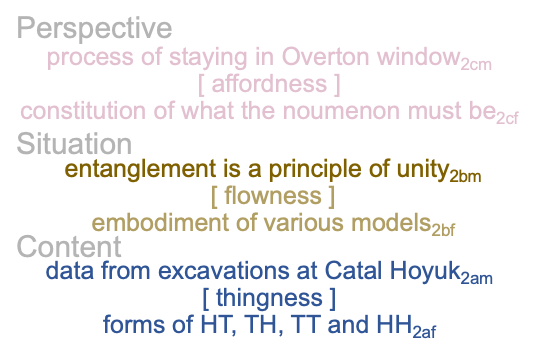
0134 In other words, Hegel’s and Marx’s things2c constitute the Overton window2a for Hodder’s discussion of entanglement as a principle of unity2bm.
0135 Of course, my digression into the phenomenology of Hodder’s early chapters, may seem a little shocking, especially the part about the author’s cognitive processing2cm staying within the bounds of an Overton window framed by Hegel and Marx.
0136 To me, the text tells the tale.
For example, the title of chapter 2 (C2), “Humans Depend on Things”, reflects Hegel’s thing, because humans provide the spiritual3 (or cognitive3) synthesis1 that substantiates processes (theses) in the face of difficulties (anti-theses)2.
The titles of chapter three (C3), “Things Depend on Other Things”, and four (C4), “Things Depend on Humans”, reflects Marx’s point of view, because the interdependence of established things and the vulnerability of established things draw people into organizationB.
The title of chapter five (C5) “Humans Depend on Humans” completes the transit from Hegel to Marx by suggesting that a systemC that thwarts the potential of ‘escaping from a sociological entanglement’A transforms entanglementB into entrapmentB.
0137 Read on, because the path from Hegel to Marx overlays a much more significant, semiotic, turn.
0138 Now, I consider chapters three and four (C3 and C4) in earnest.
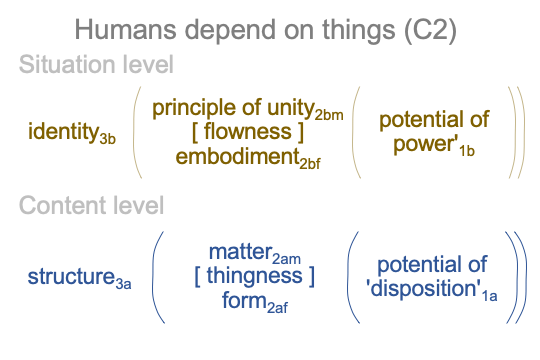
0139 Do humans depend on things (C2)?
Archaeology, unlike many of the contemporary humanities, must reach out to the empirical (or “natural” or “physical and biological”) sciences in order to figure out how humans convert stuff2am into artifacts2af in the normal context of structure3a, operating on the potential of ‘the dispositions of things’1a.
0140 Humans depend on things2a to structure3a their lives3b (identities3b).
0141 This dependence has a deep evolutionary history. Unfortunately… or some would say… fortunately, stone tools serve as archaeological evidence for human entanglement with things.
Stone tools are the tip of an iceberg of adaptive tool-use.
If Michael Tomasello is on target in saying that our genus evolves under conditions of obligatory collaborative foraging (especially in the span from bipedalism to the domestication of fire), followed by adding obligatory social-circle harmonizing (from the domestication of fire to say… 8800 years ago), then there are two social circles strongly concerned with things. These social circles are the team (15) and the community (150).
0142 Razie Mah’s two-part e-book, Comments on Michael Tomasello’s Arc of Inquiry (1999-2019) serves as a reference.
0143 Our ancestors adapt, not to “things themselves”, but to the category-based nested forms that treat things2a as {matter [substantiating] form}2a.
0144 Hodder’s great insight is that things entangle humans in mutual dependencies (C4).
This includes the fact that one thing2a, such as a composite tool made of stone and wood, may depend on many things (C3). A thing may depend on the sequence in which it is made. There is an art to structuring3a a thing2a according to the dispositions of its ingredients1a.
0145 Structure3a is situated by the power1b to do something based on a principle of unity2bm. That unity2bm substantiates the embodiment of a composite tool2bf. The form2bf“formalizes” an identity3b. Identity3b also applies to the person3b affiliated with the tool2bf.
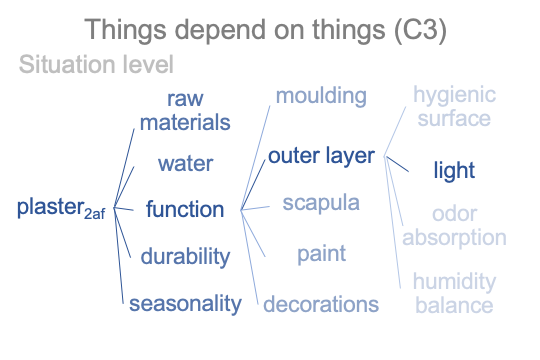
0146 In order to portray the idea that things depend on things (as well as their dispositions1a), the author presents Figure 3.2, containing a network of things2a and qualities1a associated with wall plaster in the houses at Catal Hoyuk. Here is my reproduction of a portion.
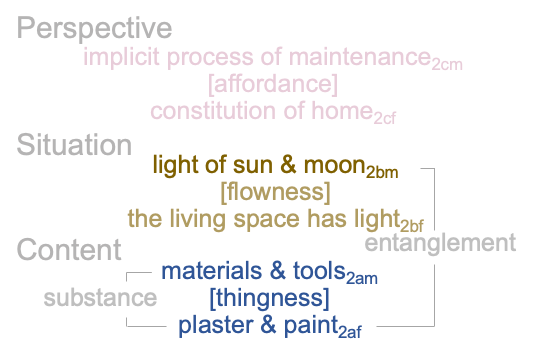
0147 My selection of items emphasizes that one of the functions of plaster as a wall outer layer is to support paint that turns the wall white, allowing daylight and moonlight to illuminate living spaces. Each of these items associate to one of the six elements in the two-level interscope of structure3a and identity3b.
0148 The two-level interscope is a sensible construction. Sensible construction presumes that a perspective level applies, even though one cannot articulate what the perspective-level may be.
Sensible construction resolves a content-level entanglement.
0149 I want to add two points (O and P).
0150 First (O), the sensible construction involves only implicit abstraction, as opposed to explicit abstraction. Razie Mah’s Primer on Implicit and Explicit Abstraction applies here. Implicit abstraction is an adaptation that exploits two of Peirce’s three natural signs: icon and index.
All signs are triadic relations where a sign-vehicle (SV) stands for a sign-object (SO) in regards to a sign-interpretant (SI). Icons are natural signs where the sign-object (SO) is based on imagery, similarity, pantomime, and so forth. Indexes are natural signs where the sign-object is based on contiguity, indication, pointing, and so forth. Icons and indexes associate to implicit abstraction because their sign-vehicles appear to image and indicate their referents, even after routinization (which is where the third natural sign, symbol, comes into play. Symbols are natural signs where the sign-object is based on habit, agreement, convention and so on.)
0151 Second, Latin Age scholastics were interested in distinguishing ens reale (mind-independent being, associated with things) and ens rationis (mind-dependent being, associated with humans). Only in the 1600s, after over three centuries of debate, do the scholastics (who are now labeled “Baroque”, because, like late-modern Spain, they ended up “broke”) come up with the definition of the sign as a triadic relation. Charles Peirce figures out his definition from reading the Baroque scholastics.
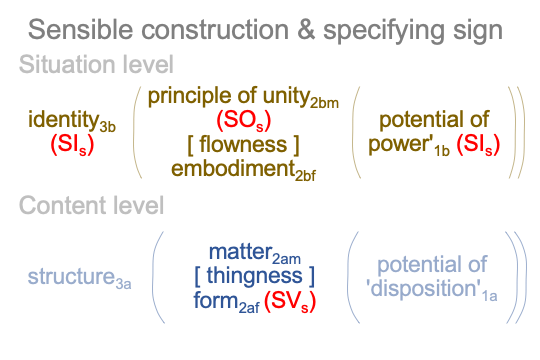
The scholastics are of interest because they explicitly distinguished two of the three sign-relations that are contained within a three-level interscope. In particular, the specifying sign-relation (technically called “specificative extrinsic or intrinsic formal causality”) associates to sensible construction in the following manner.
0152 The reference is Razie Mah’s blog for October 2023, titled Looking at John Deely’s Book (2010) “Semiotic Animal”.
0153 For the ongoing example, for the households of Catal Hoyuk, plaster and paint2af (SVs) stands for the light of the sun and moon entering the home2bm (SOs) in regards to the identity of the home3aoperating on ‘the power of the surfacing to scatter light through its whiteness’1b (SIs).
0154 This connection is crucial, because it shows that Hodder’s thesis has evolutionary roots as deep as hand talk. Hand talk is an adaptation to team activities, particularly in the span from the start of bipedalism to the domestication of fire. This early stage is pre-linguistic because it only allows sensible construction. It operates solely on the basis of specifying sign-relations.
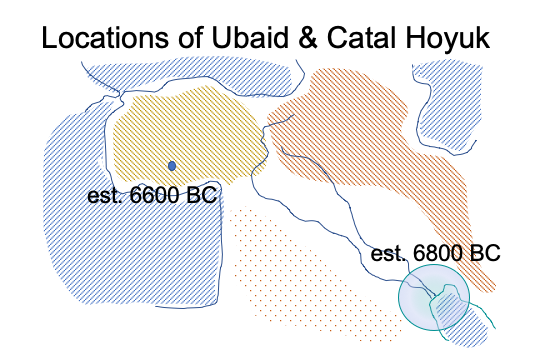
0155 The supposition that words picture or point to their referents is so deeply ingrained in the human evolutionary experience, that today, when an inquirer hears the word, “entanglement”, the presumption is that the form of the spoken term2af (SVs) stands for a principle that gives unity2bm to a real embodiment2bf (SOs) in regards to the word’s identity3a operating on the potential of ‘the power of the spoken word’1b(SIs).
0156 Specifically, the forms of HT, TH, TT and HH dependencies2af (SVs) stand for entanglement as a principle of unity2bm (SOs) in regards to hominin identity3a operating on the potential of ‘human powers1b (SIs).
0157 Chapter three (C3) concludes with a set-aside description of the archaeological site (anglicized to) Catal Hoyuk, located in central Anatolia (Turkey). The site flourished between 7400 and 6000 BC. An adjacent site (Catal Hoyuk West) started around 6000 BC and ended around 5500 BC. At its peak, the settlement is very large, but it has no streets. People traveled to their homes by walking on roof tops.
0158 Dr. Hodder was in charge of the excavation for many years. His publications on this topic span from 1996 to 2022.
0159 Catal Hoyuk consists of houses with refuse or midden sandwiched between them. There are no public administrative centers. There are no ceremonial platforms. There is plenty of evidence for a spiritual dimension in the people, because they buried their ancestors beneath their floors and adorned their walls with bones of bulls.
0160 In terms of the archaeological periods for the Levant, Catal Hoyuk corresponds to the pre-pottery B and C periods as well as the Pottery Neolithic. Radiocarbon-14 dating has been used to establish a time frame for twelve levels and four “pre-levels”.
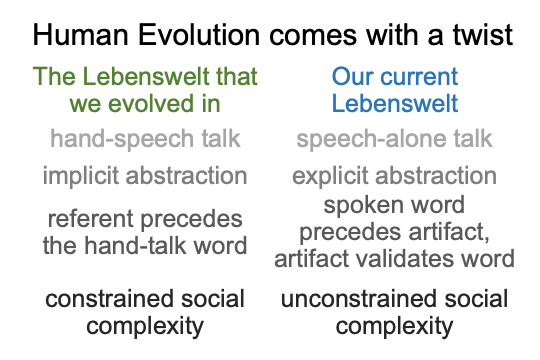
0161 A distinct change occurs with respect to pottery. Levels XII through X (say, 7100-6700 BC) contain little pottery, even though clay balls are used for cooking. Levels IX and VIII are difficult to assess. Cooking pottery is apparent in level VII (around 6610-6520 BC). At the same time, there is a shift in building material (to sandier bricks).
The site seems to prosper in levels VII and VI, reaching its greatest density and house packing. Then, there is a break, followed by the building of more elaborate houses, with areas devoted to storage and production. Stamp seals are found. The range of pottery types expands. After level V (say, 6300 BC) there is evidence for the domestication of cattle (definitely for Catal Hoyuk West) along with more intensive use of the secondary products (milk and wool) of sheep and goats.
0162 The placement of the special section on Catal Hoyuk is interesting.
It comes after chapter two (C2, “Humans Depend on Things”) and at the end of chapter three (C3, “Things Depend of Other Things”).
It comes before chapter four (C4, “Things Depend of Humans”) and chapter five (C5, “Human-Human Entanglement”).
0163 Does the author unwittingly signal a transition in the human Lebenswelt, from a Lebenswelt that is evolutionarily ancient (marked by implicit abstraction) to a Lebenswelt that is technically novel (marked by explicit abstraction)?
0164 I think so.
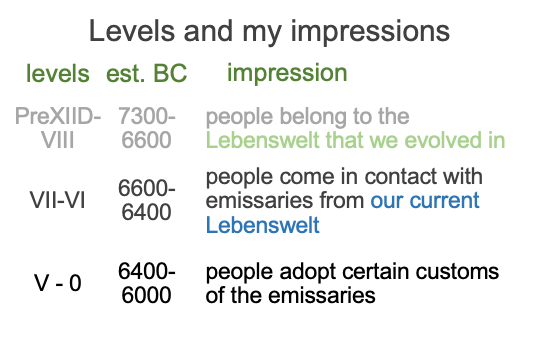
Here is my breakdown of the levels at Catal Hoyuk, estimating the (radiocarbon) dates from the figures in C3.
0165 Why do I suggest this possibility?
Where do these emissaries from our current Lebenswelt come from?
0166 The scientific proposal is found in Razie Mah’s e-work, The First Singularity and Its Fairy Tale Trace. A dramatic exposition is found in An Archaeology of the Fall.
0167 Nonetheless, I offer a brief synopsis.
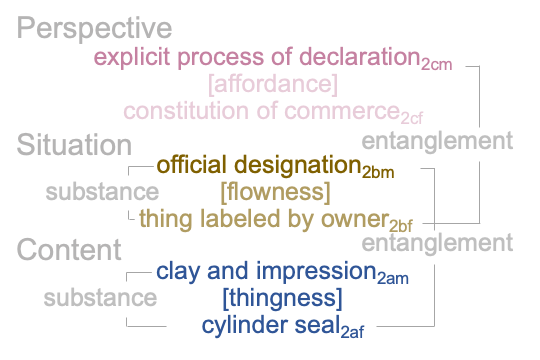
The hypothesis of the first singularity has two parts (P and Q).
0168 First (P), fully linguistic hand talk evolves after the domestication of fire, around 600kyr (thousands of years ago). It is an adaptation to the social circle of the community, the team of teams. See Razie Mah’s e-works The Human Niche (plus attendant reviews) as well as the two-part Comments on Michael Tomasello’s Arc of Inquiry (1999-2019). These were placed on sale in 2018 and 2024, respectively.
0169 Speech is added to hand talk with the evolution of our species, Homo sapiens, around 300kyr. The voice is initially added to hand-talk as an adornment. Then, speech begins to take on a life of its own, because the semiotic qualities of speech are significantly different than hand-talk. By the time when animal and plant domestication begins (maybe 15kyr), speech talk and hand talk are two complementary modes for talking. I call this “hand-speech talk”. The use of voice or manual-brachial gesture depends on tradition.
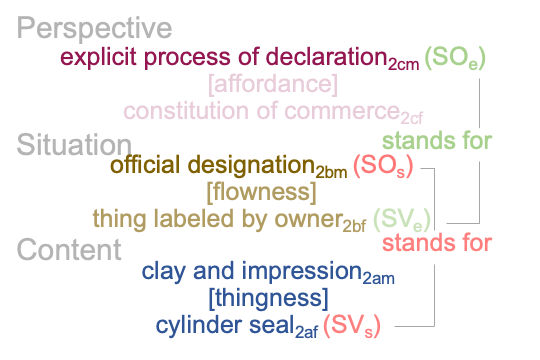
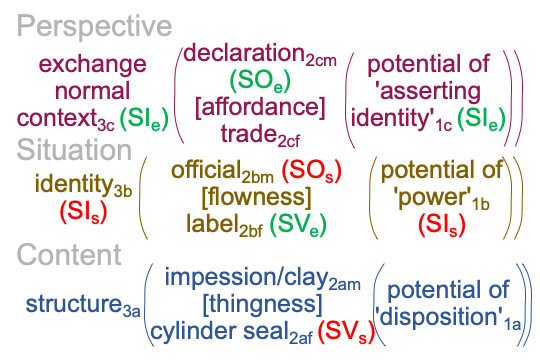
For a reference, consider Razie Mah’s e-work Synaesthesia and the Bicameral Mind in Human Evolution, editing Mah’s blogs from October and November, 2025.
0170 By 10kyr, all human cultures practice hand-speech talk and have been doing so for as hundreds of thousands of years. These cultures belong to the Lebenswelt that we evolved in. Hand-speech talk exhibits the semiotic qualities of icons and indexes and facilitates implicit, rather than explicit, abstraction.
0171 Crucially, hand-talk words are not labels. They are images and indications. Therefore, the referent precedes the hand-talk word in such a fashion that its attributes enter into word meaning. For example, the hand-talk word, [image RAVEN], may indicate a type of bird or the color black, depending on the context. The linguistic dynamics of hand-speech talk have not been investigated because… well… all civilizations practice speech-alone talk. Only a few monographs have been published on the (last remaining and maybe already dead) hand-speech languages of the North American Plains Indians and the Australian Aborigines.
0172 I am still on the first point (P).
In contrast, speech-alone talk is fully symbolic. It cannot picture or point to its referents. So, humans in our current Lebenswelt have followed a script, based on their phenotypic expectations about the nature of reference in hand talk. If a spoken word exists, then there must be a referent. This is precisely the expectation that phenomenology relies on, when someone (such as Ian Hodder) proposes a word, such as “entanglement”, as a label for the form of four dependencies: HT, TT, TH and HH.
0173 Here is a picture of the difference between the Lebenswelt that we evolved in and our current Lebenswelt.
0174 Second (Q), the cultural transition from hand-speech talk to speech-alone talk must have an “initial moment”, so to speak. No one thinks, “Why do we keep practicing the hand-component of our hand-speech talk?”, because every important word in that question is an explicit abstraction.
0175 Razie Mah identifies the Ubaid of southern Mesopotamia on the basis of a sequence of speculations. One culture forms from two hand-speech talking cultures originally living in the dry land of what is now called the… um… “Arabian”… or is it “Persian”?… Gulf. That dry land is flooded with the rise of the seas, with a nominal date around 6800 B.C. The two cultures, forced into the same territory, on the edges of the rapidly expanding Gulf, fuse, creating a pidgin, then a creole, the Sumerian language. This creole is the first language based on speech-alone talk.
The Sumerian language is called an “isolate”, because it is unrelated to any family of languages. This is what one expects for a creole.
0176 Now, I can jump to Dr. Hodder’s research, because the crucial transition starting in level VII occurs only 200 years after the fastest rise of the sea levels that, for Mah’s hypothesis, marks the constellation of the speech-alone talking Ubaid culture.
0177 Level VII may indicate first contact with speech-alone talking emissaries from a culture that is already more wealthy (from labor specialization) and more powerful (from social specialization) than the hand-speech talking culture of Catal Hoyuk. Plus, they bring pottery. They want to spread the word, along with a few recipes.
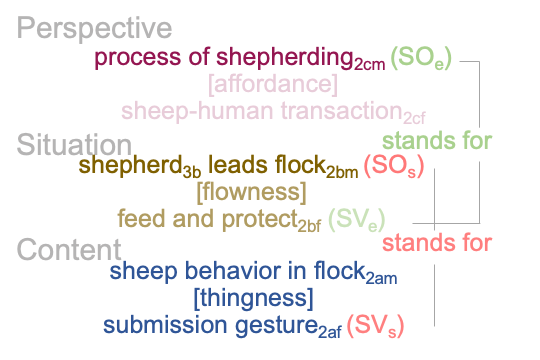
0178 Chapter four (C4) is titled, “Things Depend on Humans”.
This chapter follows the break-out section on Catal Hoyuk.
0179 Over time, things fall apart. The author provides examples from England, where stone walls, marking the boundaries of fields, are inherently unstable. He describes the use of internal buttresses to stabilize walls in level III to I of Catal Hoyuk, as well as the Chalcolithic west mound (dating 6000 to 5500BC).
0180 To me, internal buttressing of walls may require explicit abstraction.
The smelting of copper probably entails specific recipes (serving as explicit abstractions).
The cylinder seals found at the site definitely indicate explicit abstraction.
0181 Nothing says, “Things depend on humans.”, like ownership.
That is what cylinder seals are all about. They are used to seal lists of goods as well as other documentation associated with ownership and transfer of ownership.
0182 Cylinder seals are things that depend on humans.
There are two confoundings in the following virtual nested form in the category of secondness.
0183 In the first confounding, clay and a specific impression2am [thingness] a cylinder seal2af and the cylinder seal2af [entangles] the matter of an official designation2bm. Each element demands an explicit abstraction. What is the image on the seal? What does it designate?
In the second confounding, the official designation2bm [flowness] the embodiment of a thing that is labeled (with a sealed stamp) by its owner2bf and that label2bf [entangles] the matter of an explicit process of declaration2cm, that is, a process by which ownership is explicitly asserted.
0184 That is not all.
I already mentioned that sign-relations are built into the three-level interscope (points 150-156).
I explicitly detailed the specifying sign-relation.
0185 The two confoundings for cylinder seals correspond to the specifying (subscript “s”) and exemplar (subscript “e”) sign-relations. Here is a picture the sign-vehicles (SV) and sign-objects SO).
0186 Finally, all the elements of the specifying and exemplar sign-relations are labeled in the following three-level interscope.
0187 In the Lebenswelt that we evolved in, the elements of two sign-relations cannot be labeled with the gestural words of hand- or hand-speech talk. Instead, the sign-relations are simply performed. These sign-relations are adaptations into a niche composed of the potential of triadic relations. This biological proposal is set forth in Razie Mah’s e-book, The Human Niche (2018).
0188 In our current Lebenswelt,elements of the two sign-relations can be labeled with speech-alone words. The production of the seal (from thingness to flowness, so to speak) touches base with labor specialization. Not just anyone can fashion a cylinder seal for use. The embodiment of the label on a thing (from flowness to affordness, so to speak) touches base with social specialization.
0189 To me, the author – not even consciously – transits from a world where families build their own homes in a marvelously productive location (C2 and C3) to a world where social and labor specializations create things that depend on their… um… continued interventions to prevent the created things from falling apart (C4 and C5).
What was once an intrinsic manifestation of the three-level interscope of thingness, flowness and affordness shifts to extrinsically arranged specialties organized to maintain cultural traditions.
The intuitively obvious transitions into entrapment.
0191 The disciplines that deal with these topics include behavioral archaeology (S3C4) and material science (S2 and S3, C4).
0192 For example, these sciences try to figure out how the people of Catal Hoyuk dealt with refuse. These experts see attempts at refuse organization throughout the Levant in the PPNB. House floors are swept clean. Middens outside the settlement are established. This occurs without signs of social or labor specialization, long before the Ubaid of southern Mesopotamia appears on the scene.
0193 Behavioral ecology (S4C4) studies the domestication of plants and animals. Plant domestication is well underway before the sea-level rise. Cereals, lentils, fruit trees, and tubers respond to selective use and care by humans, consistent with Darwinian analysis. Humans offer a novel niche to plants and animals, because a relation with humans is an actuality that is independent of each adapting species. Plants and animals, in turn, offer niches for cultural adaptations.
One hand washes another, even in the biological realm.
0194 Mutuality is not exclusive to humans and plants and animals. For example, certain predatory fish will allow small grazing fish (otherwise an easy meal) to nibble parasites off their exteriors. It is a win-win situation. The predator gets rid of parasites. The grazing fish gets a meal and does not serve as a meal.
Of course, humans take “mutuality” to a whole new scale.
0195 Humans give food to the animals. Every type of animal is different. The humans read the signs that the animals offer.
A vast literature in behavioral and evolutionary ecology can be used to understand the phenomena of domestication. To me, these phenomena are observable and measurable facets of human adaptations to specifying and exemplar signs, which dwell within the three-level interscope that associates to Mariusz Tabaczek’s inquiry into classical and contemporary hylomorphism (points 0004 to 0012).
0196 In the following diagram, the specifying sign is rendered in light red and the exemplar sign is rendered in light green.
0197 In the specifying sign, a content-level form2af (SVs) stands for situation-level principle of unity2bm (SOs) in regards to identity3b operating on the potential of ‘power’1b (SIs).
In the exemplar sign, a situation-level embodiment2bf (SVe) stands for a perspective-level process2cm (SOe) in regards to a perspective-level normal context3c operating on the potential of ‘contextualizing identity’1b (SIe).
0198 For example, sheep perform a submission gesture, making it easy for humans to figure out how to become a leader of sheep. The sheep recognize their shepherd. Sheep are disposed to submit. The human whose identity3b is the shepherd2bm has the power1b to lead the flock2b on the basis of the way that he is able to read submission gestures2af.
0199 Animal domestication involves s human becoming pack leader and taking responsibility1c for feeding and protecting his flock2bf.
0200 In the specifying sign, the sheep’s submission2af (SVs) stands for the flock2bm (SOs) in regards to the shepherd3b operating on the potential of ‘human power’1b (SIs).
In the exemplar sign, the form of the feeding and protecting of the flock2bf (SVe) stands for a specialized way of living2cf (SOe) in regards to the normal context of animal domestication3c operating on the potential of ‘human responsibility’1c (SIe).
0201 On top of that, the process of serving as a shepherd2cm [substantiates by way of affordance] a human-sheep transaction2cf enacts the suggestion, “Give fodder to the animals.” (Genesis 1:30).
0202 The biblical reference is not an accident.
Domestication of animals implies that our kind adapts to the potential of ‘responsibility’1c.
0203 Does that connection appear in the vast scientific literature of human behavioral ecology?
Maybe, the connection may be winnowed from references to immediate and delayed return systems (S6C4).
Or, the connection pertains to the conclusion (S7C4) that things can be unruly, even when they depend on humans.