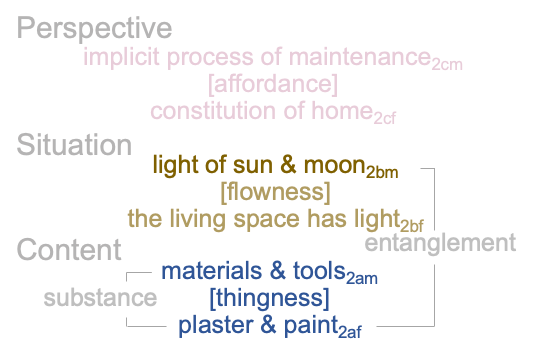
08/26/26

Looking at E. Michael Jones’s Book (2025) “Walking with a Bible and a Gun”  (Part 5 of 27)

0045 I review.

The author, Dr. E. Michael Jones, uses a model in order to illuminate historical texts and arts of America.

That model, in its most thing-like expression, is esse_ce precedes (or calls forth) essence.

I demonstrated the utility of this model using an empty category-based nested form as esse_ce and the title of this book as essence.  The essence of the book transforms into a filled-in category-based nested form.

0046 Here is the first manifestation of the author’s model.

The gun1 becomes a talisman not in service to a transcendental, but rather for protection from a Satanic transcendental, the wilderness, which is where we (Americans) are walking.

If the gun was a “symbol” of a transcendental, then the gun would represent its transcendental.

The gun is a “talisman” of a transcendental, so the gun is “an expression of”, or is “in touch with”, or “makes obvious” its Satanic transcendental.

That transcendental is um… not what is good or what is beautiful or what is prudent or what is wise.

It is potentially deadly foe.

0047 So far so good.

Have I missed anything?

0048 What about “American Identity”?

It is right there in the title.

0049 Oops.  Maybe the American identity goes with essence.

Does that mean that the above nested form goes with esse_ce?

If so, then the esse_ce calls forth essence paradigm shifts, creating the space for an expanded model.

0050 The introduction says as much.

The Introduction opens with a question, “What does it mean to be an American?”

0051 Sam P. Huntington (1927-2008), famous for his book The Clash of Civilizations and The Remaking of World Order (1996), publishes a book titled, Who Are We? (2004).

Who are we (Americans)?

That is a good question.

We are the ones who are walking3 with a Bible2 and a gun1.

This is like our esse_ce, writ large.

0052 Different views are common.

The so-called “triple-melting agenda” says that Americans classify as Protestants, Catholics and Jews.

Perhaps, another agenda divides people between um… capitalist and communist affiliations.

0053 The author notes that America starts as a Protestant nation. The Protestant work-ethic serves as a spirit of capitalism.

What else informs the American intuition?

0054 The author asks, “What about Paradise Lost?

Here is where a professor of literature has advantage over political and economic historians.  John Milton (1608-1674) composed an epic poem titled, Paradise Lost (1667).  Paradise Lost is not a political treatise.  It is not an economic program.  Perhaps, it is a theological disquisition.  Most of all, it is a work of art, a vision, an icon of the intellect, depicting the rebellion of Satan, and the fall of Humanity.

0055 Paradise Lost begins with… hmmm… the personification of the transcendental whose talisman is the gun.  E. Michael Jones does not draw this association.  But, what better way to isolate the transcendental value animating the declaration, “I will not serve.”?

I not only will not serve, but I got a gun.

0056 Satan’s heroic proclamation resonates with King Henry VIII’s reform of the English Catholic Church (1509-1547), which was not so much a “reformation”, as a revolution.

How so?

Revolutions tend to be looting operations.  This is the topic of Chapter 4.

0057 Furthermore, looting operations lead to civil wars.

Is it all about the booty?

Compare the time span between the Henry VIII’s first divorce (1533) and the start of the English Civil War (1642-1651) to the time span between the American Revolution (1776) and the start of the American Civil War (1864).

0058 King Henry VIII (1491-1547) and fellow travelers extracted the wealth of the great monasteries and churches of England and repurposing those lands and properties for um… their own personal advantages.  One wonders, “Is this where the ‘capital’ of ‘capitalism’ gets its start?”

In order to do this, the king established a police state.  His henchmen executed many minor establishment figures.  He founded a precedent that becomes paradigmatic.  If you get a lot of wealth, then temptations increase dramatically, and the only way to overcome those temptations is an equally dramatic exercise of one’s own authority.

Many of Henry’s pals squandered their fortunes.  They lost their ‘capital’.  Not Henry.  Henry had something that money cannot buy.  Like Satan, he had celestial blood and an insatiable will to rule over his own domain.

0059 So, if Henry VIII conducts the revolution that slowly constellates a civil war, then who are the parties that were present at the beginning, who would fall into conflict, and battle within the one jurisdiction?

One party consists of Anglicans, who are Protestants in the mildest manner possible.  They retain all the sacraments of the Catholic Church and reject the papal institutional framework, preferring to have their own “pope”, or something like that, in the person of the Archbishop of Canterbury…er… I meant to say, the King or Queen of England. 

The other party includes the Puritans, who are Protestants in the most militant manner possible.  They reject all the sacraments of the Catholic Church except for one or two (depending on the sect) and regard the papal institutional framework with derision, preferring authority to be constellated in the people (of the sect) or their charismatic leader.

0060 The Puritans follow Martin Luther (1483-1546) and John Calvin (1509-1564) in promulgating a slogan, which, in Latin, goes like this, “Sola fide, sola scriptura, et sola gratia”. The slogan translates into “By faith alone, by scripture alone and by grace alone”.

The Puritans are so successful that even the Anglicans adopt the slogan.

0061 Why?

Sola fide (by faith alone) jettison’s reason.  They reject not just any reason, but the logic of the scholastics who had been so successful at taming the philosophy of Aristotle and bringing its logical powers into service of the Catholic Church.  The rejection is in Latin because Latin is the disciplinary language of scholastics, who were the only educated people around.  Scholastics ran the medieval universities.

0062 So, how does a Protestant become educated?

One learns to read the Bible, in one’s own language, and dismisses all the Aristotelian claptrap, which is in Latin.  Faith no longer requires the logical reasoning of educated (and fat and manipulative) priests.  Faith comes directly from reading the Bible.

Of course, the Puritans were very happy to provide you with a translation of the Bible in your vernacular, because of the invention of the movable-type printing press (by German Johannes Gutenberg, around 1440).  The price was reasonable, but the authorities must never know.

With one’s own Bible in hand, then one can walk3a in faith alone.

0063 Sole scriptura (by scripture alone) situates the actuality of the Bible2a, as {scripture [substantiates] who we are}2a.

Some of the doctrines of the Catholic Church are retained, even though every “educated person” (who can read the Bible on his or her own) can interpret the sacred text.  For example, the doctrine of original sin is retained, but modified according to Luther, Calvin and other notables in the Protestant tradition.

0064 Sola gratia (by grace alone) situates the potential of ‘the gun’1a, which is a talisman (an “enforcer”, if I may say) of the Satanic transcendental that declares, “I will be my own sovereign, even if against the will of God.”

Does that sound like essence, writ large?

08/25/26

Looking at E. Michael Jones’s Book (2025) “Walking with a Bible and a Gun”  (Part 6 of 27)

0065 So, where am I going with this discussion of Chapters 1 and 4?

0066 To me, the following diagram applies.

The Protestant slogan, “sola fide, sola scriptura, et sola gratia” virtually situates the title of Jones’s book, “Walking with a Bible and a Gun”.

0067 The author’s model constitutes a two-level interscope.  Esse_ce associates to content.  Essence associates to situation.

For instruction on this purely relational structure, consult Razie Man’s e-books, A Primer on the Category-Based Nested Form and A Primer on Sensible and Social Construction.  They are not long and will help immensely.

0068 On the content level, the normal context of walking3a brings the actuality of the Bible2a into relation with the potential of ‘the gun’1a.

On the situation level, the normal context of sola fide3b brings the actuality of sola scriptura2b into relation with sola gratia (the potential of grace alone)1b.

0069 Yes, sola gratia1b labels the potential of grace alone1b.

Plus, I already know that, in Jones’s mantra where existence precedes essence, grace is never alone.

0070 I review.

Jones’s dyad derives from Aristotle’s hylomorphe.

0071 If I imagine that esse_ce corresponds to the book’s title, “walking with a Bible and a gun “, and, essence corresponds to the slogan, “sola fide, sola scriptura et sola gratia “, then I can say that the American identity calls forth the Protestant reformation. 

Hmmm, this seems to be the very opposite of what the author claims.

However, if the esse_ce of content calls to mind the essence of situation, then the following intuitively satisfying dyad results.

0072 “Walking with a Bible and a gun” intuitively calls to mind the slogan “sola fide, sola scriptura, et sola gratia”.

Content (esse_ce) [calls forth] situation (essence).

I think that provides an insight into the Introduction and Chapter 4.

0073 What else?

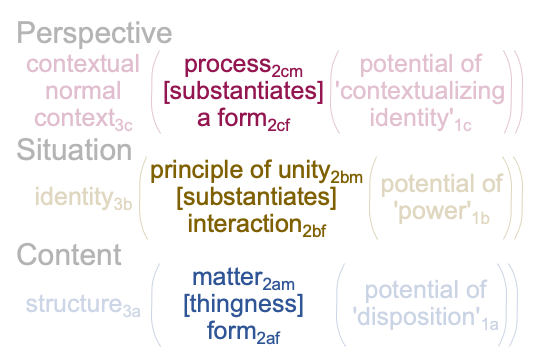
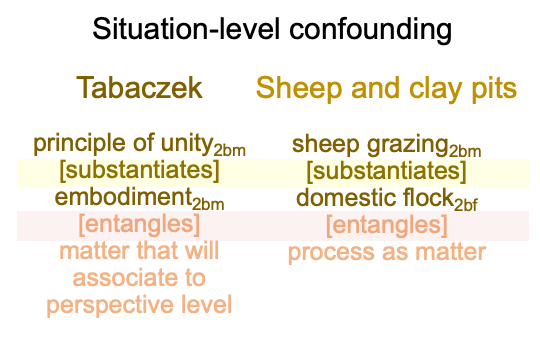
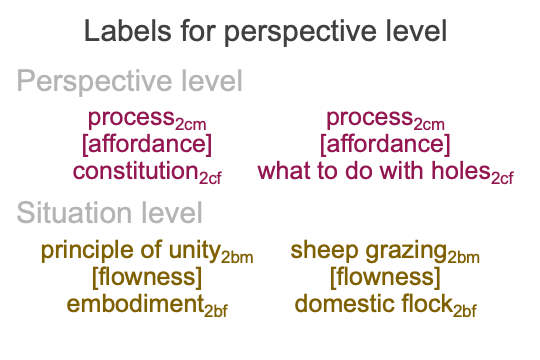
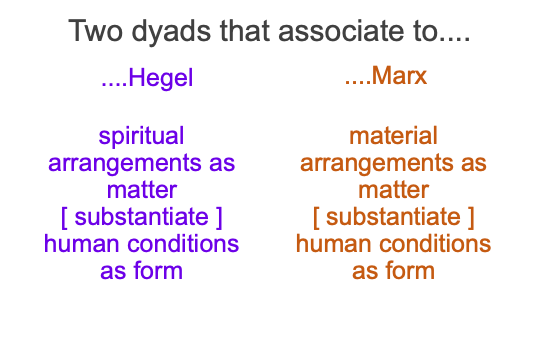
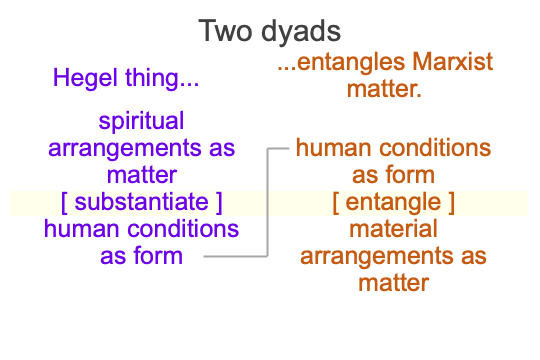
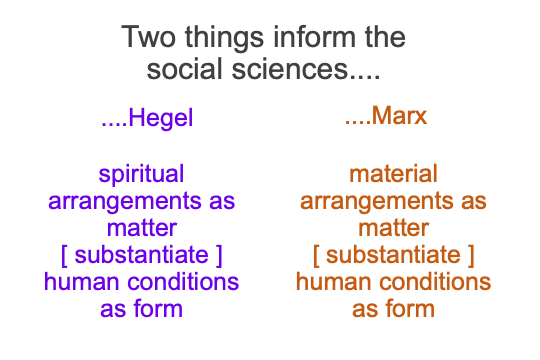
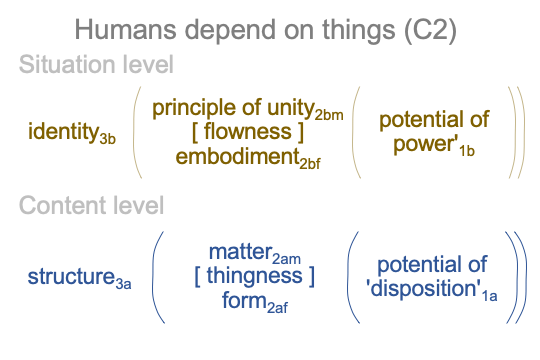
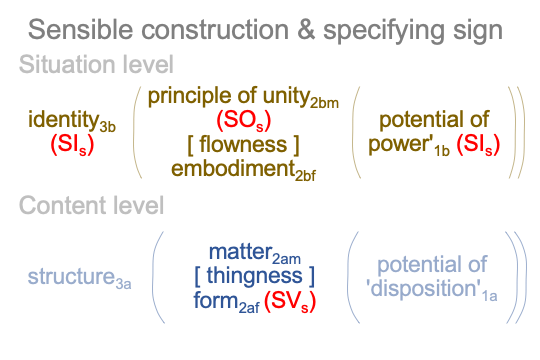
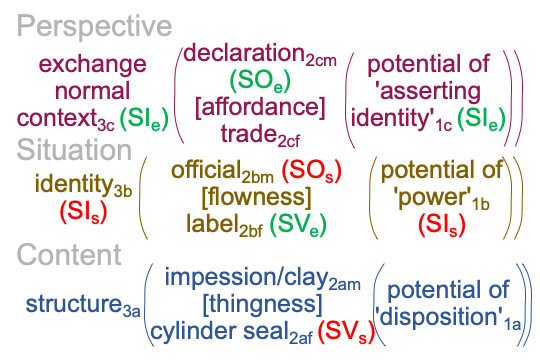
I suspect that there is a dyad that complements the above dyad.  Plus, this complementary dyad contains the term, “identity”.  This dyad derives from a post by an independent scholar, responding to a 2025 article on hylomorphism by Mariusz Tabaczek O.P., titled “Contemporary and Classical Versions of Hylomorphism: A Critical Evaluation”.

0074 Here is a picture.

0075 What does this imply?

These two dyads complement one another.  They are not identical.  They do not perfectly align.  Rather, they offer two relational structures, one from an expert in literary analysis and one from a respondent to Aquinian philosophers.  Both can be used in examining this book.

For example, the esse_ce of the title of Jones’s book provides a structure3a for a thing2a, according to the thing’s dispositions1aThe essence of the Protestant slogan provides an identity3b for an embodiment2bf, according to the embodiment’s powers1b.

0076 Further, the dyad opens into a two-level interscope that complements the interscope attained from examining the Introduction and Chapter 4.

0077 Students should now read Chapter 1.

08/24/26

Looking at E. Michael Jones’s Book (2025) “Walking with a Bible and a Gun”  (Part 7 of 27)

0078 Here is a cue card for some of Jones’s terminology.

0079 The term, “existence”, corresponds to the Latin term, esse, or “matter substantiating”.

The term, “hidden grammar” corresponds to the substance, or the contiguity between esse_ce and essence.

The essence allows a contemporary meaning, presence and message to historical art and literature.  Recall that the slogan, “existence precedes essence” constitutes a model that allows the matter of American history to substantiate the form of American literature in such a way as to entangle a contemporary language of meaning, presence and message (points 26-32).

0080 Chapter 1 starts with “A Brief Recognition of New England’s Errand into the Wilderness”, a lecture by Samuel Danforth, delivered in 1670, forty years after the founding of the Massachusetts’ Bay Colony.  Of course, the natives who once lived on the hills of Boston are long displaced.  Why?  They did not have guns.

0081 Danforth regards the forested lands stretching inland as a desert, a “wilderness”, because… well… the Puritan colony compares to the tribes of Israel after they crossed the Jordan River… er… the Atlantic Ocean.

Yeah, I see the comparison, especially when the Puritan’s claim to fame is sola scriptura2b.

Here is a diagram of my associations.

0082 On the situation level, covenant theology3b is a version of sola fide3b.

Here is the deal.  Humans are well… totally depraved because of the Fall of Adam and Eve.  So, God, through Jesus the Christ, pays for all the sins of humanity.  But, there is a catch.  If you are not predestined to failure (the fate of all Catholics, I am afraid to say), then God will offer you a covenant, which you may elect to join.  Then, you are saved because your personal covenant with God1b has been actualized.

Jones makes a great commotion about how a total depravity of reason (due to Adam’s Fall) does not allow the reasoning that goes into the above paragraph.  However, the total depravity of reason associated with Calvinist theology does permit the above-mentioned reasoning.

0083 The Puritans’ personal covenants3b allows the members of the English sect to migrate to a place where they will be free1b from… you know… those criminal Anglicans who are their enemies in the English Civil War.

So, in the normal context of settling this Puritan colony3a, the scriptural narrative of Joshua crossing the Jordan as matter2am provides the hidden grammar for us2bf, locating our new England1a in the Boston hills.

0084 In Virginia, another English colony is founded for commercial, rather than religious, purposes.  The Anglicans have plans for English colonies to supply raw materials for an always-improving British industry, under the auspices of a clever crown.  Amazingly, after liberating the Church properties in the Revolution of Henry VIII, and then surviving the English Civil War (which was anything but “civil”), the crown was ready to do business.

0085 The theology is acquisitional.  Recall, when Joshua entered into the promised land, he takes the title from the Canaanites who are already there.  Similarly, Henry VIII takes the titles for the monastic lands and common areas and gives them to his buddies.  Then, he executes anyone who says that such acts are… um… “ungodly”.

0086 Compared to cold, damp Britain, sunny Virginia seems like paradise.  Plus, the crown is able to award large “plantation-sized” land grants.  The parcels are larger than anyone can possibly farm without help.  Happily, some enterprising agents start to supply indentured Irish… well, slaves.  So, the labor shortage is solved… but wait… what about these Africans who are much less expensive and more clueless than those Irish slaves?

The English are so enterprising.

They can pluck the fruit of slave labor from the tree of the knowledge of good and evil and not get kicked out of paradise.

0087 Here is my guess as to Virginia’s sensible construction.

0088 Shakespeare (1564-1616) wrote a play about some of Henry VIII’s buddies who squandered great fortunes.  The name of the play is Timon.

For theatrical purposes, Timon lives in Arcadia (the Greek analog to paradise) before he goes bust.  So, theologically, Arcadia is the wonderful span between acquisition (of great wealth) and dispossession (a turn of fortune).  The theology of acquisition mimics covenantal theology because God delivers some sort of bonus deal to certain people (the English plantation owners), but not to others (the folk that end up as property in order for others to command their labor).

08/22/26

Looking at E. Michael Jones’s Book (2025) “Walking with a Bible and a Gun”  (Part 8 of 27)

0089 I ask, “What are the implications of my initial associations to Chapter 1?”

0090 First, the identities3b of the Massachusetts Bay Colony and of the Virginia plantations are characterized by Protestant theology3b.  Both colonies are structured3a as settlements3a from English civilization, which had passed through revolution (1533-1547) then civil war (1642-1651) then restoration (1660-1688).

0091 Second, the following purely relational structure is mind-independent reality (in Latin, ens reale).

However, once spoken words are placed into the empty slots of the two-level interscope, then one can visualize mind-dependent reality (in Latin, ens rationis).

0092 The content-level and situation-level actualities are the slots most likely to gain associations.  The author calls these associations, “categories of the mind”.

Here is a picture.

0093 Surely, categories of the mind allow free-floating associations.  After all, the forests outside the Bay colony are not like ancient Middle Eastern landscapesThe plantations of Virginia are not like the Garden of Eden, except for the acquisition and dispossession business.

The author mentions the Puritan Grand Marshall, General Oliver Cromwell, of unhappy memory.  Cromwell categorized the Catholic Irish as “Amalek”, that is, inhabitants of Baal-worshipping Canaanite cities.  Once declared “Amalek”, the Irish were slated for slaughter.

0094 Third, a category of mind2, a label for an actuality2, no matter how goofy, occupies the foreground.  Its normal context3 and potential1 stand in the background.

The Exodus story where Joshua crosses the Jordan River in the pursuit of conquest2am is like matter.   The Massachusetts’ Bay Colony2af is like form.  This matter and form goes with the Bible2a.  The Bible2a is the Puritan’s thing.

The ancient Greek stories of Arcadia and the Genesis tale of Paradise2am are like matter.  The Virginian colonies2af are like form.  Just as in ancient Greece, slaves can do the labor on the plantations.

0095 At the end of Chapter 1, the author draws a contrast… a mirroring (so to speak)… that portrays a rupture during the Reformation.  A single situation level shears into two.

The nested form above is the Protestant slogan.

The normal context of faith alone3b brings the actuality of only scripture2b into relation with the potential of ‘spiritual blessings’1b.

The nested form below addresses Catholic scholastic inquiry.

The normal context of beings of reason3b brings the actuality of scientia (or science, writ large)2b into relation with the potential of ‘mind-independent being’1b.

0096 These two situation-level nested forms stand in dynamic tension.

With the Reformation, the second nested form (which expresses the doctrines of the Catholic Church in Thomistic formulations) falls into shadow with the Puritans and Calvinists, but not so much with the Anglicans (in England) and the Lutherans (in Germany).

Imagine a colony of Puritans sailing across the Atlantic in a wooden boat and arriving in a place that they will call, “New England”.   The forest, the wilderness, stretches before them.  The inland is full of danger.  Then, after the colony becomes a bustling town and the forests have been pushed back by hard-working farmers, it seems as if the wilderness has entered the colony.  The second nested form reflects a projection of… what?… their disconnect with England, or worse, their disconnect from Christ.

It’s hard to tell.

0097 According to their own reading of the Bible, the Massachusetts’ Bay colony is the New Israel.

0098 The student should read Chapter 2.

08/21/26

Looking at E. Michael Jones’s Book (2025) “Walking with a Bible and a Gun”  (Part 9 of 27)

0099 Nothing unites a community more than a common enemy.

But, what happens when the enemy enters into the community?

0100 Chapter 2 concerns the Salem Witch Trials (starting in 1692) and fictionalized by Nathaniel Hawthorne (1804-1864), whose family lived in Salem since the 1660s. 

The elected members of the Massachusetts Bay Colony adhere to the upper situation level, yet project their fears, anxiety and guilt onto the situation-level that would have corresponded to classical Christian reason.

According to the author, one of the drivers of this projection is the Calvinist rejection of the Catholic sacrament of confession.  Confession is a sacrament built on Christ’s commissioning his disciples to preach and forgive sins.  The Puritans turned their backs on those sacraments that empowered Catholic priestly institutions.  So, the Puritan rejection of reason really applies to Catholic reason, not to plain commonsense reasoning.

0101 Okay, even plain commonsense reasoning may be suspect, especially, when the Fall of Adam has left humans devoid of reason3a and willing to use witchcraft2a in order to cast spells from the wilderness1a.  Here, the “wilderness” is both literal (the forests outside the colony) and figurative (the desires inside our bodies).

0102 In effect, the lower situation-level nested form becomes a mirror of the upper situation-level nested form.

Because the Puritan’s vocabulary is inspired by scripture alone2b, they have no words2am (or categories of the mind) for contradicting an impression that witches are operating on the premises.  They have no vocabulary for conducting an inquisition into whether the rumors have “natural” (not supernatural) formal and final causes (designs and intentions).

0103 Jones discusses Nathaniel Hawthorne’s story about Goodman Brown.  Brown’s Calvinism takes whatever matter that cannot be unified with the principle of sola scriptura2bm into the form of the Satanic2bf.

Jones’s consideration reflects the following associations.

0104 Sola scriptura2b is the category of the mind2b where a principle of unity2bm [substantiates] the embodiment2bf of the Puritan identity3bAn election to receive a covenantal relation with God characterizes the principle of unity2bmMembership in a church in the Massachusetts Bay Colony figures into the embodiment2bf.  Sola scriptura2b emerges from (and situates) the potential of ‘grace alone’1b.

Sola scriptura2b virtually situates the Biblical thing2a of the Massachusetts Bay Colony, which emerges from (and situates) the potential of ‘the gun’1a.

0105 The Biblical thing2a also constitutes a category of the mind2a, because the Exodus, when applied to British colonialists, grants immunity of guilt for their displacement of the Amalek… I mean… native population.  Of course, the so-called “Indians” may have deserved their misfortune, because rumors have it that the Indians kidnapped and cooked a couple of wayward colonists.

Isn’t that Satanic?

0106 The student should read Chapters 3 and 5.

08/20/26

Looking at E. Michael Jones’s Book (2025) “Walking with a Bible and a Gun”  (Part 10 of 27)

0107 Chapters 3 and 5 brings the reader back to Virginia.

One nice feature of a prosperity gospel is that one person is chosen and everyone else is expected to work for free for that person.  Henry VIII sets the paradigm.  After all, he reaps what he does not sow.  And, for the most part, the Anglican bishops do not disagree.  After all, the ones who do fail to get ahead.

0108 Here are my associations to this chapter on Virginia.

0109 Why do plantations2af require guns1a?

Is ‘inexpensive labor’1b an appropriate substitute for ‘plucking fruit from the tree of the knowledge of good and evil’1b?

0110 If the bourgeois owner wants the lowest cost for labor, then why not slaves?

0111 Of course, no one imagines that Adam and Eve ended up as slave owners, but that knowledge must have been embedded within the fruit that they ate.  The knowledge is obvious.  The cheapest laborer is the slave.

Enterprising British traders started with the poor Irish.  They shifted to African tribes selling people that they kidnapped from other tribes.  The price was right.  Shipping human cargo like cattle minimized costsSelling them to other humans was perfectly justified, because slavery is common in the Old Testament.  Plus, the plantation owners were willing to pay.

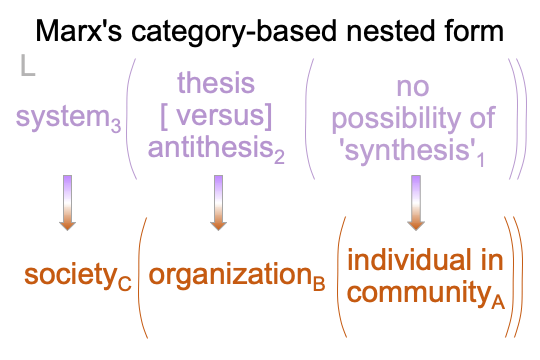
0112 I imagine that only a modern genius of the greatest acumen could re-articulate this travesty by applying Marxist nomenclature.  According to Marx, acquisitional theology3b does not bring the actuality of a deal that is election for the owner and damnation for the slave2b into relation with the potential of ‘the most inexpensive labor possible’1b.  Rather, material arrangements2m [substantiate] human conditions2f.

0113 So, what is the most obvious material arrangement2m that an enterprising Marxist can envision?

Obviously, the African slave is colored “black” and the English plantation owner is colored “white”.

Does the modern Marxist genius say that the material arrangement of “whites” and “blacks” [substantiates] the human condition of slavery in the plantations of Virginia?

0114 Here, Jones does not argue that the modern Marxist genius constructs a literary text as fictional as Nathaniel Hawthorne’s novel, The Scarlet Letter.

Rather, the author claims that the Marxist intellectual makes a categorical error.

0115 At the time, the Virginian is deeply religious, in the Anglican tradition.

Here are my associations to the ongoing sensible construction.

0116 To me, the question should be, “Does the Old Testament really justify labeling others as subhuman and slaughtering or enslaving them?”

It is as if Jesus never walked the Earth.

0117 The student should read chapters 6, 7 and 8.

08/19/26

Looking at E. Michael Jones’s Book (2025) “Walking with a Bible and a Gun”  (Part 11 of 27)

0118 What about Jesus?

Covenant and election theology, as well as acquisitional theology, call to mind the stuff of Adam and Eve, Moses, Joshua, David, Solomon, Nehemiah and Isaiah.  This is the stuff of the Old Testament and associates to faith alone3b.

Once Jesus serves as the Alpha (the Word in Genesis) and Omega (the Messiah of God’s chosen people), then Greek philosophy enters into the picture.  Where does our world come from?  Where do we (humans) come from?  What went wrong?  What is the cure?  This is the stuff of faith seeking understanding.

0119 Where does theology, the “study of God”, begin?

If the Bible reveals the form of God (that is, the essence of God), then theology should start with the matter of God (that is, His esse_ce).

Thomas Aquinas (1225-1274) offers proofs of the existence (the esse_ce) of God at the start of his grand synthesis.

0120 Centuries later, the Puritans, now settled firmly in New England, cannot deny the intellectual richness of Christendom (that is, Catholic Europe before the Reformation).  Their Protestant tradition rejects many of those riches.  Nevertheless, members are aware that their own Calvinist traditions require a synthesis greater than what John Calvin (1509-1564) offered.

They need a systematic review of the theology of the Massachusetts’ Bay colony.

0121 This is the topic of Chapter 6.

0122 In 1727, Sam Willard publishes one attempt, under the title, A Compleat Book of Divinity.

In this treatise, the radical rupture between faith and reason is plain to see.  The foundations of this Christian… or is it Judeo-Christian?… faction stands completely in the realm of Protestant faith and outside the realm of Catholic reason.

Unfortunately, there is another reason in town.

The mechanical philosophers of the 1600s propose “scientific reason” and take the literalism of the Reformers to the next level.

0123 What happened to reason?

Before reading my story about what happened, take a look at the following three situation-level nested forms and ask, “Which of these do I associate with faith and which do I associate with reason?”

The mechanical philosophers propose a mirror image of the Protestant philosophers.

Now, here is a story about the fall of reason.

0124 God cast Adam and Eve out of the garden of Eden, while saying, “What the hell were you thinking?”

John Calvin puts it this way (more or less), “Adam replies to God as fallen humanity stands on the far side of the waterway, ‘Yeah, I guess that our behavior does not make much sense.'”

That admission does not stop the cherubim from replying, “Move along.  Nothing to see here.”

Why does the angel not sympathize with Adam’s regrets?

The messenger knows (along with John Calvin) that fallen human reason is totally deranged.

Oh, I meant to say, “depraved”.

0125 It’s like a weird vitamin deficiency.

Or, it’s like a infectious agent that modifies the human genome.

0126 Before the Reformation, when goofy, philandering, friendly, intoxicated and otherwise collaborative monks operated vast estates, built over centuries by occasionally strenuous labor, grace inflowed nature.  Patience and hard work tamed a wild landscape.

During this time, grace is like matter.  Nature is like form.  Nature without grace is not conducive to human flourishing.  Nature with grace is like brewing beer.  Since humans belong to nature, as well as to God, catholic intellects wove sacraments from the threads of the Lord’s words and actions.  For example, the sacrament of confession forgives sins (unlike that cherubim, who had no kindness for Adam) that allows the wayward back into communion.  The sacraments offer grace that flows into human nature, which is fallen, but not so fallen as to be unable to reason along with Aristotle and Plato.

0127 After the Reformation, the monastic communities are looted.  The shared fields are fenced off.  Manors are built on properties with titles.  The titles represent capital.  Ownership becomes a sign of God’s favor.  The Puritans work diligently and do not waste their wealth on indulgences.  The scriptures are now interpreted by faith alone.  They don’t need priests to read the Bible for them.

0128 Here is the deal.

In this realm of total depravity, God offers a covenant to the chosen.  The one’s predestined to say “yes” in reply become electors to the heavenly realm.

Here is the catch.

The “yes” that makes me an elector remains just a word, a thin thread that holds me from falling into the bottomless pit of total depravity, the world without faith or reason.

0129 Here is a picture of the dilemma posed by the matter of covenant-election2am [substantiating] the form of being suspended by the thin-thread of God’s mercy above the bottomless pit of total depravity2af.

Willard’s systematic theology is supposed to assist by establishing firm footing.

But, it does not succeed.

0130 The elector says, “The uncertainty is killing me.  But, what about joining a party to head out West?”

What about settling a new place, where I can cut the forest and build my own farm, and live with a nature that is open to God’s grace?

An escape from the Puritan’s total commitment despite complete uncertainty opens.

08/18/26

Looking at E. Michael Jones’s Book (2025) “Walking with a Bible and a Gun”  (Part 12 of 27)

0131 The children of immigrant Englishmen and Germans and Dutch and Irish avoid the hanging theological commitment of Puritan covenant theology and the awkwardly two-faced acquisitional theology of the Virginian plantations owners by moving west.  The west does not fear the bottomless pit of total depravity (at least, not yet).  The west rewards folk for their own labor.  The west promises opportunities that do not much depend on one’s theological refinements.  The frontier depends on the person carrying a gun.

0132 Chapter 7 discusses movements within eighteenth-century Protestantism.  The Calvinist theology that once united the Puritan political faction against the Anglican political establishment in Britain, could not attain the systematic expositions of the Catholics nor comport with the slippery Anglican word-games that somehow justified owning African slaves.

0133 The pragmatic American brings his bag of cornmeal, his flask of whiskey and his gun out into the wilderness.  He makes a living hunting.  Maybe, he marries and puts down a farm. He is shiftless, so why should God extend His covenant?  The fellow may be baptized, but he is unelected.

Perhaps, the Bible allows that, if that believer has an experience of conversion, or if a man or a woman gains a personal relation with Jesus the Savior, then that would be enough.

The trick, of course, is that the covenant-election business offers a ticket to the justifications of the Old Testament, especially the one where Joshua could kill the Canaanites by declaring them less-than-human and taking their lands.

0134 Solomon Stoddard (1643-1729) starts a church and preaches a “half-way covenant”.   

Surely, the situation level of identity3b must be changing as well.

The Eastern seaboard looks to Britain.  The western inland looks to walking into lands beyond New England.

0135 The mechanical philosophies of the 1600s bear fruit.  John Locke (1632-1704) writes An Essay Concerning Human Understanding.  The essay does not advocate a return to Thomistic Aristotelian scholasticism.  The essay extols ideas.  The theologian, Jonathan Edwards (1703-1758) is intrigued.  How does one reconcile idealism and the Calvinist worldview?

0136 If ideas are the first elements of knowledge and if essence can be labeled, then labels constitute the furniture of our minds.

Do I see such furniture in the following figure?

0137 Ideating reality3a is apparently the same as walking3a.

This makes sense, in so far as walking3a tends to follow established paths.

Plus, the Calvinism of the original Puritanism constitutes a well-appointed path.

0138 The Bible [furnishing] my mind2a compares to the Bible [constitutes] us2a.

0139 Does the potential of ‘applying Puritan labels’1a somehow match ‘the gun’1a?

The author offers a passage from a standard conventional American history of Jonathan Edwards.  Edward’s mental furniture accommodates the Calvinist theory of freedom of will (allowing election) as well as the total depravity of fallen humans (keying into covenant theology and predestination).  While the union of these two ideas (or labels) makes no sense to many, the house that Edwards builds does not stand against itself.

By grace alone1b, scripture2b magnifies these metaphysical potentials1a.  In 1755, Edwards pens a treatise titled, “The Nature of True Virtue”, where the paths of election and total depravity intertwine in the person’s first ideation, which must be predestined, because no one knows what a baby ideates, except for God, of course.

08/17/26

Looking at E. Michael Jones’s Book (2025) “Walking with a Bible and a Gun”  (Part 13 of 27)

0140 Chapter 8 discusses Benjamin Franklin (1706-1790).

Rather than admitting that virtue arises from God’s covenant to a chosen few and from our election to choose God, Franklin devises a homespun program for moral self-improvement.

How enlightened!

0141 Years later, he concludes that he is a reasonable creature and that he is under no religious constraints not to… you know… construct his own “religion”.

T the term, “religion”, expands during the so-called “Western Enlightenment”.  At first, the label refers to Christian factions.  Then it broadens to all creeds.  Then, it broadens to what the native Americans are practicing as well as the metaphysical traditions of all those other people around the world.  Finally, the label broadens to sort of include what Benjamin Franklin is working on (but, not really).

0142 Does Jonathan Edwards favor esse_ce over essence?

Does Benjamin Franklin favor esse_ce over essence?

Or do both the following two content-level nested forms structure3a the American identity3b?

0143 One could say that, as far as mental furniture goes, the Bible2am offers ideas and my own investigations3am offer ideas as well.

Both are in the business of ideating reality3a at around the time when the American Revolution plays out.  It makes me wonder about the literary character of the American founding documents.  Do they assume Puritan labels1a?  Do they express a pragmatic guide1a to forming a government under the conditions when anyone can formulate his own pragmatic guide to moral advancement1a?

Why work so diligently to divide the federal government into three interdependent institutions, the legislative, the executive and the judicial branches, with the intent that each will hold the others in check?  Why attempt to retain sovereignty in the states?  The states will never unanimously agree to losing their sovereignties.

Will they?

Uh oh, see the March 2026 issue of Culture Wars Magazine.

0144 To me, its seems that the two potentials1a, both contextualized by idealism3a, have something in common.  This reflects the logics of firstness.  The logics of firstness are inclusive and allow contradictions.  Why?  The logic pertains to a monadic realness, where one can see only one side of something in the sea of possibility1a at a time.  In the realm of firstness, Edward’s application of Puritan labels1a to ideas2a and Franklin’s application of his own conclusions1a to ideas2a may portray facets of a single ‘something’, a single ‘wilderness’ that demands some sort of precautionary mechanism, like a gun1a.

0145 Here is a picture.

0146 Chapter 9 describes the Great Awakening (1734-1749).

When I look at the above potentials1a, on the left, I see the agenda of elites, whether Puritan (Edwards) or Enlightenment (Franklin).  These positions are convertible, because both walk3a the path of idealism3a.

On the right, I see a dawning awareness that allowed the original Puritans to regard the forest wilderness as Satanic (on the outside of the colonies) and to see witches in the solitary ladies in Salem (on the inside of town).  This is the position driving the Great Awakening.

0147 The Great Awakening starts outside the coastal, European-facing townships, who still care about the doctrinal distinctions between Puritans (Massachusetts) and Anglicans (Virginia).  These outsiders ask questions.  Who cares about Protestant doctrinal distinctions?  Do they tell me how to live a moral life?  And, don’t tell me that I am supposed to come up with a moral life through my own reckoning.  I don’t have the book-learning for that.

Prior to the American Revolution, the Great Awakening sweeps through all the colonies.

Americans begin to wake up to an identity3b that is based on a structure3a that contextualizes what it means to own a gun1a.

0148 The Bible2am matters.  The Bible2am inflows into us2af, and calls us into a form2af.  The Old Testament tells stories of war, conflict, and entering into a promised land.  When Nehemiah returns with his remnant, he builds a wall.  He carries arms.  The Bible2am allows me2af to carry a gun1a for my own self-defense1a in a world where kings are ruthless and uncivilized folk are occasional adversaries.  Americans wake up to walking3a in faith3b as one people2bm, even though each one of us will stand before the Lord2bf.  That is our covenant with God.  That is what we elect to do.

0149 Here is a diagram for the above statements.

This is a diagram of the Great Awakening.  Walking3a gives structure3a.  Faith3b offers identity3b.

0150 The student should read Chapters 9, 10 and 11.

08/15/26

Looking at E. Michael Jones’s Book (2025) “Walking with a Bible and a Gun”  (Part 14 of 27)

0151 Why go to a tent-service to hear a preacher call me into the presence of the Lord?

Why let the spirit overcome me, when I all I want to do is walk with my Bible and my gun?

Sola fide3b does not mean “without reason”.  It3b means that I feel a responsibility to turn to the Lord.  The covenant that God offers me is like the covenant that God offers Abraham.  Yes, God makes a deal.  Take my offer, elect to follow me, and you will be free.  You will gain a land for your descendants.  You will stand for yourself.

Abraham walks in the path of the Lord.

He finds God’s blessing.  He becomes independent.

0152 Surely, the American identity3b is no longer yoked to the Puritan identity3b.

The structure3a of the colonies has changed between the mid-1600s and the mid-1700s.

0153 Esse_ce precedes essence.

The potential of the ‘gun’1a is virtually situated by the potential of ‘blessings and independence’1b.

What do ‘blessings and independence’1b imply?

Freedom1b.

What does faith3b suggest?

Responsibility3b.

0154 Is the following a diagram of the American Identity achieved during the Great Awakening?

0155 The American people want to stand before the Lord.

They don’t want to stand before King George III, not anymore.

0156 The two-level interscope portrayed above constitutes a psychological earthquake, turning away from the familiarity of English sovereignty, but not towards utopian Enlightenment ideals.  It shakes both Puritanism and Anglicism, lightening up on Calvinism and no longer recognizing what Anglicanism pretends to be (the third way between Protestantism and Catholicism).

0157 Chapter 10 (on George Whitefield (1714-1771) and John Wesley (1703-1791)) and Chapter 11 (on how the Great Awakening leads to the American Revolution) complete Part 1.

0158 Part 1 addresses the rise of the American Identity.

Part 2 considers the fall.

0159 So, before leaving Part 1, allow me to restate my initial guess concerning the author’s model that puts American history and literature into perspective.  The guess relies on the title, Introduction and Chapter 4.

0160 The above figure comports with the author’s expression, “existence precedes essence”, writ large.

The esse_ce of the content level precedes (or calls forth) the essence of the situation level.

0161 When the author proclaims that existence precedes essence, he initially points to Aristotle’s thing.  Aristotle’s hylomorphe is matter2am [substance] form2af.

In Peirce’s philosophy, actuality2 consists of two contiguous real elements.  On the content level, the two real elements parallel the real elements in Aristotle’s hylomorphe: matter2am and form2af.  The contiguity is labeled with a much-abused word, “substance”.  [Substance] can be either noun or verb.  In the above figure, [it] is rendered as a verb.

0162 However, the author’s proclamation writ small is open to an expansion writ large.

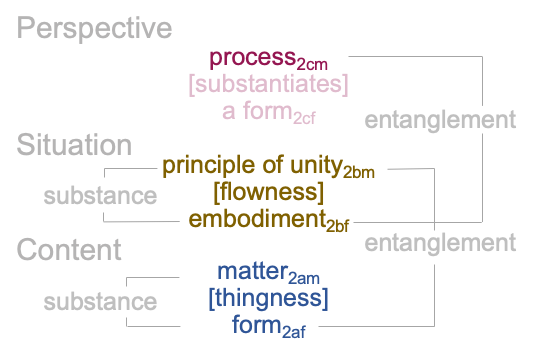
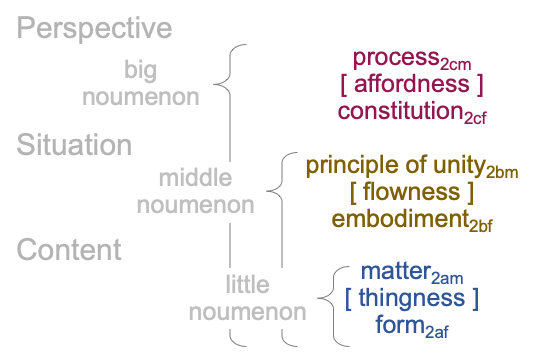
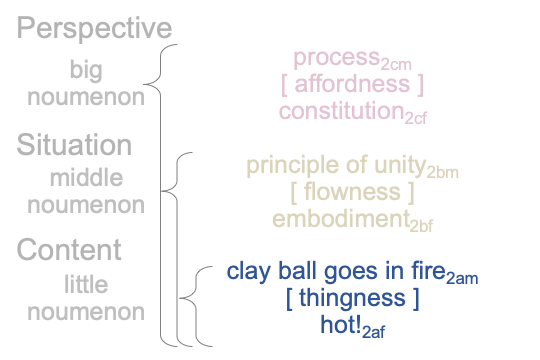
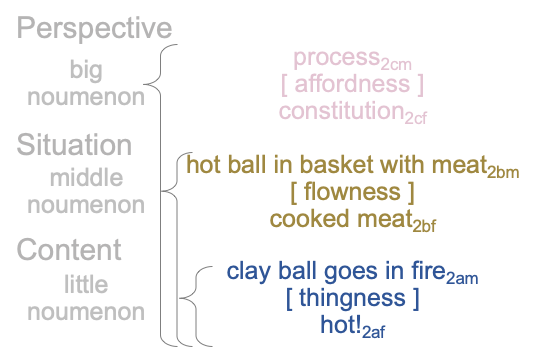
Contemporary scholarship on Aristotle’s hylomorphe ends up generating the following sensible construction.  Aristotle’s hylomorphe2a portrays a thing2a which is also (for scientists, more or less) a little noumenon.  I call it “little” because the corresponding two-level interscope may be regarded as a “big” noumenon.

Here is a picture of the big noumenon.

The big noumenon contains the original little noumenon as the content-level actuality2a.

0163 A comparison of the above sensible constructions allow the inquirer to visualize how the author’s model induces the reader to appreciate historical texts in terms of contemporary meanings, presences, and messages.

0164 Plus, a comparison permits an appreciation for the rise of American identity in the constellation of a co-oppositionA co-opposition is a pair of terms where, when one serves as a normal context, the other tends to serve as the potential.

The normal context of responsibility3b operates on the possibilities inherent in ‘freedom’1b.

0165 Here is a picture of the American Identity at the time of the founding revolution.

0166 The inquirer must wonder.

Why doesn’t Jones present his argument with diagrams like this?

The author is practicing what this examination is displaying.

This examination shows a theoretical model within Jones’s argument.

This model is directly based on Thomism.  My diagrams follow the Thomist tradition after it passes through Peirce.  Peirce’s philosophy begins where Baroque scholasticism leaves off.

0167 The student should now read Chapters 12, 13, 15 and 17.