Looking at E. Michael Jones’s Book (2025) “Walking with a Bible and a Gun” (Part 2 of 27)
0012 Does the author perform a confounding?
0013 Does the author start with historical literary texts (or works of art, {A[&]B})?
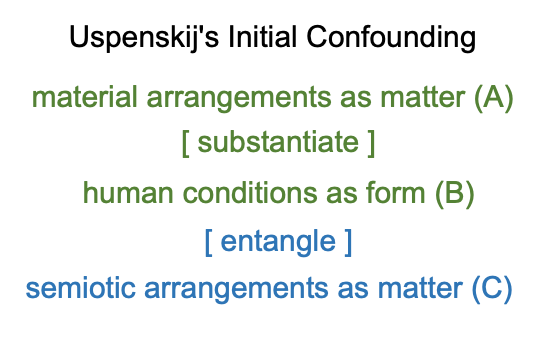
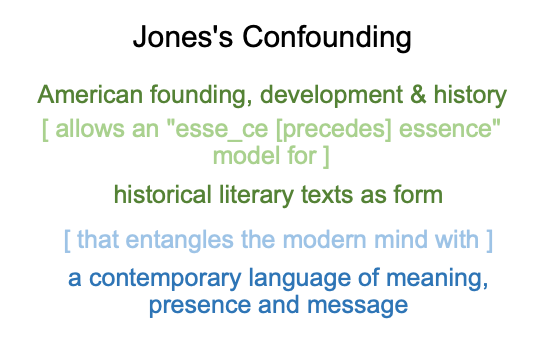
Yes, this book is divided into fifty-three chapters. Each chapter focuses on an author and his works of art. The matter, A, consists of an author’s life and the plotlines of his literary and artistic works. The form, B, consists of the literary text in history.
0014 Does the author frame each historical text in terms of a semiological structuralist model (the Tartu-Moscow School’s flickering flame of illumination)?
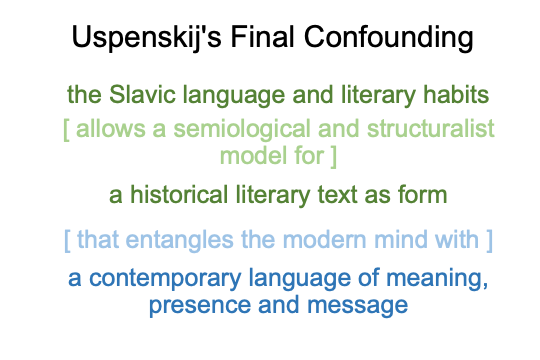
No. But, the author does frame historical works of art in terms of a model. The model is not based on semiology or structuralism. The model is based on the philosophy of Saint Thomas Aquinas (1225-1274 AD), who interprets Aristotle (384-322 BC) during the so-called “Middle Ages”.
0015 Of course, the historical trajectory of Thomism is not so straight-forward. John Deely (1942-1917 AD) articulates a narrative of “the causalities inherent in signs” in his massive masterwork, Four Ages of Understanding (2001).
Aristotle treats signs as symptoms or indexes. The Latins, starting with Augustine (354-430), notice that signs operate in both nature and culture, but the nature of signs is not a focus of inquiry. This stance includes even Aquinas, who writes about signs, but not about their nature. Over the centuries, Aristotle’s methods, passing through Aquinas, eventually formulate the definition of sign as a triadic relation. The honor goes to John of St. Thomas (aka John Poinsot, 1589-1644), a junior colleague to the famous Baroque scholastic, Francisco Suarez (1548-1617).
Fast forward to America, three centuries later. After reading Francisco Suarez, among others, Charles Sanders Peirce (1839-1914) comes up with the same definition of sign-relation as John Poinsot. Peirce uses his own home-grown vocabulary, rather than Aristotelian terminology. In this manner, Thomism passes from the Baroque scholastic (written in Latin) to Peirce’s philosophy and semiotics (written in English), long after (what John Deely calls) the Latin Age ends.
Here, I mention Robert Junqueira, whose 2025 doctoral thesis is titled, The Coimbra Jesuit Course as a Source of the Semiotic Logic of Charles Peirce.
0016 So what am I saying?
E. Michael Jones uses a model based on the Aristotelian philosophy of Thomas Aquinas.
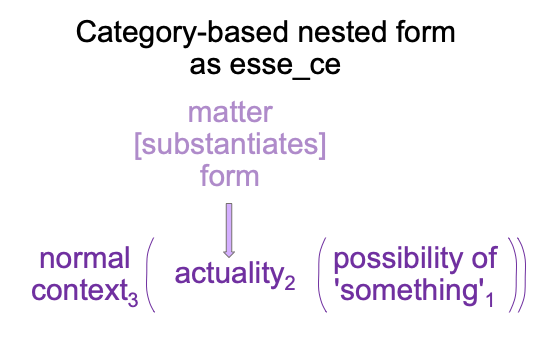
However, Charles Peirce stands within the grand historical tradition of Thomism and provides a novel “scientific-sounding” terminology for Aristotle’s insights. Plus, Peirce’s tradition allows diagrams, such as the category-based nested form.
This is where my examination adds value to the author’s text.
I offer diagrams of relational structures.
0017 Of course, E. Michael Jones does not know of this historical development in philosophical inquiry into the nature of signs.
Who does?
This diversion into disquieting twists in the history of philosophy is necessary, because the examiner intends to render the model that E. Michael Jones uses to illuminate historical persons and texts in terms of Peirce’s categories.
0018 Here is the foundational association.
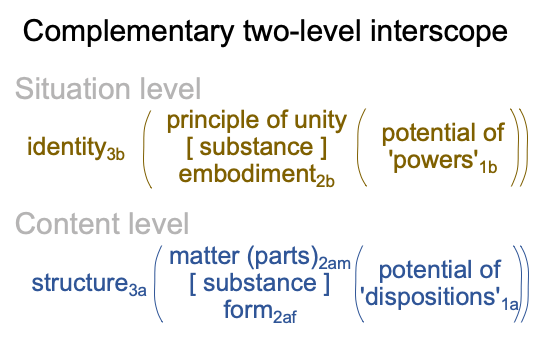
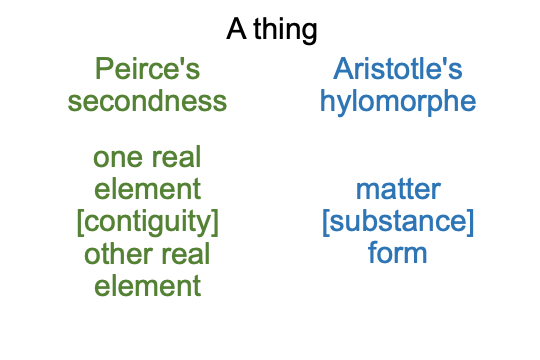
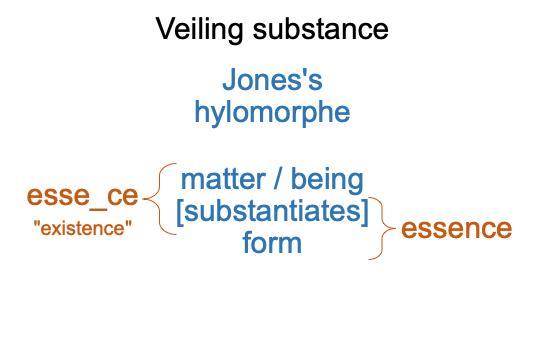
For Aristotle, a thing is a hylomorphe, consisting of two real elements, matter and form. Peirce’s category of secondness is defined as two contiguous real elements. For proper notation, the contiguity will be placed in brackets. For Aristotle’s hylomorphe, the contiguity is [substance]. Here is a picture of Peirce’s secondness and Aristotle’s hylomorphe.
0019 This is the basic building block of the author’s model.
I can use it to frame the author’s burning wick, in a simple fashion. A more complex model will follow.
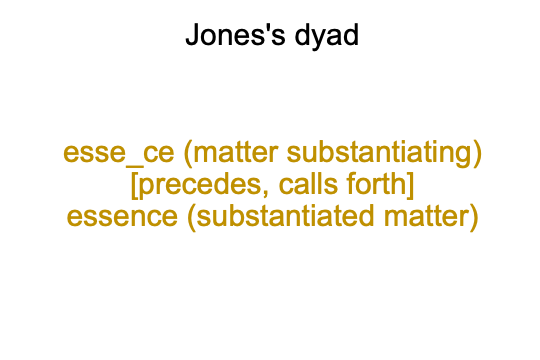
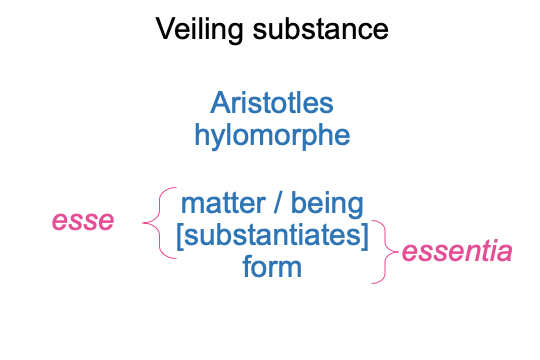
For now, it pays to look for other familiar terms that fit into Aristotle’s schema. In Latin, these are esse (matter substantiating, anglicized to “esse_ce”, corresponding to Jones’s “existence”) and essentia (substantiated form, corresponding to Jones’s “essence”).
0020 Here is a picture.
0021 Now, I will anglicize the Latin terms into the terms that I will use for this examination.
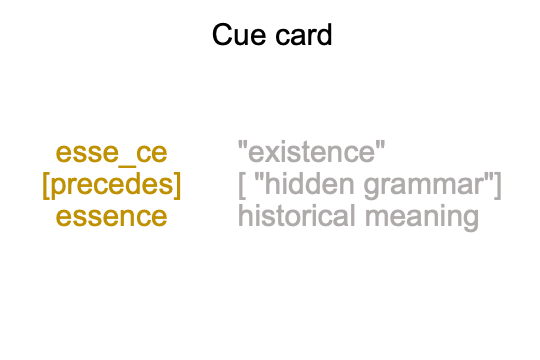
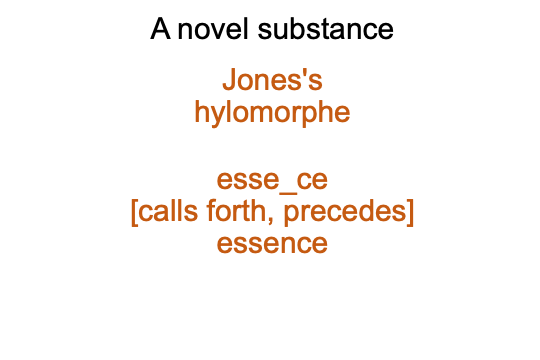
0022 One more step is required in order to get my first snapshot of the model that E. Michael Jones works with, as an artisan working with historical texts. Many slogans are attributed to Aquinas. Jones selects the slogan, “Existence precedes essence”.
0023 How do I place this slogan into the above diagram?
The magic of spoken labels allows me to regard “esse_ce” (“existence”) and “essence” as real elements. So, following the logic of Peirce’s category of secondness, there must be a contiguity. This contiguity is [calls forth], according to the above slogan.
0024 What is one advantage of Jones’s hylomorphe?
It is a flickering candle of illumination.
How so?
Let me ask the question, “Which of the dyads next to the candle shines most brightly within Jones’s model?”
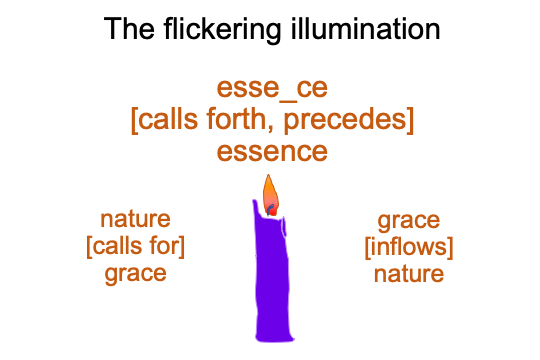
0025 “Calls forth” and “precedes” cannot manifest simultaneously as “calls for” and “inflows”.
At any time, [the substance] shines as one or the other.
The above figure is a Peircean diagram of the author’s model.
Existence calls forth essence.